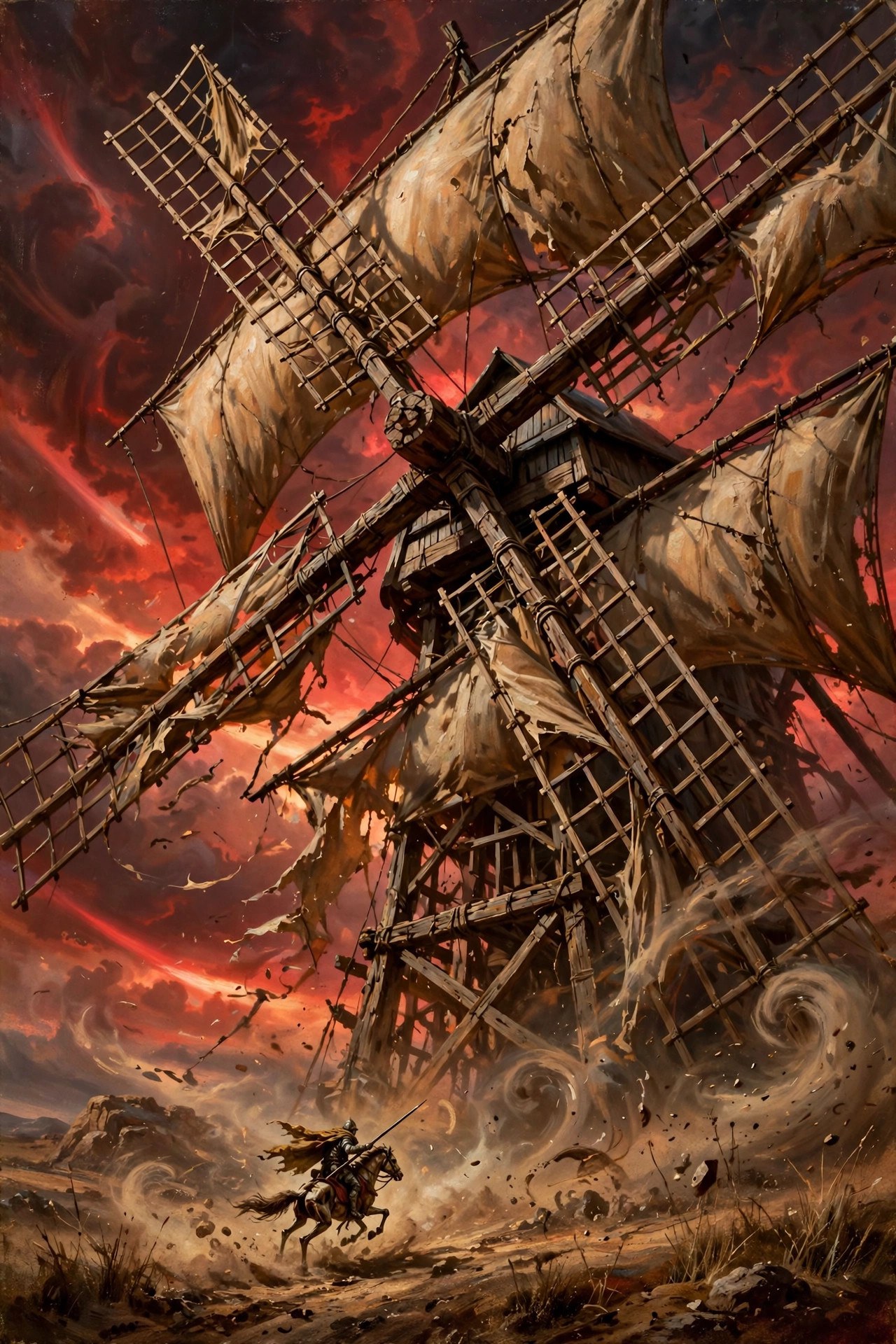
The Windmills
Thirty or more monstrous giants — or thirty or forty windmills. The most famous scene in the novel.
The scene
Discovering "thirty or forty windmills" on the plain, Don Quixote announces to Sancho:
"Fortune is arranging matters for us better than we could have shaped our desires ourselves, for look there, friend Sancho Panza, where thirty or more monstrous giants present themselves, all of whom I mean to engage in battle and slay, and with whose spoils we shall begin to make our fortunes; for this is righteous warfare, and it is God's good service to sweep so evil a breed from off the face of the earth."
Sancho answers with plain sight:
"What giants?" said Sancho Panza.
"Those thou seest there," answered his master, "with the long arms, and some have them nearly two leagues long."
"Look, your worship," said Sancho; "what we see there are not giants but windmills, and what seem to be their arms are the sails that turned by the wind make the millstone go."
Quixote's reply is the whole novel in two lines:
"It is easy to see," replied Don Quixote, "that thou art not used to this business of adventures; those are giants; and if thou art afraid, away with thee out of this and betake thyself to prayer while I engage them in fierce and unequal combat."
The charge
He commends himself to Dulcinea, cries "Fly not, cowards and vile beings, for a single knight attacks you," adds "Though ye flourish more arms than the giant Briareus, ye have to reckon with me" — and drives Rocinante at the nearest mill. A sail catches his lance, lifts horse and rider, and "dashed them all to pieces" against the ground. Sancho rushes to help, finds his master unable to stir, and hears the theology of defeat:
"Hush, friend Sancho," replied Don Quixote, "the fortunes of war more than any other are liable to frequent fluctuations; and moreover I think, and it is the truth, that that same sage Friston who carried off my study and books, has turned these giants into mills in order to rob me of the glory of vanquishing them, such is the enmity he bears me; but in the end his wicked arts will avail but little against my good sword."
Why this scene, of all scenes
The windmills are the novel's thesis statement: a man who has read the world wrong, a squire who reads it right, and a defeat that changes nothing — because the enchanters can always be blamed. It is also the novel's gentlest cruelty. Cervantes loves his knight enough to let him rise, mount Rocinante again ("he got up, and mounting Rocinante, who was half dead with the fall"), and ride on to the next adventure with the same whole heart.
The phrase "tilting at windmills" entered the language from this chapter — fighting imaginary enemies, or noble causes mistaken for monsters. See quixotic idealism.
Source notes
- All dialogue quoted verbatim from the Ormsby translation, Part I, ch. 8 (Project Gutenberg eBook #996).
- "thirty or forty windmills" vs. "thirty or more monstrous giants": both phrasings occur in the chapter.
- Friston (Fristón): the imaginary enchanter Quixote blames for his defeats.