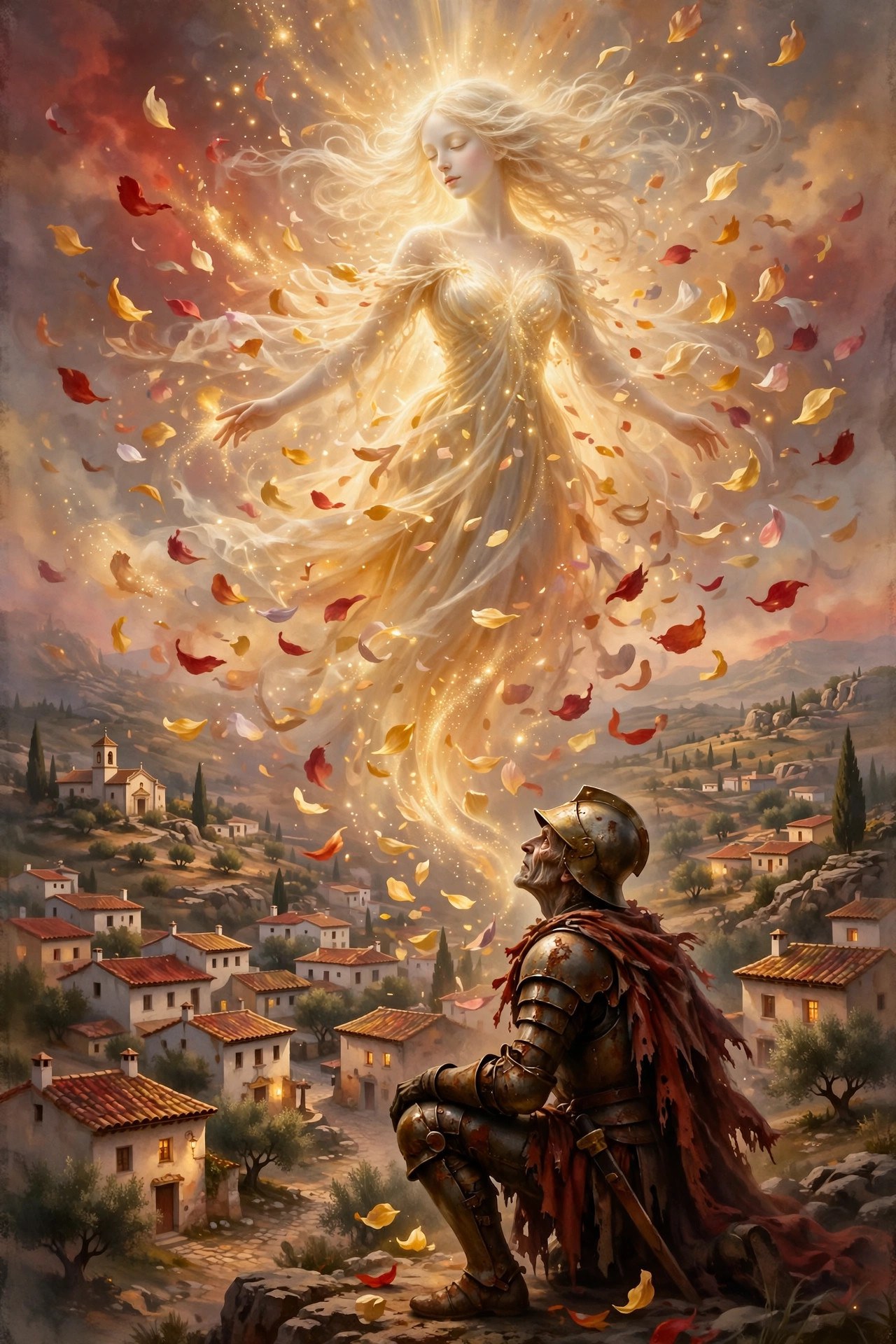
Dulcinea del Toboso
She never appears — and she is everywhere.
Aldonza Lorenzo
The lady's earthly original is a farm girl from El Toboso, "a very good-looking wench" whom the young Alonso Quixano once fancied from afar (Part I, ch. 1). In the novel's present she is strong, loud, and thoroughly uninterested in being anyone's ideal. Sancho knows her; the reader never quite meets her; and that absence is the point.
The invention of Dulcinea
A knight-errant must have a lady — "a knight-errant without love was like a tree without leaves or fruit, or a body without a soul" (Part I, ch. 1). So Quixote confers upon Aldonza "the title of Lady of his Thoughts" and renames her Dulcinea del Toboso — "a name, to his mind, musical, uncommon, and significant." Every quest is undertaken in her name; every victory is laid at her feet; the penance in the Sierra Morena (Part I, ch. 25–26) is performed for her.
The enchantment (Part II)
In Part II, Sancho — who could not find her in El Toboso — improvises: three peasant girls on donkeys become the lady and her damsels, "enchanted" by wicked magicians (Part II, ch. 10). Quixote, half-seeing the trick and half-refusing it, accepts the enchantment as the explanation. From then on, the "disenchantment of Dulcinea" — 3,300 lashes on Sancho's backside — becomes the engine of the plot, and the cruelest of the duke's jokes. The lady who never existed becomes the wound the whole second volume circles.
What she means
Dulcinea is the novel's purest idea: devotion with no object but the devotion itself. Quixote does not love a woman; he loves loving — constancy, service, the high style of feeling. When Alonso Quixano dies sane, Dulcinea dies with him: the last thing the knight's madness needed was a face, and the first thing his sanity surrenders is the dream.
Source notes
- Aldonza/Dulcinea invention: Ormsby, Part I, ch. 1.
- "a knight-errant without love was like a tree without leaves or fruit, or a body without a soul": Part I, ch. 1.
- "he decided upon calling her Dulcinea del Toboso—she being of El Toboso—a name, to his mind, musical, uncommon, and significant": Part I, ch. 1.
- The enchantment: Part II, ch. 10; the disenchantment: Part II, ch. 35–41.