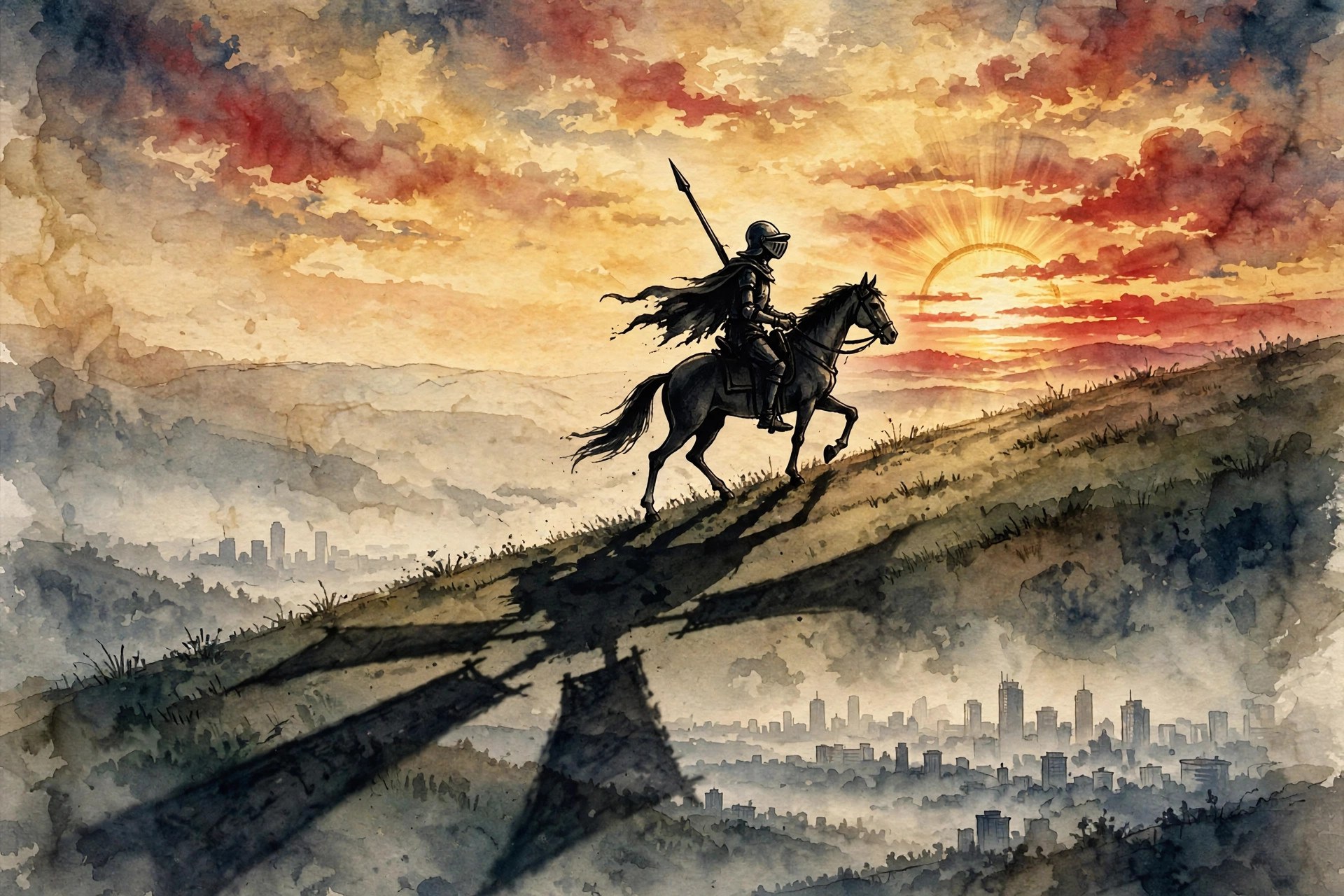
Quixotic Idealism
The word one fictional knight gave the world — and what it costs to live by it.
Few fictional characters have donated a word to a language. Don Quixote donated two things: the adjective quixotic — extravagantly idealistic, romantic past the point of practicality — and the idiom "tilting at windmills," for attacking imaginary enemies. Both come straight from the novel's machinery, and both are still working, four centuries on.
Where the word comes from
"Quixotic" entered English in the 18th century, built directly on the hero's name. The dictionaries define it as "extremely idealistic; unrealistic and impractical" — the knight who charges the windmill rendered as an adjective. It is a rare honor: to name a human tendency after a fictional person, and have the name stick across languages. Spanish has quijotesco; French quichottesque. The knight belongs to the world's vocabulary now.
Tilting at windmills
The idiom comes from Part I, chapter 8 — the charge at the thirty mills, shouting "Fly not, cowards and vile beings, for a single knight attacks you." To "tilt at windmills" is to fight enemies that exist only in your own vision. It is usually said with a smile, but the novel earns the phrase's melancholy too: Quixote is wrong about the mills and right about the courage, and the idiom keeps both halves.
The Romantic Quixote vs. the comic Quixote
Every age has argued about what the knight means. The 18th century largely laughed at him — a fool for the age of reason to feel superior to. The Romantics reversed the verdict: for them he was the poet crushed by a prosaic world, the imagination martyred by fact. The 20th century found an existentialist, a man inventing his essence one adventure at a time — "I know who I am," the knight says in Part I, chapter 5, and means it absolutely.
The novel supports all three readings, which is why the argument never ends. Cervantes wrote a comedy that keeps turning serious when you aren't looking — the Golden Age speech (Part I, ch. 11), the freedom speech (Part II, ch. 58) — and a tragedy that keeps turning comic. Quixotic idealism is the name we give to living inside that tension.
The knight as archetype
Quixote is the template for a whole lineage: the dreamer beside the realist — Emma Bovary with her romances, the American dreamers of the great novels, every sitcom duo built on vision versus common sense. And always Sancho rides alongside: quixotic idealism, in the novel's full form, is not the knight alone but the pair — the vision and the appetite, the lance and the saddlebags, arguing all the way down the road. See sancho panza.
When idealism works
The novel's hardest question is also its most quixotic: does the knight's folly ever do any good? Sometimes — rarely, but unmistakably — it does. The beaten boy Andres is the counterexample (Part I, ch. 4): Quixote's intervention makes things worse. But the knight's courtesy, his eloquence, his absolute refusal of cynicism, win over nearly everyone who spends time with him — including, by the end, Sancho, who weeps at the deathbed of the "madman" he followed for an island and stayed with for love. The book's final accounting is Carrasco's epitaph: "A crazy man his life he passed, / But in his senses died at last" (Part II, ch. 74). Whether that is a tragedy or a triumph, four centuries of readers have been unable to decide — which may be the most quixotic thing about the book.
Source notes
- Quotations cite part and chapter of the Ormsby translation; see sayings and sources.
- The history of the word "quixotic" and the Romantic reinterpretation follow standard literary-historical consensus; the readings offered here are the site's own synthesis, labeled per methodology.