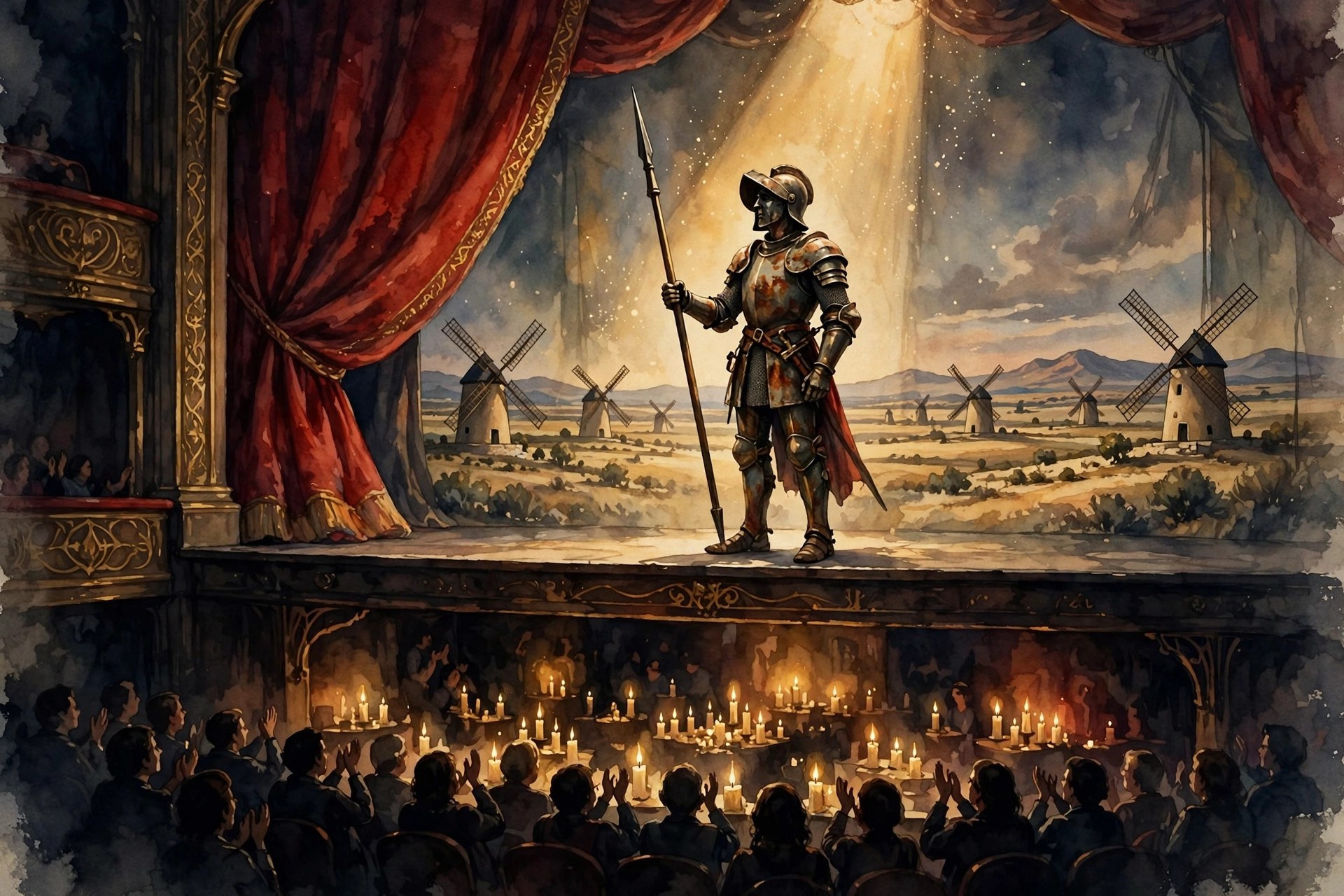
Adaptations of Don Quixote
Four centuries of other people's Quixotes — on stage, in music, and on film.
No novel in history has been reimagined more often, or in more forms. The adaptations began while Cervantes was still alive — and he answered them inside the book itself.
The first "adaptation": the false sequel of 1614
Before any stage or film, there was Avellaneda. In 1614 a spurious second part of Don Quixote appeared under the name Alonso Fernández de Avellaneda, and Cervantes spent the genuine Part II (1615) demolishing it: in chapter 59 his characters read the false sequel in an inn and reject it, and in the closing chapter he warns against "any other author save Cide Hamete Benengeli bringing him to life again falsely." The first adaptation of Quixote was a piracy, and the author sued his pirate in print. See the manuscript.
Illustration: Doré and the visual Quixote
The Quixote of the popular imagination — gaunt, bearded, lance couched — owes more to illustrators than to Cervantes's text, which describes its hero only glancingly. Gustave Doré's engravings of the 1860s fixed the image for the modern world: the knight charging the windmills, the gaunt silhouette against the Spanish sky. Every film and stage Quixote since has been, knowingly or not, quoting Doré.
Music: Strauss, Massenet, Minkus
- Richard Strauss, Don Quixote, Op. 35 (1897) — a tone poem for cello, viola, and orchestra, subtitled "Fantastic Variations on a Theme of Knightly Character." The cello is the knight; Sancho gets the tuba.
- Jules Massenet, Don Quichotte (1910) — a five-act opera with the great bass Feodor Chaliapin creating the title role; its famous last act gives the knight a death of operatic tenderness.
- Ludwig Minkus, Don Quixote (1869) — the ballet, choreographed by Marius Petipa, which has stayed in the repertory ever since, all Spanish color and virtuoso dancing.
Stage: Man of La Mancha
The most famous stage Quixote is the Broadway musical Man of La Mancha (1965), book by Dale Wasserman, music by Mitch Leigh — the story of Cervantes in prison telling the Quixote tale to fellow inmates, built around "The Impossible Dream." It won the Tony for Best Musical and has been revived ever since, becoming for many audiences the primary way they know the story at all. The musical's Cervantes-as-prisoner framing has no basis in the historical record — Cervantes was imprisoned, but not as the musical imagines it — which is worth knowing when the songs start.
Film: from silent reels to Gilliam
Quixote reached film almost as early as film existed, and almost every version has been a famous struggle. The great unfinished Quixote is Orson Welles's — shot intermittently over decades and never completed. The most notorious completed one is Terry Gilliam's The Man Who Killed Don Quixote (2018), decades in the making, which turns the director's own long failure to film the novel into the film's subject: a modern man drawn into playing Sancho to a cobbler who believes he is the knight.
Art: Picasso's sketch
Pablo Picasso's 1955 ink sketch of Don Quixote and Sancho — a few strokes for the gaunt knight, a round mass for the squire — became one of the most reproduced literary images of the 20th century. It is the whole novel in half a dozen lines.
Why Quixote adapts so well
Every age finds its own knight. The Romantics saw a poet destroyed by prose; the 20th century saw an existentialist; the musical saw a dreamer in a dungeon. The novel invites it: Part II is already about people staging Quixote's story back at him. To adapt Don Quixote is, in a sense, to do what the Duke and Duchess did — and Cervantes, who put them in the book, seems to have expected it.
Source notes
- The Avellaneda episode and Cervantes's response are documented in the novel itself (Part II, ch. 59, 72, 74); see the manuscript.
- Dates above (Doré 1860s, Minkus 1869, Strauss 1897, Massenet 1910, Picasso 1955, Man of La Mancha 1965, Gilliam 2018) are standard reference facts; see sources.
- The claim that the musical's prison framing is unhistorical is the site's own note, per methodology; Cervantes's actual imprisonments are covered in cervantes.