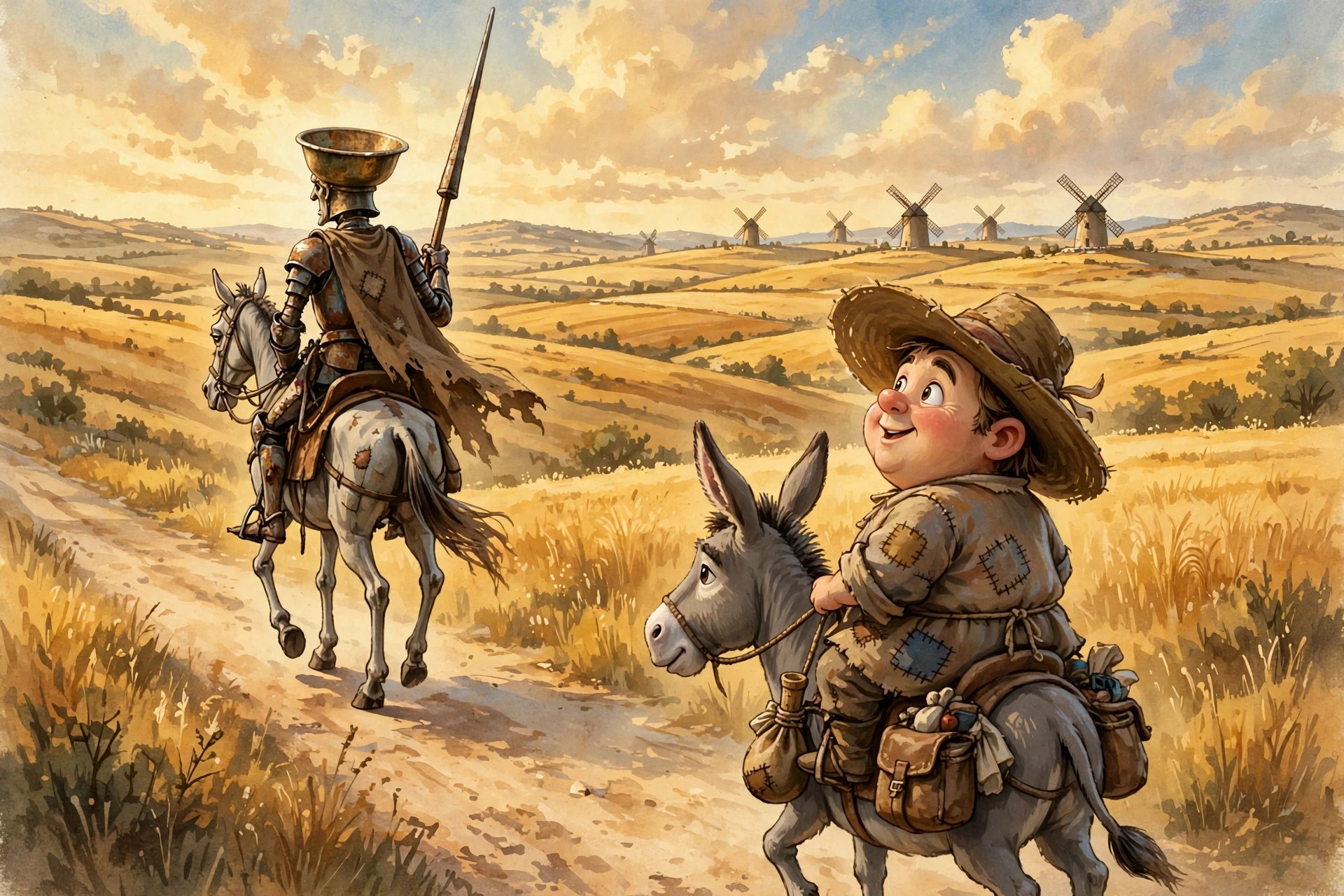
Sancho Panza
The belly to the knight's soul — and the wisest fool in literature.
The man
Sancho Panza is a laborer from the same village as Alonso Quixano — short, round, illiterate, married to Teresa Panza, father of Sanchica. He signs on as squire for the oldest of reasons: Don Quixote promises him the governorship of an island. He brings Dapple, his donkey; a wineskin; and a bottomless store of proverbs.
The counterweight
The novel runs on the dialogue between the two travelers. Quixote speaks in high romance and rhetoric; Sancho answers in proverbs, appetite, and common sense. Yet the counterweight is never simple: Sancho slowly absorbs his master's idealism — "quixotized," as the critics say — while Quixote absorbs Sancho's prudence. By Part II, the squire who once believed in islands governs one, and the knight who once saw only giants begins to see the man beside him.
The governorship of Barataria (Part II, ch. 45–53)
The duke's household grants Sancho the "island" of Barataria as an elaborate joke — and the joke backfires. Sancho settles lawsuits with peasant Solomon's wisdom, refuses bribes, eats sensibly, sleeps little, and governs so well that the prank becomes an embarrassment to its authors. Then, after the staged invasion alarm and a night of terror, he resigns: "I was not born to be a governor." He returns to Dapple and his master, preferring liberty to office. Don Quixote's farewell counsels to him (Part II, ch. 42–43) are among the novel's finest pages of practical ethics.
Why he matters
Sancho is the novel's reality principle — but also its heart. He follows a madman across Spain knowing exactly what the world thinks, and stays because of something the world can't see: loyalty, and then love. His grief at Quixote's deathbed is the proof that the adventures were real in the only way that counts.
In his own words (from the sayings)
- "…diligence is the mother of good fortune" — the proverb he repeats to the Duchess (Part I, ch. 29).
- To his master, on freedom and bread: "Happy he, to whom heaven has given a piece of bread for which he is not bound to give thanks to any but heaven itself!" (Part II, ch. 58).
Source notes
- Character and governorship: Ormsby, Part I–II (Project Gutenberg eBook #996).
- Counsels to Sancho: Part II, ch. 42–43. Governorship: Part II, ch. 45–53.