The Quests of Don Quixote
Every adventure of the knight-errant, in order, with part and chapter.
The novel is built as a procession of adventures — Cervantes calls them aventuras — across three sallies from home. What follows is the complete catalogue, in narrative order, with part-and-chapter citations from the Ormsby translation. For the two parts as wholes, see part-one guide and part-two guide; for the most famous adventure in depth, see the windmills.
First sally — Part I, chapters 1–6
The dubbing at the inn — Part I, ch. 3
Quixote takes an inn for a castle and persuades the innkeeper to dub him knight in a mock ceremony — a night's vigil over his arms in the stable yard, punctuated by a fight with muleteers. The novel's first sustained joke: chivalric ritual performed on a manure pile.
The boy Andres — Part I, ch. 4
The new knight's first "rescue": he orders a farmer to stop beating his servant boy, extracts a promise of payment, and rides off satisfied. The moment he is gone, the beating resumes — worse than before. Idealism's first invoice.
The merchants of Toledo — Part I, ch. 4
Quixote demands a party of merchants confess Dulcinea the most beautiful lady in the world; they refuse without seeing her, and he is beaten senseless. He is carried home in a fever (ch. 5), which sets up the library scrutiny (ch. 6).
Second sally — Part I, chapters 7–52
The windmills — Part I, ch. 8
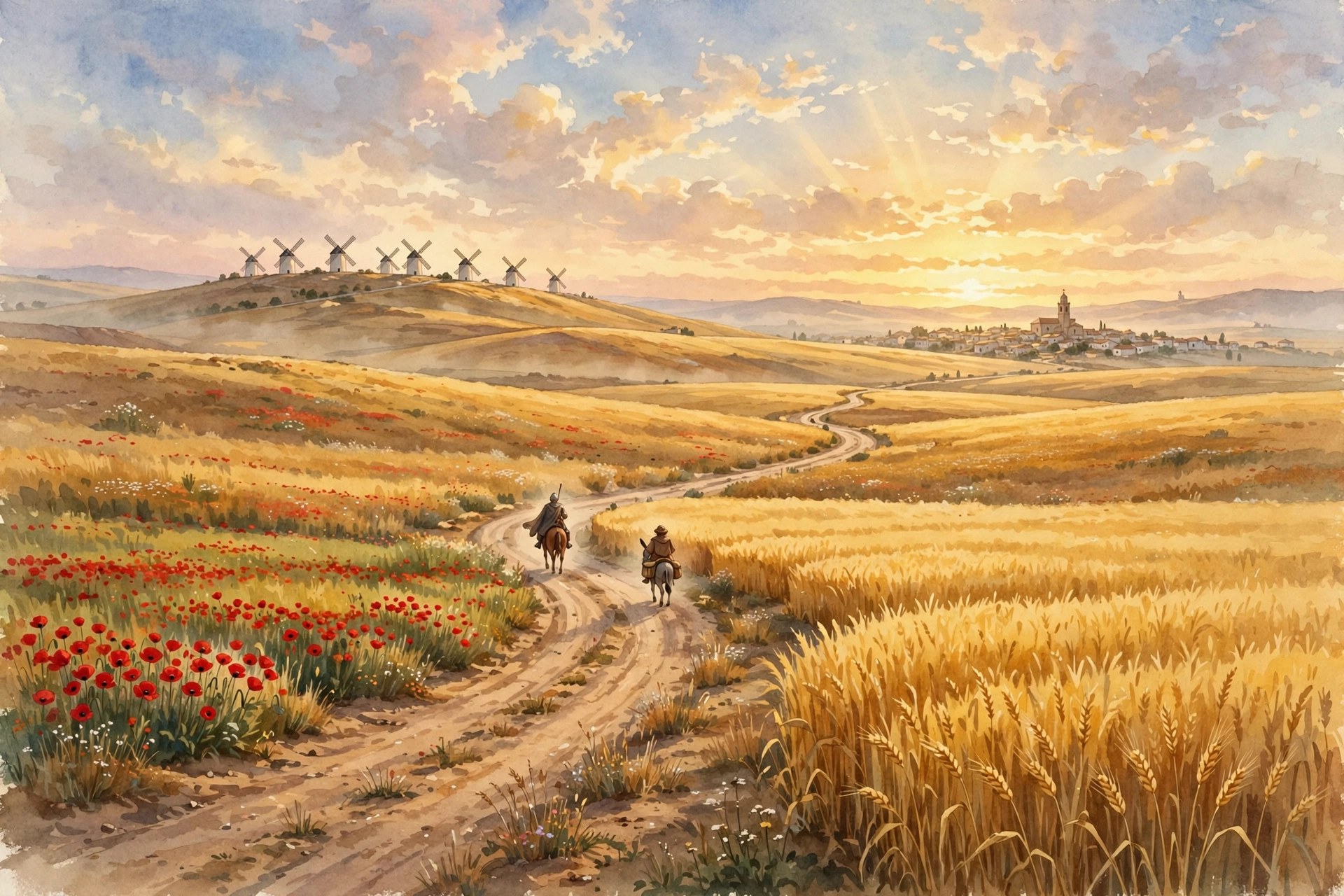
Thirty monstrous mills on the plain: "monstrous giants" to Quixote, who charges shouting "Fly not, cowards and vile beings, for a single knight attacks you" — and is swept up, lance shattered, horse and rider rolling on the plain. The scene that became the world's shorthand for the whole book. See the windmills.
The Biscayan — Part I, ch. 8–9
A running sword fight with a Biscayan squire over Dulcinea's honor, interrupted mid-stroke — which is where Cervantes invents the manuscript of Cide Hamete Benengeli to continue the story. See the manuscript.
The goatherds and the Golden Age — Part I, ch. 11
Among goatherds, Quixote delivers his great speech on the lost Golden Age — "they that lived in it knew not the two words 'mine' and 'thine'!" The knight at his most eloquent, and the novel's clearest statement of what he is fighting for. See sayings.
The fulling mills — Part I, ch. 20
By night, the pounding of fulling hammers sounds like giants; Sancho, terrified, ties Rocinante's legs to stop his master. At dawn the "giants" are laundry machinery, and Sancho's laughter earns him a beating. The novel's cruelest and funniest deflation.
Mambrino's helmet — Part I, ch. 21
A barber's brass basin, glinting in the sun, becomes the enchanted golden helmet of the romance hero Mambrino. Quixote wears it for the rest of the book. See glossary.
The galley slaves — Part I, ch. 22
Quixote frees a chain gang of convicts on principle — and is stoned and robbed by the beneficiaries. The adventure the novel never lets him forget; the Holy Brotherhood wants him for it.
The Sierra Morena penance — Part I, ch. 23–26
In the mountains, Quixote performs a lover's penance in imitation of Amadis — stripping half-naked, doing somersaults, writing verses to Dulcinea — while Sancho carries a letter to her. The interpolated tales (Cardenio, Dorothea) gather around this episode.
The wineskins — Part I, ch. 35
Asleep at the inn, Quixote dreams he is beheading a giant and slashes the inn's wineskins; he wakes ankle-deep in red wine, convinced of his victory. Sancho's deadpan accounting of the damage is the scene's glory.
The enchanted cage — Part I, ch. 46–52
The curate and barber, in league with the innkeeper, cage Quixote as an "enchanted" knight and cart him home. He rides in the cage discoursing on diligence being the mother of good fortune — mad, caged, and making perfect sense. The second sally ends where it began.
Third sally — Part II, chapters 12–74
The Knight of the Mirrors — Part II, ch. 12–14
Samson Carrasco, the young graduate, disguises himself to defeat Quixote and force him home — and is beaten. The first of Part II's staged adventures, in which the world starts performing the book back at its hero.
The lions — Part II, ch. 17
Quixote challenges two lions being transported to the King; the lions decline to fight and yawn. He takes the title Knight of the Lions. The bravest and most pointless of his victories.
The Cave of Montesinos — Part II, ch. 22–23
Lowered into a real cave, Quixote reports a dream-vision of enchanted heroes — Durandarte, Belerma, and a disenchanted Dulcinea demanding money. The novel's strangest episode: no one, including the reader, knows how much of it he invented.
The puppet show — Part II, ch. 26
Master Peter's puppet show of a chivalric tale drives Quixote to leap in, sword drawn, to rescue the puppets — smashing the theater. Art destroyed in the name of art: Cervantes's joke about his own readers.
The Duke and Duchess — Part II, ch. 30–57
A great household adopts the knight and squire as entertainment, staging elaborate pranks: the "disenchantment" of Dulcinea, the wooden horse Clavileño (ch. 41), and Sancho's governorship of the "island" Barataria (ch. 45–53) — where the peasant governs better than the nobles who mock him.
Barcelona and the Knight of the White Moon — Part II, ch. 61–65
In Barcelona, Quixote sees a printing press running off the false Avellaneda sequel (ch. 62) — the novel confronting its own piracy. On the beach, the Knight of the White Moon (Carrasco again) defeats him and binds him by knightly oath to retire for a year.
The return and the death — Part II, ch. 65–74
Quixote goes home, falls ill, recovers his senses, renounces knight-errantry as Alonso Quixano the Good, makes his will, and dies. Samson Carrasco's epitaph closes the book: "A crazy man his life he passed, / But in his senses died at last."
Source notes
- All adventures cite part and chapter of the Ormsby translation (1885), verified against Project Gutenberg eBook #996; see sources and methodology.
- Summaries are the site's own; disputed interpretations are labeled per methodology.