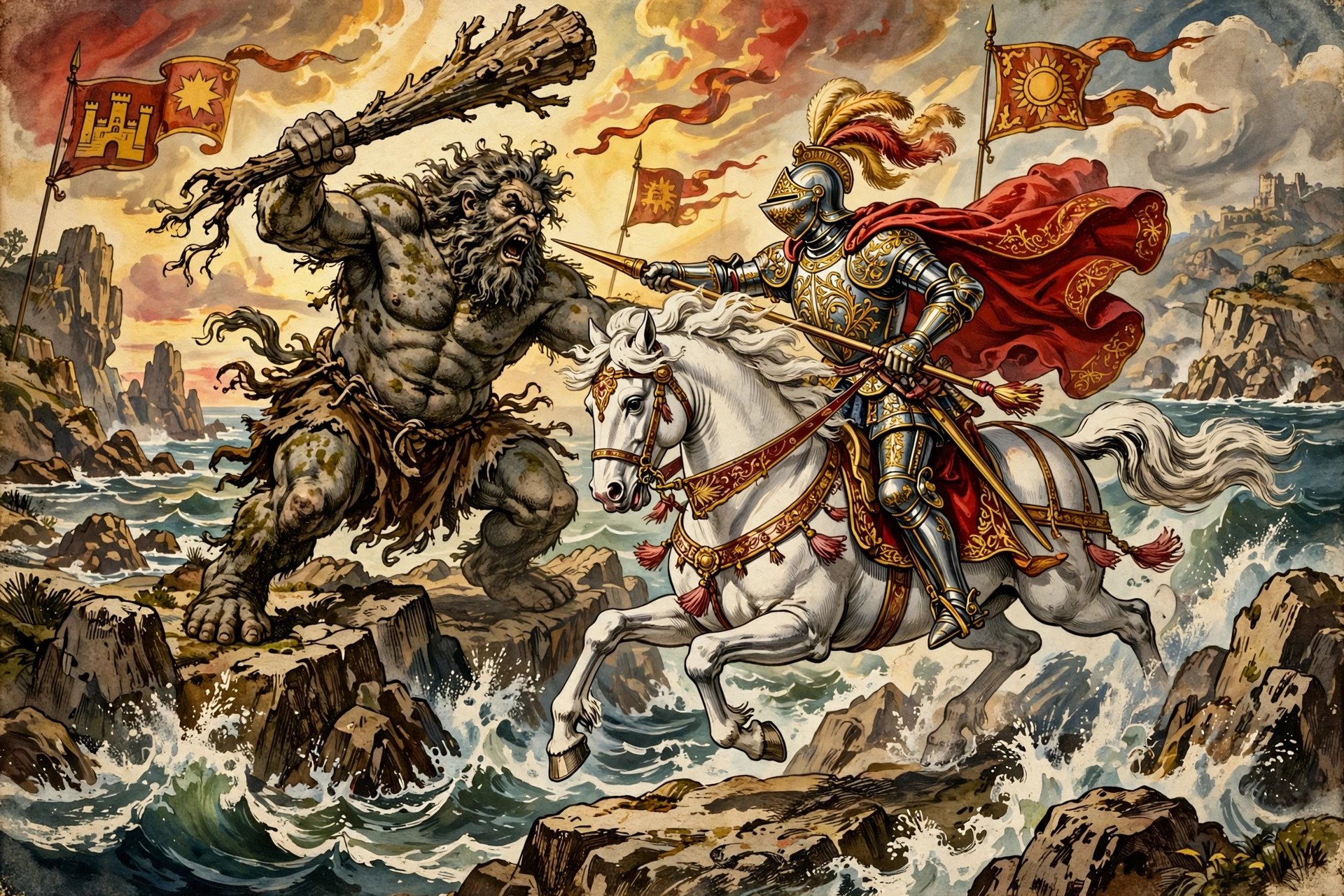
The Knight-Errant
Before Quixote tilted at them, the romances of chivalry ruled Europe's imagination.
The romances of chivalry
For a century before 1605, Spain devoured libros de caballerías — prose romances of wandering knights, giants, enchanters, and impossible loves. The genre's patriarch was Amadis of Gaul (Amadís de Gaula, printed 1508, older in manuscript): the perfect knight, constant to his lady Oriana, hero of a hundred enchanted adventures. Dozens of sequels and imitations followed — Palmerin of England, Belianis of Greece, the Esplandián cycle — each more extravagant than the last.
Alonso Quixano read them all, believed them all, and decided to live inside one. The prologue to Part I states Cervantes' aim plainly: to "undermine the authority" of the books of chivalry, which had bewitched readers and "wrought such mischief."
The scrutiny (Part I, ch. 6)
The priest and the barber — conducting the famous donoso escrutinio, the "facetious scrutiny" of Quixote's library — pass judgment book by book while the housekeeper burns the condemned. Their verdicts are Cervantes' literary criticism in disguise:
- Amadis of Gaul is spared: "the best of all the books of this kind that have ever been written," the doctrine and model of the genre.
- Palmerin of England is saved too, and a handful of others.
- The rest — the Belianis sequels, the endless Amadis continuations, the absurdities — go to the flames, with jokes attached.
The scene is both parody and canon-making: Cervantes destroys the genre while preserving its one true classic.
The code Quixote lives by
From the romances he takes the whole operating system of knight-errantry:
- The lady. A knight without a love is "like a tree without leaves or fruit, or a body without a soul" — hence Dulcinea.
- The quest. Wrongs to right, giants to slay, maidens to defend — "to defend maidens, to protect widows and to succour the orphans and the needy" (Part I, ch. 11).
- The enchanter. Every defeat is some sage's malice; the world of romance always supplies a villain.
- The fame. "The good report of a man's actions" outlives him; Quixote rides for eternal renown.
The paradox
Cervantes set out to kill the romances. He succeeded — the genre withered after 1605 — and in the same stroke made their greatest hero immortal. Nobody reads Belianis of Greece now; everyone knows the man who read it. The parody outlived the thing parodied, because the parody turned out to be about something larger: the human habit of living inside stories.
Source notes
- Prologue aim and library scrutiny: Ormsby, Part I, prologue and ch. 6–7.
- "the best of all the books of this kind that have ever been written": Ormsby, Part I, ch. 6 (of Amadis of Gaul).
- "to defend maidens, to protect widows and to succour the orphans and the needy": Ormsby, Part I, ch. 11.
- Publication history of Amadis (1508, Garci Rodríguez de Montalvo): standard scholarly record; see sources.