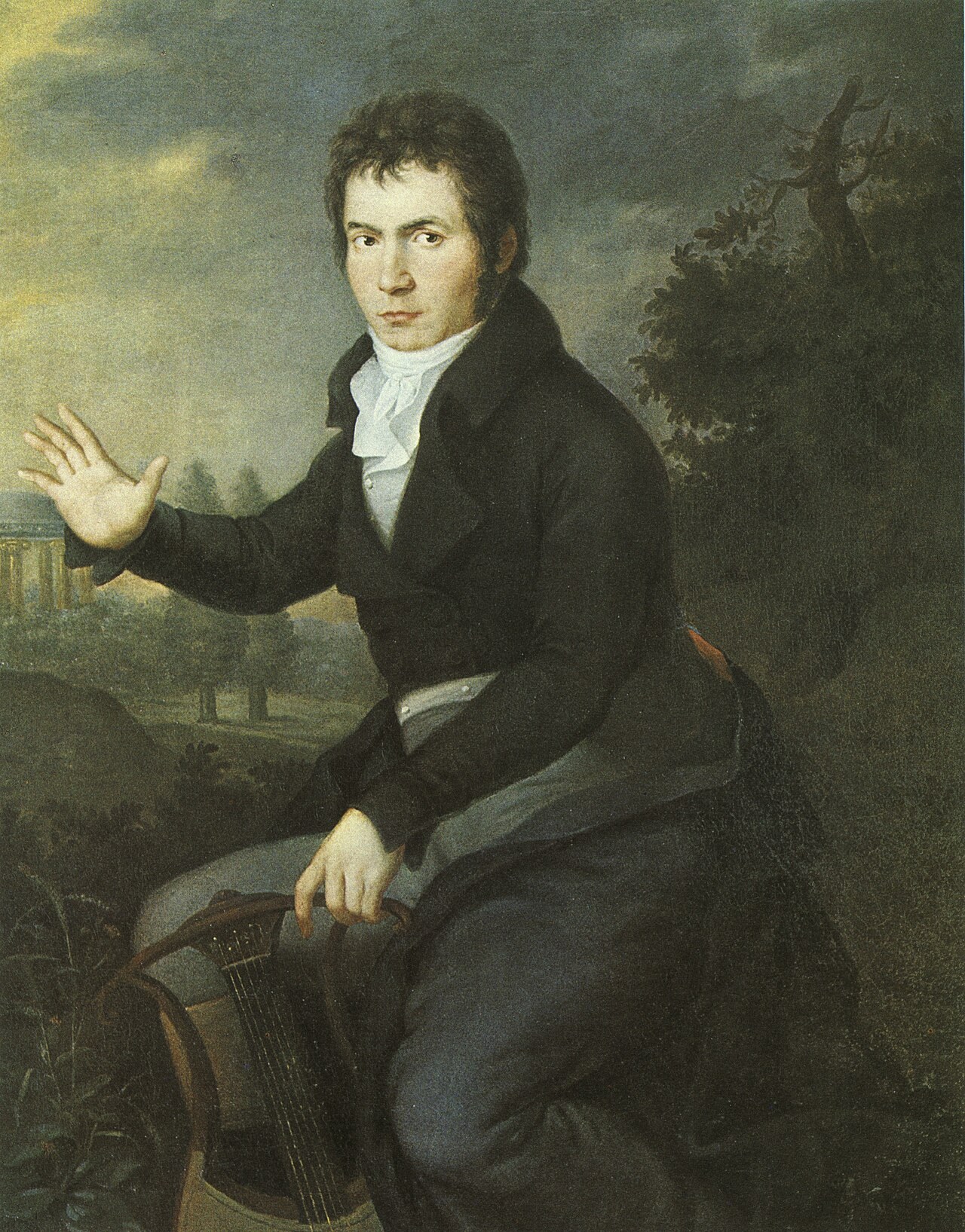
The Nine Symphonies
Nine symphonies in twenty-four years — from the Haydnesque First to the choral Ninth. The form was never the same afterward.
No. 1 in C major, Op. 21 (1799–1800)
Premiered 2 April 1800 at the Burgtheater, Vienna, at Beethoven’s benefit concert. Still Classical in manners — it famously opens on a dominant chord, a witty feint — but the finale’s scale already hints at what’s coming.
No. 2 in D major, Op. 36 (1801–02)
Composed alongside the Heiligenstadt crisis — sunny, vigorous music written in the shadow of the Testament. Premiered 5 April 1803 at the Theater an der Wien.
No. 3 in E-flat major, Op. 55 — “Eroica” (1803–04)
The watershed: twice as long as any previous symphony, with a funeral march as its slow movement and a finale of variations. First intended for Napoleon; dedication withdrawn — see Eroica and Napoleon. Premiered privately at Prince Lobkowitz’s palace (1804); public premiere 7 April 1805.
No. 4 in B-flat major, Op. 60 (1806)
The “slender Greek maiden between two Norse giants” (Schumann’s phrase — reported). Light, witty, perfect — and often underrated. Premiered March 1807 at Lobkowitz’s palace.
No. 5 in C minor, Op. 67 (1804–08)
The four-note opening — “fate knocking at the door” is Schindler’s reported anecdote, not documented (see Mythology vs. Record). The symphony’s real drama is structural: C minor struggles through to a blazing C-major finale with trombones and piccolo, instruments new to the symphony. Premiered 22 December 1808 at the marathon Theater an der Wien concert.
No. 6 in F major, Op. 73 — “Pastoral” (1808)
“More the expression of feeling than painting” — Beethoven’s own subtitle. Five movements: arrival in the country, brookside scene, peasant merrymaking, thunderstorm, shepherd’s thanksgiving. Premiered the same night as the Fifth, 22 December 1808.
No. 7 in A major, Op. 92 (1811–12)
Wagner reportedly called it “the apotheosis of the dance.” The second movement (Allegretto) became one of Beethoven’s most famous pages. Premiered 8 December 1813 at a charity concert for soldiers wounded at Hanau — with Beethoven himself conducting.
No. 8 in F major, Op. 89 (1812)
Short, high-spirited, Haydnesque in wit — Beethoven called it “much better” than the Seventh when a listener preferred it (reported). Premiered 27 February 1814.
No. 9 in D minor, Op. 125 — “Choral” (1822–24)
The finale sets Schiller’s Ode to Joy for soloists and chorus — the first time voices entered the symphony. Premiered 7 May 1824 at the Theater am Kärntnertor; Beethoven, deaf, reportedly had to be turned to see the ovation. See The Ninth and Ode to Joy.
Why they changed everything
- Scale: the Eroica and Ninth roughly doubled the symphony’s length and expressive range.
- Narrative: from the Fifth on, symphonies trace a dramatic arc — struggle to triumph — that became the Romantic template.
- The finale problem: after the Ninth, composers spoke of the “curse” of writing a tenth symphony. Brahms waited until 1876 for his First; his friends called it “Beethoven’s Tenth.”
Source notes
- Dates, keys, opus numbers, and premiere details follow standard catalogues (Kinsky–Halm) and the Beethoven-Haus Bonn chronology.
- “Fate knocking at the door”: Anton Schindler’s Biographie (1840); modern scholars treat Schindler’s anecdotes with caution — see mythology-vs-record.md.
- Schumann’s “Greek maiden” remark on the Fourth: reported in Schumann’s writings — treated here as reported.
- The 22 December 1808 concert (Fifth, Sixth, Fourth Piano Concerto, Choral Fantasy) is documented in contemporary Viennese sources.