Fidelio
His only opera — a rescue drama about marital devotion and political freedom, premiered to a half-empty house while French troops occupied Vienna, then revised twice into a triumph.
The story
Fidelio (Op. 72) tells of Leonore, who disguises herself as a young man, “Fidelio,” to infiltrate the prison where her husband Florestan is being starved by the tyrannical governor Pizarro. In the finale, a minister’s arrival exposes the villain; the prisoners emerge into daylight singing of freedom. The libretto (by Joseph Sonnleithner, after Jean-Nicolas Bouilly’s Léonore) is a rescue opera — the fashionable French genre — but Beethoven makes it a moral drama about courage and liberation.
Three versions
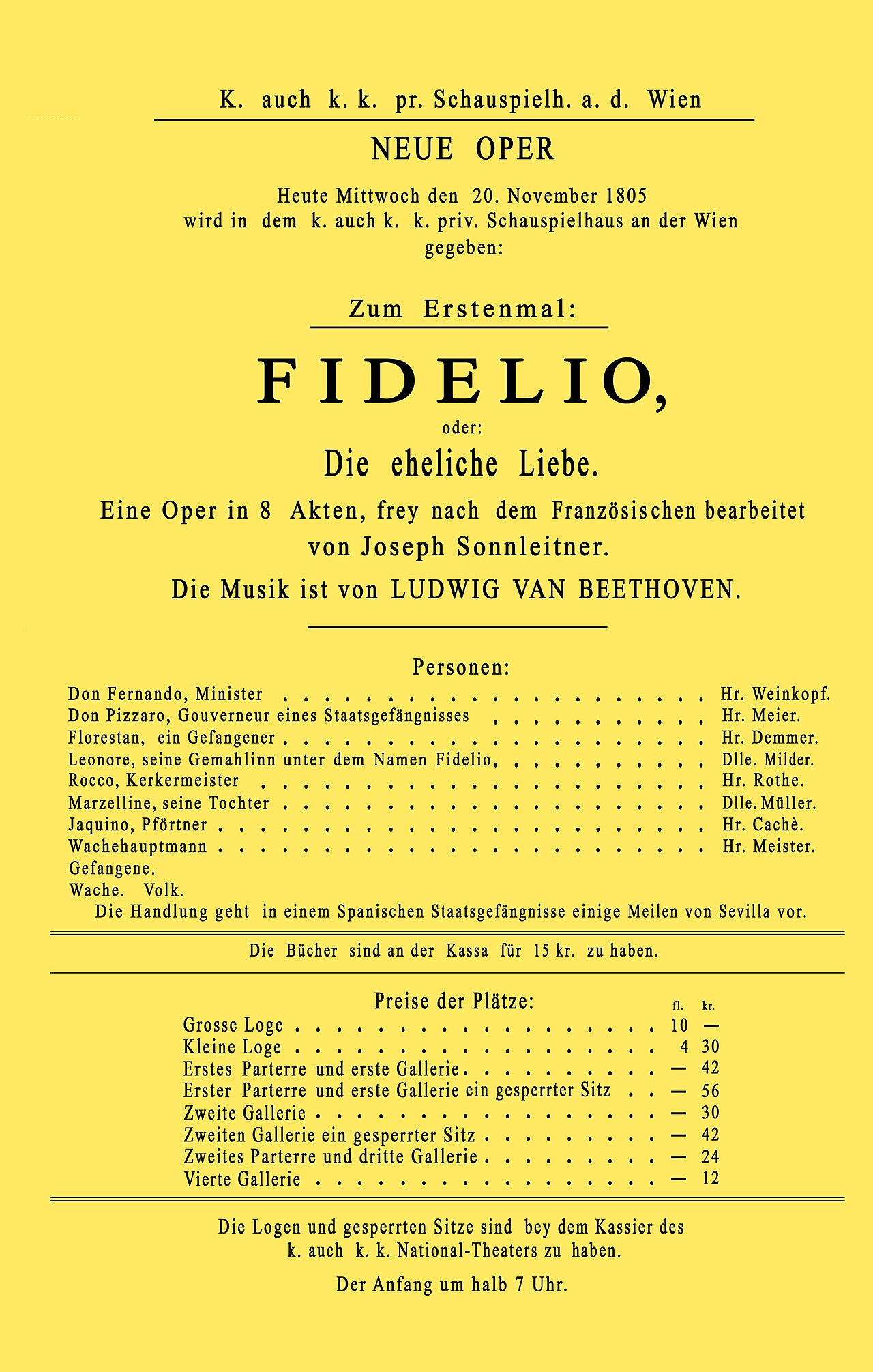
- 1805 (Leonore): premiered 20 November 1805 at the Theater an der Wien — days after Napoleon’s army entered Vienna. The audience was thin (aristocrats had fled), the opera long, the reception cool. The playbill for that night survives (shown on this page).
- 1806: revised to two acts with a new overture; better received, then withdrawn after a quarrel with the theater management.
- 1814: the final version — tightened, with the great Leonore Overture No. 3 replaced by the lighter Fidelio Overture. Premiered 23 May 1814 to real success; it has held the stage ever since.
Why only one opera
Beethoven struggled with the form: he demanded dramatic truth, rewrote obsessively, and fought librettists. Projects came and went (Vestas Feuer, a Faust, a Melusine). Fidelio survived because its theme — freedom against tyranny — was the closest thing Beethoven had to a creed. The “Prisoners’ Chorus” (O welche Lust) and Leonore’s great aria Abscheulicher! remain the opera’s peaks.
The overtures
Beethoven wrote four overtures for the opera: three Leonore overtures (Nos. 1–3) plus the final Fidelio Overture. The Leonore No. 3 is effectively a symphonic poem of the whole drama — often played in concert, sometimes interpolated into the opera itself.
Source notes
- Libretto: Sonnleithner after Bouilly; three versions 1805/1806/1814: documented in the Kinsky–Halm catalogue and Viennese theater records.
- 20 November 1805 premiere at the Theater an der Wien; French occupation of Vienna (13 November 1805): contemporary records.
- The surviving 1805 playbill: Beethoven-Haus Bonn collections; image via Wikimedia Commons (CC BY-SA 4.0) — see the image credits on this page.
- Final version premiere 23 May 1814, Theater am Kärntnertor: contemporary records.