Biography
Baptized 17 December 1770 in Bonn, dead 26 March 1827 in Vienna. Between those dates: the most consequential composing life in Western music — carried out, for its second half, in deafness.
Bonn, 1770–1792
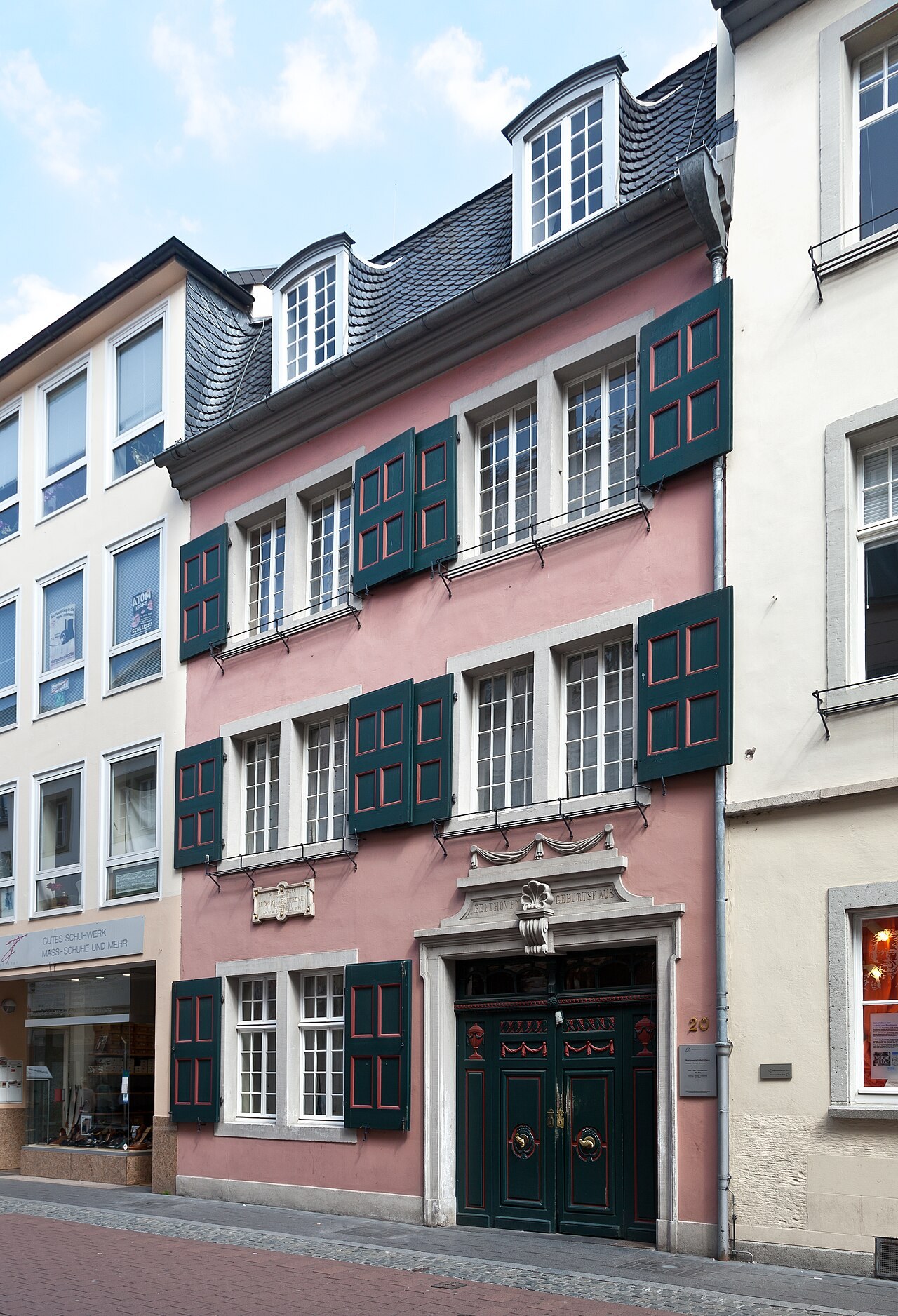
Ludwig van Beethoven was baptized on 17 December 1770 at St. Remigius in Bonn. His birth date is not documented; 16 December is traditional, not proven — the family celebrated his birthday on the 16th, and Beethoven himself believed he was born in 1772, two years later than he was. His father Johann van Beethoven was a court singer; his grandfather Ludwig (1712–1773), Kapellmeister at the Bonn court, was the family success story. His mother was Maria Magdalena Keverich (1746–1787).
Johann pushed the boy hard as a prodigy — the “second Mozart” marketing included shaving a year or two off his age on concert bills. The real musical education came from Christian Gottlob Neefe, the court organist, who taught him Bach and gave him his first published work (piano variations, 1783). Count Ferdinand von Waldstein, a young aristocrat, became an early patron and later the dedicatee of the Waldstein Sonata. By 1792 the Elector’s court funded Beethoven’s move to Vienna to study with Haydn. See Bonn Childhood.
Vienna: the arrival, 1792–1802
Beethoven reached Vienna in November 1792 — weeks after Haydn had left for London, an awkward start. He studied with Haydn through 1794, but the relationship cooled: Beethoven, proud and suspicious, quietly took counterpoint lessons from Johann Schenk and later Johann Georg Albrechtsberger, and studied singing and Italian opera with Antonio Salieri. (The Salieri-poisoned-Mozart legend belongs to another story; Salieri was Beethoven’s respected teacher.)
Vienna made him first as a pianist — famed for improvisation — then as a composer. Aristocratic patrons competed for him: Prince Karl von Lichnowsky (who gave him a famous annuity), Prince Lobkowitz, Count Razumovsky. The early masterpieces piled up: the Pathétique Sonata (1799), the First Symphony (1800), the Moonlight Sonata (1801). And underneath, the catastrophe: from about 1798 his hearing was failing. See The Vienna Years and The Deafness Story.
The heroic decade, 1803–1812
After the Heiligenstadt crisis of 1802, Beethoven entered the most productive decade of his life — the “heroic” middle period. The Eroica Symphony (1803–04), first meant for Napoleon; the Fifth and Sixth (Pastoral) Symphonies, premiered together at a freezing four-hour concert on 22 December 1808; the Violin Concerto (1806); the Razumovsky Quartets (1806); the Appassionata Sonata (1804–05); the opera Fidelio (1805, revised 1806 and 1814); the Emperor Concerto (1809). In 1809 three patrons — Archduke Rudolph, Lobkowitz, and Prince Kinsky — guaranteed him an annuity of 4,000 florins to keep him in Vienna rather than accept a Kapellmeister post elsewhere. He stayed.
The fallow years and the nephew, 1813–1817
Output slowed: illness, money trouble, the collapse of the annuity’s value during wartime inflation, and the Napoleonic wars disrupting Viennese life. In 1815 his brother Caspar Carl died, and Beethoven began the long, bitter custody battle for his nephew Karl against the boy’s mother Johanna — a fight he pursued with obsessive moral certainty and won in 1820. The struggle consumed years and damaged everyone in it, Karl most of all.
The late period, 1818–1827
Deaf now almost completely — the conversation books (from 1818) preserve one side of his dialogues — Beethoven composed less but greater: the last five piano sonatas including the Hammerklavier (Op. 106, 1817–18), the Missa Solemnis (1819–23), the Ninth Symphony (1822–24, premiered 7 May 1824), and the late string quartets (1824–26), music so far ahead of its time that players and audiences found it baffling. In 1826 Karl attempted suicide; Beethoven, shattered, took him to his brother Johann’s estate at Gneixendorf, where he finished his last quartet (Op. 135) and worked on the Große Fuge’s replacement finale. He returned to Vienna ill and died on 26 March 1827, during a thunderstorm. See Death and Funeral.
Character
Contemporaries describe a man of volcanic temper and deep tenderness: generous to friends, brutal to servants and publishers, suspicious to the point of paranoia about money, capable of extraordinary kindness to the poor. He never married. The unsent Immortal Beloved letter (July 1812) is the great romantic mystery of his life — the recipient has never been proven. He was, by every account, utterly absorbed in his work: sketchbooks show themes reworked dozens of times; inspiration was 1% and revision 99%.
Source notes
- Baptismal date (17 Dec 1770) and the undocumented birth date: parish register, Bonn; see timeline.md.
- Biographical framework follows the Beethoven-Haus Bonn chronology and standard scholarship (Lockwood, Beethoven: The Music and the Life; Swafford, Beethoven: Anguish and Triumph).
- The annuity (1809, 4,000 florins, Archduke Rudolph / Lobkowitz / Kinsky): documented agreement; payments eroded by inflation and Kinsky’s death — see vienna-years.md.
- Karl custody (1815–1820) and suicide attempt (July 1826): court records and correspondence; see people.md and death-funeral.md.
- Immortal Beloved letter (6–7 July 1812, Teplitz): manuscript in the Berlin State Library; recipient unidentified — see mythology-vs-record.md.