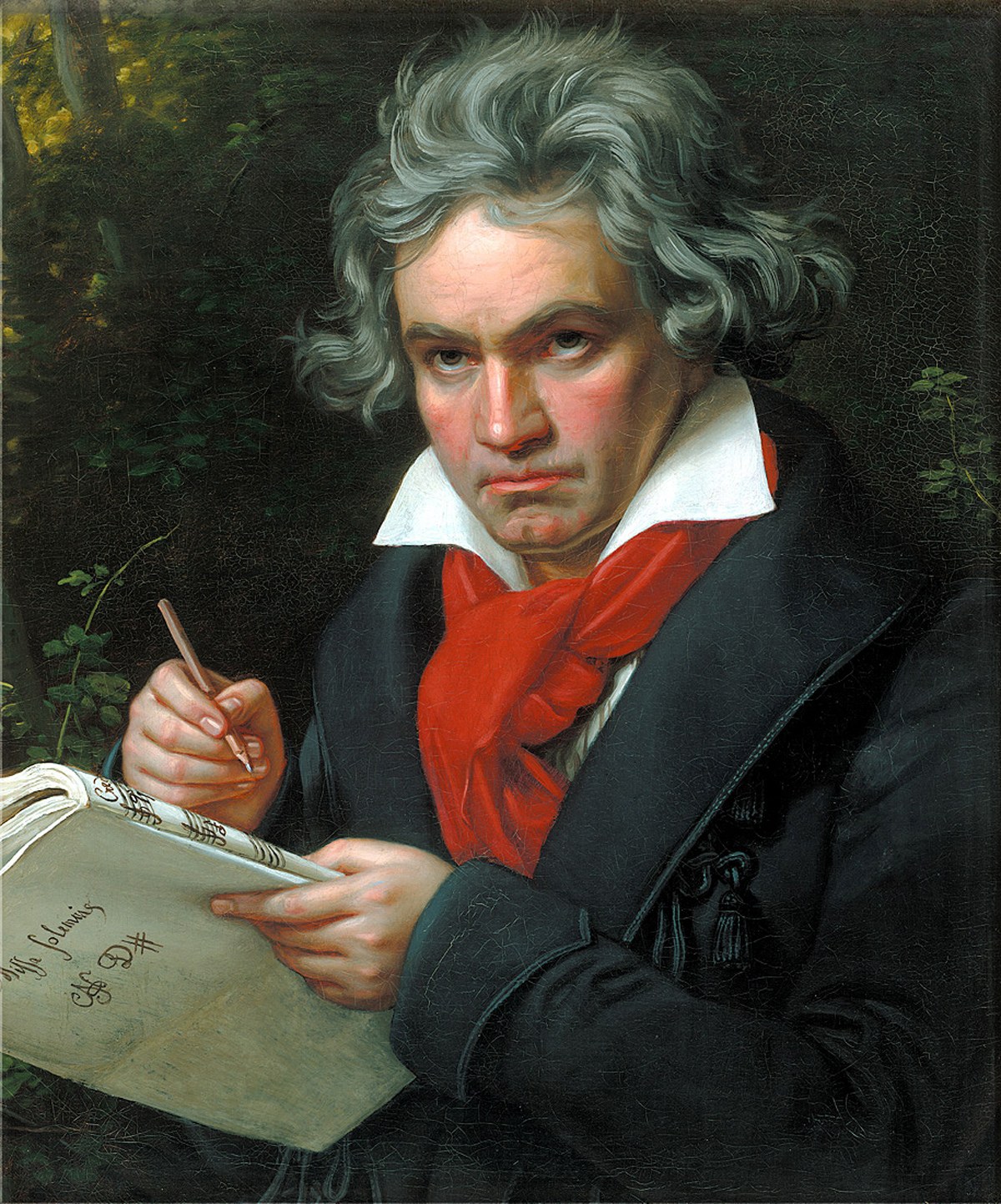
The Ninth and Ode to Joy
The symphony that put voices into the orchestra — premiered in 1824 by a composer who could not hear it, ending with the melody the world now sings as an anthem.
Thirty years in the making
Beethoven had wanted to set Schiller’s An die Freude (Ode to Joy, 1785) since his Bonn youth — sketches toward a choral symphony finale go back decades. The Ninth Symphony in D minor, Op. 125, composed 1822–24, is where the idea finally landed: three vast instrumental movements, then a finale that begins with the famous orchestral recitative — the cellos and basses rejecting the earlier themes — before the “Joy” theme emerges and the chorus enters.
The premiere, 7 May 1824
The Theater am Kärntnertor, Vienna. Beethoven, functionally deaf, was on stage beating time; the orchestra largely followed the concertmaster. At the end, the contralto Caroline Unger reportedly turned him around to see the thunderous applause — reported by witnesses (Unger among them); the gesture is tradition, the ovation is documented. The scherzo had to be repeated; the police commissioner reportedly had to signal that applause limits had been exceeded.
The finale’s architecture
The “Ode to Joy” theme is deliberately simple — almost folk-like — so it can bear the weight of variations, a Turkish march episode, a double fugue, and the final blazing peroration. Schiller’s poem is about universal brotherhood (“Alle Menschen werden Brüder”); Beethoven’s setting made it music’s great utopian statement.
What it became
- 1824–1900s: the summit of the symphonic tradition; Wagner conducted it, Mahler re-orchestrated it.
- 1985: the Council of Europe adopted the finale’s melody (no words) as the European anthem.
- 1989: Leonard Bernstein conducted it in Berlin as the Wall fell — with “Freiheit” (freedom) substituted for “Freude” (joy).
- Today: the Ode to Joy is among the most recognized melodies on earth — New Year’s concerts in Japan, protest movements, film scores, ringtones.
The deafness question
Could a deaf man write this? He did — working from inner hearing, sketchbooks, and a lifetime’s mastery of orchestration. The Ninth’s finale has passages of awkward vocal writing (the famous high passages that punish sopranos), which some scholars hear as the cost of composing without hearing voices. It is also the most heard music ever written by someone who couldn’t hear it.
Source notes
- Composition 1822–24; premiere 7 May 1824, Theater am Kärntnertor: contemporary Viennese records.
- The “turned to see applause” episode: reported by Caroline Unger and others present — flagged as reported; the extraordinary ovation is documented.
- Schiller’s An die Freude (1785); Beethoven’s Bonn-era interest: documented in early correspondence and sketchbooks.
- European anthem adoption (1985, melody without words): Council of Europe records.
- Bernstein’s 1989 Berlin performance with “Freiheit”: documented broadcast.