Death and Funeral
26 March 1827, during a thunderstorm — and three days later, a funeral that stopped Vienna. What the witnesses reported, and what the science later added.
The final illness
From late 1826 Beethoven was seriously ill — dropsy (edema), jaundice, abdominal pain: the classic picture of liver failure. He was operated on (paracentesis) multiple times that winter. He kept working as long as he could: finishing Op. 135, planning a Tenth Symphony (sketches exist), corresponding about the Missa Solemnis’s publication. In March 1827 he declined rapidly.
26 March 1827
He died on the afternoon of 26 March 1827, aged 56, during a violent thunderstorm over Vienna. Anselm Hüttenbrenner, who was present, later reported that Beethoven raised his fist toward the heavens at a thunderclap and fell back dead — an eyewitness report, impossible to verify, widely repeated. What is documented: the death, the storm, and the grief of the small circle at the bedside (including Schindler and Breuning).
The funeral, 29 March
Three days later Vienna gave him a funeral fit for a head of state: the coffin from the Alser parish church to the Währing cemetery, torchbearers, a guard of honor, schools closed. Thousands attended — contemporary estimates range from 10,000 to 20,000; the honest figure is “thousands” (see Mythology vs. Record). Eight Kapellmeisters carried the pall; Franz Schubert was among the torchbearers — he would be buried beside Beethoven within the year.
The grave
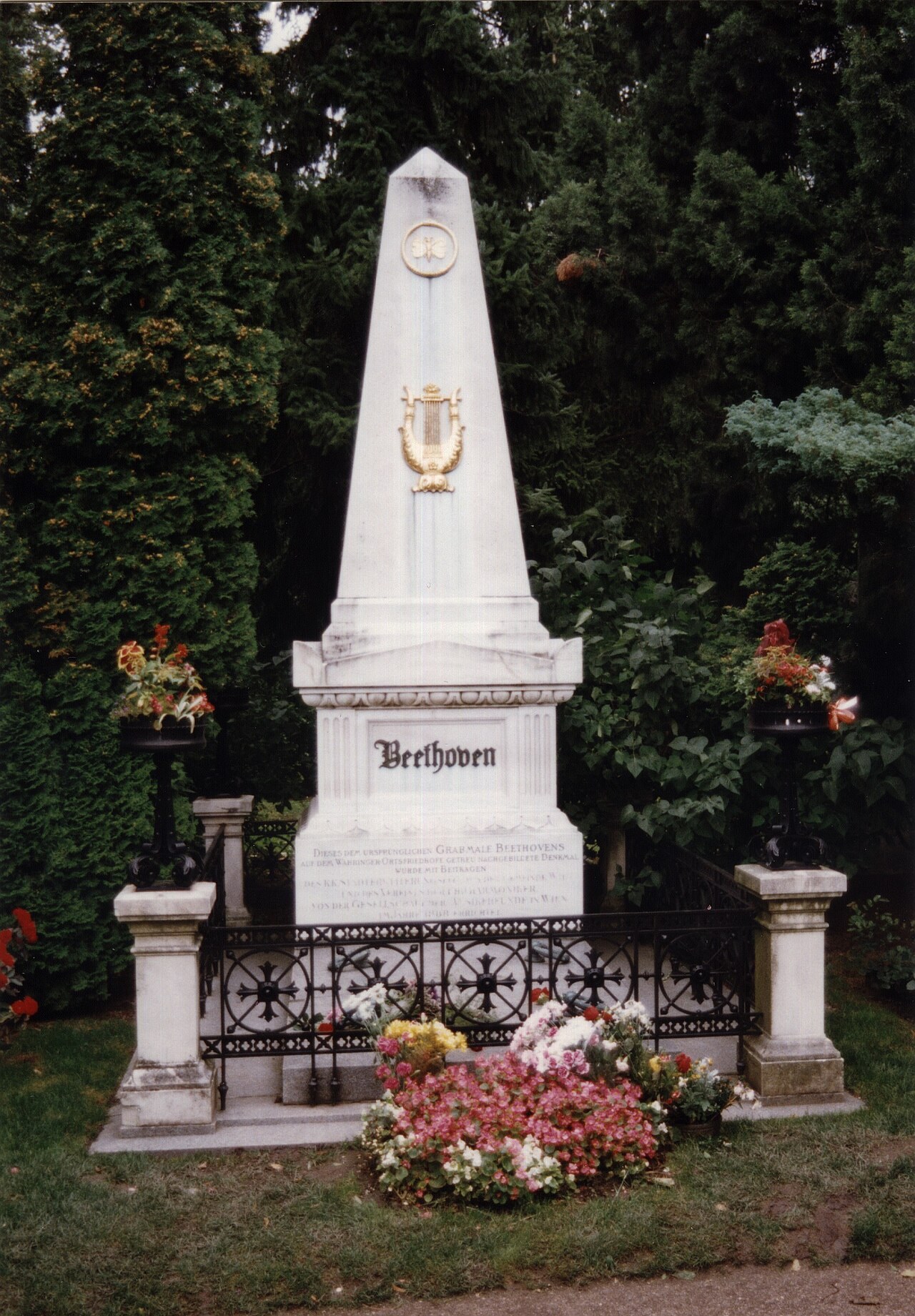
First buried at Währing; in 1888 the remains were moved to the Zentralfriedhof (Central Cemetery), Vienna, where the honor grave (Ehrengrab) stands today — near Mozart’s memorial and Schubert’s grave (shown on this page). A lock of hair, autopsy notes, and the conversation books survived him; the skull fragments taken at the 1863 exhumation were long rumored and partly recovered in modern times.
What killed him
The 1827 autopsy described a shrunken, cirrhotic liver. Modern posthumous studies — a 2007 hair analysis showing high lead, and 2023 genomic sequencing of authenticated hair locks suggesting hepatitis B infection and genetic liver-disease risk — point to liver failure, likely compounded by alcohol and lead exposure. These are posthumous hypotheses, not a diagnosis — but liver failure as the mechanism of death is consistent with every contemporary description.
Source notes
- Death 26 March 1827; funeral 29 March 1827, Alser church to Währing cemetery: contemporary Viennese records and press.
- Hüttenbrenner’s deathbed report: eyewitness testimony, published later — flagged as unverifiable.
- Funeral attendance: contemporary estimates vary (10,000–20,000); “thousands” used here.
- Schubert as torchbearer; 1888 reburial at the Zentralfriedhof: documented.
- 2007 hair-lead analysis and 2023 genomic findings (hepatitis B, liver-disease risk variants): published scientific studies — presented as posthumous hypotheses.
- Grave photograph via Wikimedia Commons (public domain) — see the image credits on this page.