Bonn Childhood
Twenty-one years in a small Rhineland court city — a harsh father, a great teacher, and a patron who saw the future. Everything Vienna inherited.
The Bonn he was born into
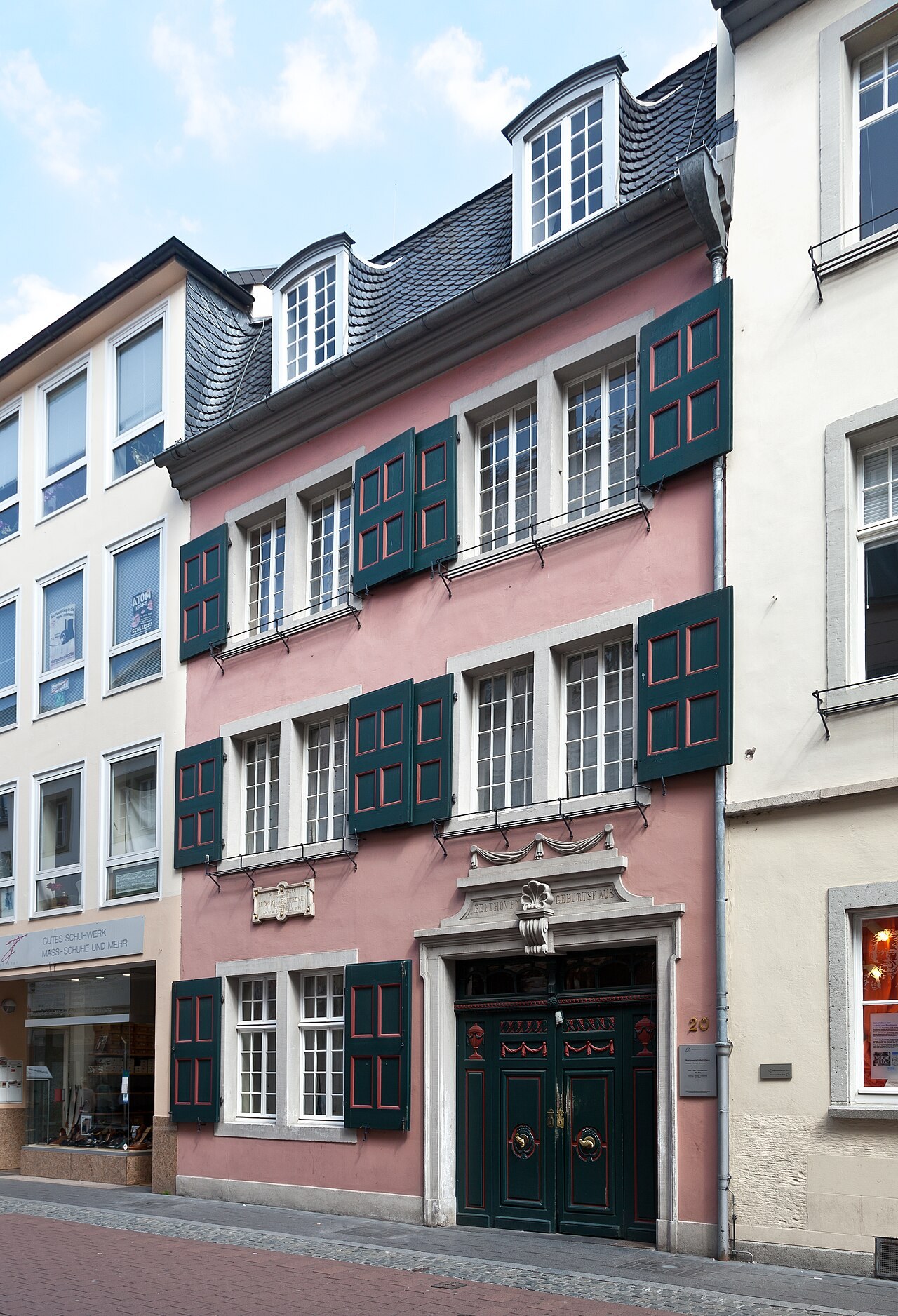
Bonn in 1770 was the seat of the Electorate of Cologne — a modest court with a serious musical establishment. The Beethoven family had served it for two generations: grandfather Ludwig (1712–1773) was Kapellmeister; father Johann (c. 1740–1792) sang tenor in the chapel. The family lived at Bonngasse 20 (now the Beethoven-Haus museum, shown on this page) among other addresses; they moved often, and money was usually short.
The father
Johann van Beethoven recognized his son’s talent and exploited it. The boy was drilled at the keyboard — neighbors reported weeping at the clavier late at night, though such stories come from later memoirs and should be handled carefully. What is documented: concert advertisements shaving a year or two off Ludwig’s age, the “second Mozart” marketing, and a father whose drinking worsened as the boy’s talent grew. Beethoven’s adult secrecy, suspicion, and fierce independence have roots here.
Neefe: the teacher who mattered
Christian Gottlob Neefe, court organist from 1781, gave Beethoven a real education: Bach’s Well-Tempered Clavier, thoroughbass, composition — and a philosophical breadth unusual for a music teacher. Neefe’s 1783 magazine notice praised the “eleven-year-old” (twelve, really) who could play “the greater part of Sebastian Bach’s Well-Tempered Clavier.” Beethoven served as Neefe’s assistant organist. When he left for Vienna, he carried Neefe’s Bach with him for life.
Waldstein and the road out
Count Ferdinand von Waldstein, a music-loving young aristocrat in Bonn, became Beethoven’s first significant patron — chamber music at his home, introductions, and eventually the push (and the Elector’s funding) for Vienna in 1792. His farewell inscription in Beethoven’s album set the mission: win “Mozart’s spirit from Haydn’s hands.”
What Bonn left him
- Bach, via Neefe — the counterpoint that would return in the late style.
- The organ loft — improvisation as a daily discipline.
- A chip on his shoulder — the provincial outsider who would conquer Vienna without ever quite belonging to it.
- The mother-shaped hole — Maria Magdalena’s death in 1787, when he was sixteen, left him the family caretaker and, friends said, permanently softened toward the vulnerable.
Source notes
- Birth/baptism dates, addresses, and court records: Bonn parish and court archives; Beethoven-Haus Bonn.
- Neefe’s 1783 notice: Magazin der Musik (Cramer), 2 March 1783.
- Waldstein’s album inscription (1792): surviving album leaf, quoted in standard biographies.
- Childhood drilling anecdotes: largely from later memoirs (Wegeler–Ries) — treated as reported where used.
- Beethoven-Haus Bonn photograph via Wikimedia Commons (CC BY-SA 3.0) — see the image credits on this page.