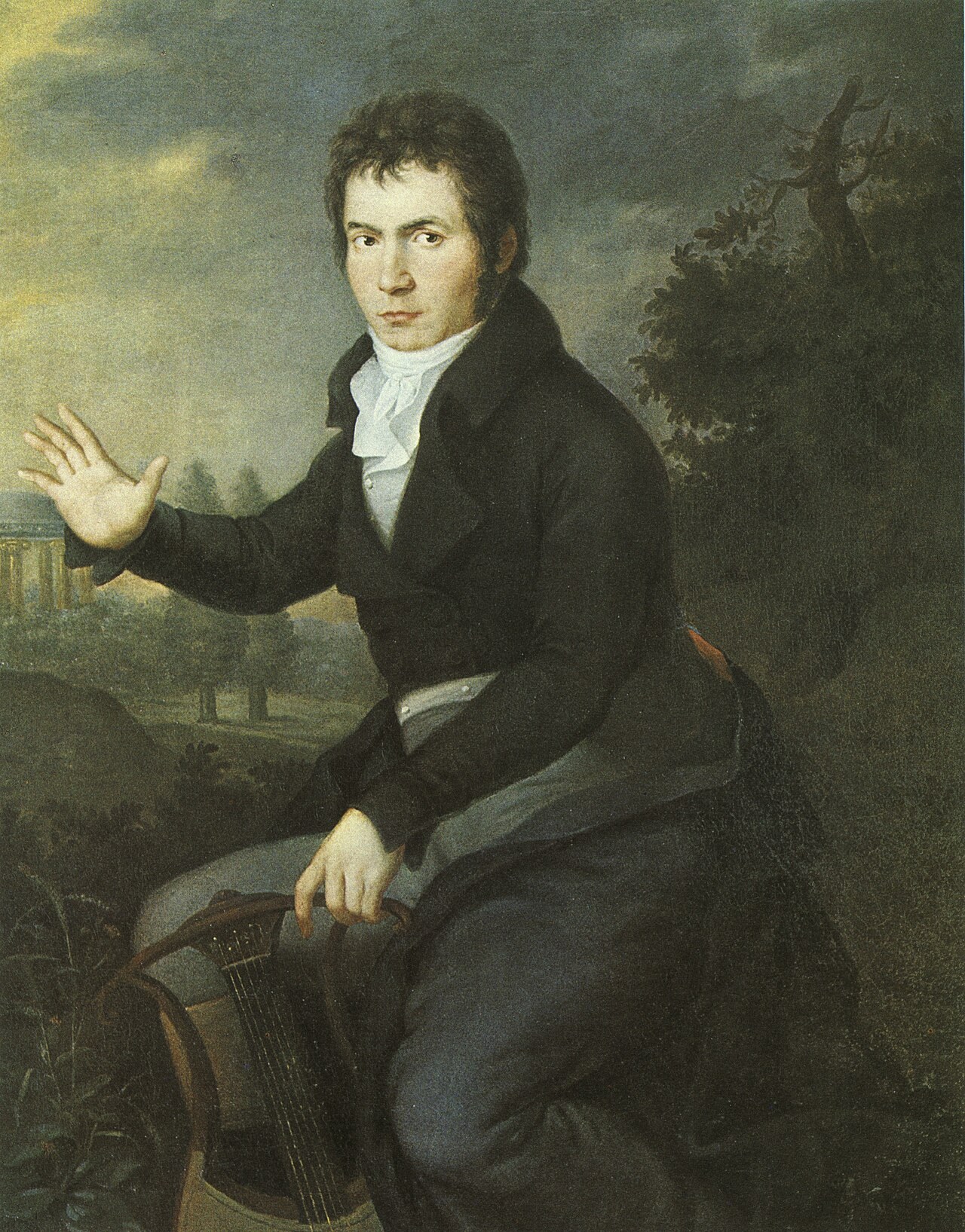
Start Here: Beethoven in Five Minutes
The essentials — who he was, why the music still matters, the deafness, and the five works to hear first. Five minutes, then the deep end is yours.
The one-paragraph version
Ludwig van Beethoven (baptized 17 December 1770, Bonn; died 26 March 1827, Vienna) was the composer who carried music from the Classical order of Haydn and Mozart into the Romantic age — and he did the second half of it deaf. He began losing his hearing around 1798, wrote the despairing Heiligenstadt Testament in 1802, and kept composing for another 25 years: the Eroica, the Fifth, the Pastoral, the late piano sonatas, the Missa Solemnis, the late string quartets, and the Ninth Symphony with its Ode to Joy finale — premiered in 1824, when he could not hear the applause.
Why he matters
- He expanded what music could say. The symphony grew from a half-hour entertainment into an hour-long drama of ideas (the Eroica, the Ninth). The piano sonata became a confessional form.
- He made the composer an artist, not a servant. Beethoven was among the first major composers to live primarily from aristocratic patronage and publishing rather than a court appointment — and to insist on artistic independence.
- He composed deaf — and it shows in the music. The late works are stranger, more inward, and more radical than anything before them. Scholars hear the isolation in the late quartets’ otherworldly slow movements.
Five works to hear first
- Symphony No. 5 in C minor, Op. 67 (1808) — the famous four-note opening; darkness to triumph in half an hour. Start with The Nine Symphonies.
- Piano Sonata No. 14, “Moonlight,” Op. 27 No. 2 (1801) — the nickname came later (see Mythology vs. Record); the music needs no nickname.
- Symphony No. 9 in D minor, Op. 125 (1824) — the Ode to Joy finale. See The Ninth and Ode to Joy.
- Piano Sonata No. 8, “Pathétique,” Op. 13 (1799) — the young Beethoven announcing himself.
- String Quartet No. 14 in C-sharp minor, Op. 131 (1826) — his own favorite of the late quartets; seven movements played without pause.
The deafness, briefly
Around 1798 Beethoven noticed ringing and fading hearing. By 1801 he confessed it in letters (including the famous “I will seize Fate by the throat” letter to Wegeler). In October 1802, at Heiligenstadt outside Vienna, he wrote the unsent Testament to his brothers — contemplating suicide, then resolving to live for his art. By the premiere of the Ninth (1824) he was functionally deaf. The full story, with the Testament quoted verbatim, is on The Deafness Story.
Where to go next
- The full life: Biography, then Timeline.
- The Napoleon story: Eroica and Napoleon.
- His own words: Sayings & Letters.
- The myths, tested: Mythology vs. Record.
- The Vizlings animated character: Meet the Character and Stream.
Source notes
- Dates and works summarized from biography.md, timeline.md, and symphonies.md; see their Source notes for citations.
- “His own favorite of the late quartets” (Op. 131): Beethoven reportedly told the publisher Schott that Op. 131 was his favorite — reported, not documented in a surviving letter; flagged as reported.