The Deafness Story
The central fact of Beethoven's life after 1798 — and the central myth. Here is what the documents actually say, including the Heiligenstadt Testament in full-length quotation.
The onset, c. 1798
Around 1798 Beethoven began noticing ringing in his ears and a fading of high frequencies; he had difficulty hearing high instruments and voices. He told almost no one. For a musician — and a proud young virtuoso at the height of Viennese fashion — it was unspeakable. The cause has never been established: modern theories include otosclerosis, Paget’s disease, and complications of his chronic illnesses, but no diagnosis is documented. Posthumous analyses (including a 2007 analysis of hair samples showing high lead levels, and 2023 genomic work suggesting liver disease and hepatitis B) are suggestive, not conclusive.
The confession: the Wegeler letter, 1801
On 16 November 1801 he finally confessed to his Bonn friend Franz Gerhard Wegeler — and in the same letter wrote the defiant line quoted on Sayings & Letters: “I will seize Fate by the throat; it shall not wholly overcome me.” He begged Wegeler to keep the secret.
Heiligenstadt, 1802
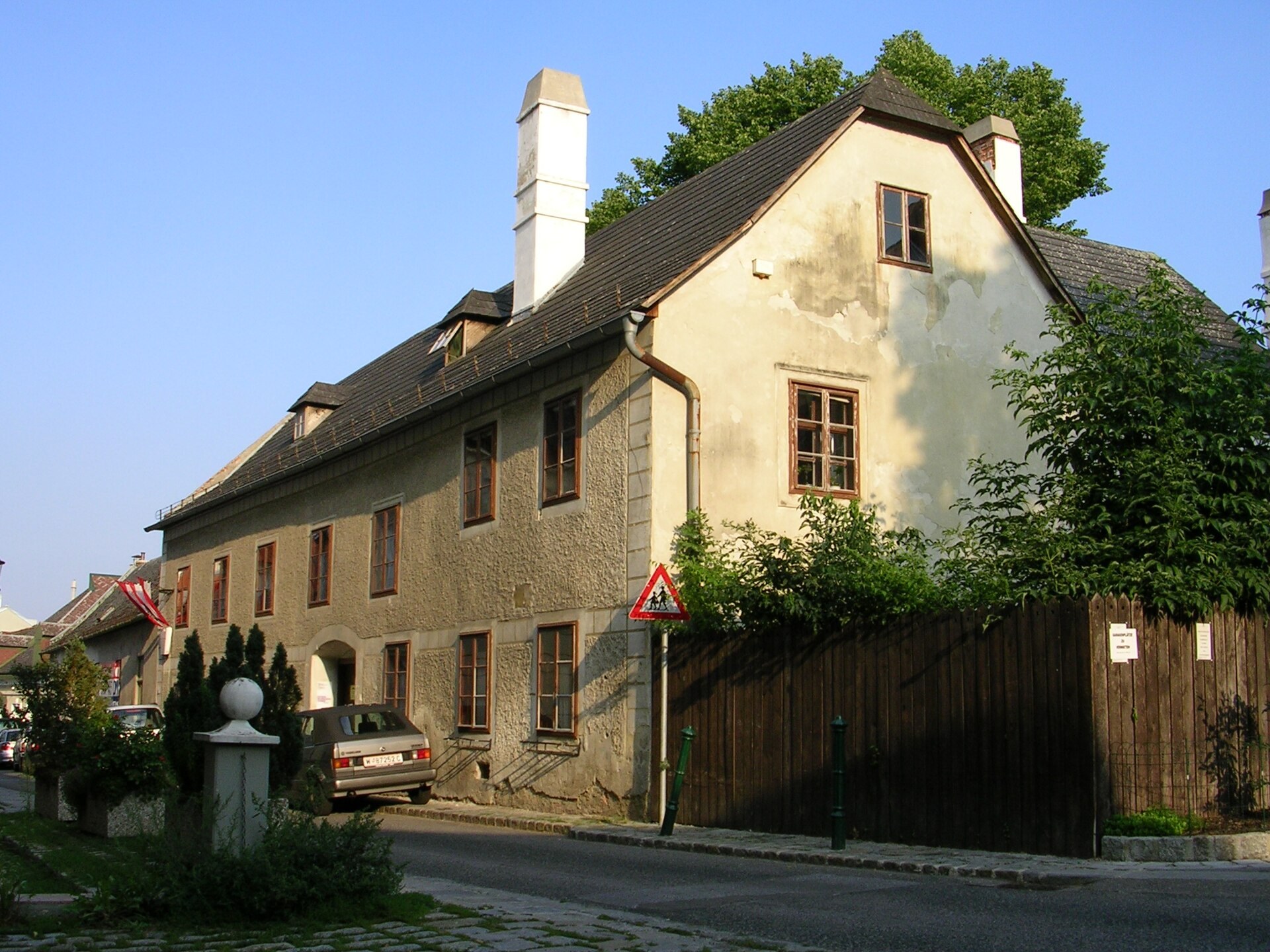
On his doctor’s advice Beethoven spent the spring and summer of 1802 in Heiligenstadt, then a village outside Vienna (the house at Probusgasse 6, shown on this page, is now a memorial). The rest cure failed. On 6 October 1802 he wrote the unsent letter to his brothers Carl and Johann known as the Heiligenstadt Testament — discovered after his death and published in October 1827. The original is in the Hamburg State and University Library. The English translation below is the public-domain Wikisource translation:
For my brothers Carl and [Johann] Beethoven.
O you men who think or say that I am malevolent, stubborn or misanthropic, how greatly do you wrong me, you do not know the secret causes of my seeming, from childhood my heart and mind were disposed to the gentle feelings of good will, I was even ever eager to accomplish great deeds, but reflect now that for six years I have been a hopeless case, aggravated by senseless physicians, cheated year after year in the hope of improvement, finally compelled to face the prospect of a lasting malady (whose cure will take years or, perhaps, be impossible), born with an ardent and lively temperament, even susceptible to the diversions of society, I was compelled early to isolate myself, to live in loneliness, when I at times tried to forget all this, O how harshly was I repulsed by the doubly sad experience of my bad hearing, and yet it was impossible for me to say to men speak louder, shout, for I am deaf. Ah how could I possibly admit such an infirmity in the one sense which should have been more perfect in me than in others, a sense which I once possessed in highest perfection, a perfection such as few surely in my profession enjoy or have enjoyed — O I cannot do it, therefore forgive me when you see me draw back when I would gladly mingle with you, my misfortune is doubly painful because it must lead to my being misunderstood…
He describes the humiliations in the countryside — hearing a shepherd’s song that others heard and he did not — and comes to the edge:
…such incidents brought me to the verge of despair, but little more and I would have put an end to my life — only Art it was that withheld me, ah it seemed impossible to leave the world until I had produced all that I felt called upon me to produce, and so I endured this wretched existence…
And closes by commending virtue to his brothers’ children — “it alone can give happiness, not money, I speak from experience, it was virtue that upheld me in misery” — and hastening, he writes, “with joy towards death.”
Four days later, on 10 October, he added a postscript:
Heiligenstadt, October 10, 1802 — thus do I take my farewell of thee — and indeed sadly — yes that beloved hope — which I brought with me when I came here to be cured at least in a degree — I must wholly abandon, as the leaves of autumn fall and are withered so hope has been blighted, almost as I came — I go away — even the high courage — which often inspired me in the beautiful days of summer — has disappeared — O Providence — grant me at least but one day of pure joy — it is so long since real joy echoed in my heart — O when — O when, O Divine One — shall I find it again in the temple of nature and of men — Never? no — O that would be too hard.
The long decline
The Testament changed nothing medically. Through the 1800s and 1810s his hearing worsened; he used ear trumpets, stood close to pianos, and eventually withdrew from conducting and performing. From 1818 he carried conversation books — notebooks in which visitors wrote their half of the dialogue. (Schindler later destroyed many of them, an archival crime scholars still lament.) By the Ninth Symphony’s premiere in 1824 he was functionally deaf.
How he kept composing
Beethoven’s musical memory and inner ear were extraordinary; sketchbooks show him working out entire structures on paper, testing sonorities he could no longer hear. Friends reported him at the piano, playing with terrible force. The late works — composed in near-total silence — are among the strangest and greatest music ever written. Deafness did not “purify” his music into abstraction; it isolated him, and the isolation is audible: the late quartets speak as if to no audience but the composer himself.
Source notes
- Onset c. 1798 and the 1801 Wegeler confession: Beethoven’s letters (Brandenburg edition).
- Heiligenstadt Testament: written 6 October 1802 (postscript 10 October), to brothers Carl and Johann; discovered after Beethoven’s death by Anton Schindler and Stephan von Breuning; published October 1827. Original: State and University Library Hamburg (gift of Jenny Lind and Otto Goldschmidt, 1888). English text quoted verbatim from the public-domain translation on Wikisource (translator unknown).
- Heiligenstadt house: Probusgasse 6, Vienna-Heiligenstadt; photograph via Wikimedia Commons (CC BY-SA 3.0) — see the image credits on this page.
- Conversation books from 1818; Schindler’s destruction of many books: documented in modern scholarship.
- Cause of deafness: no contemporary diagnosis; modern theories (otosclerosis, Paget’s, lead exposure, hepatitis B/liver disease) are posthumous hypotheses, labeled as such.