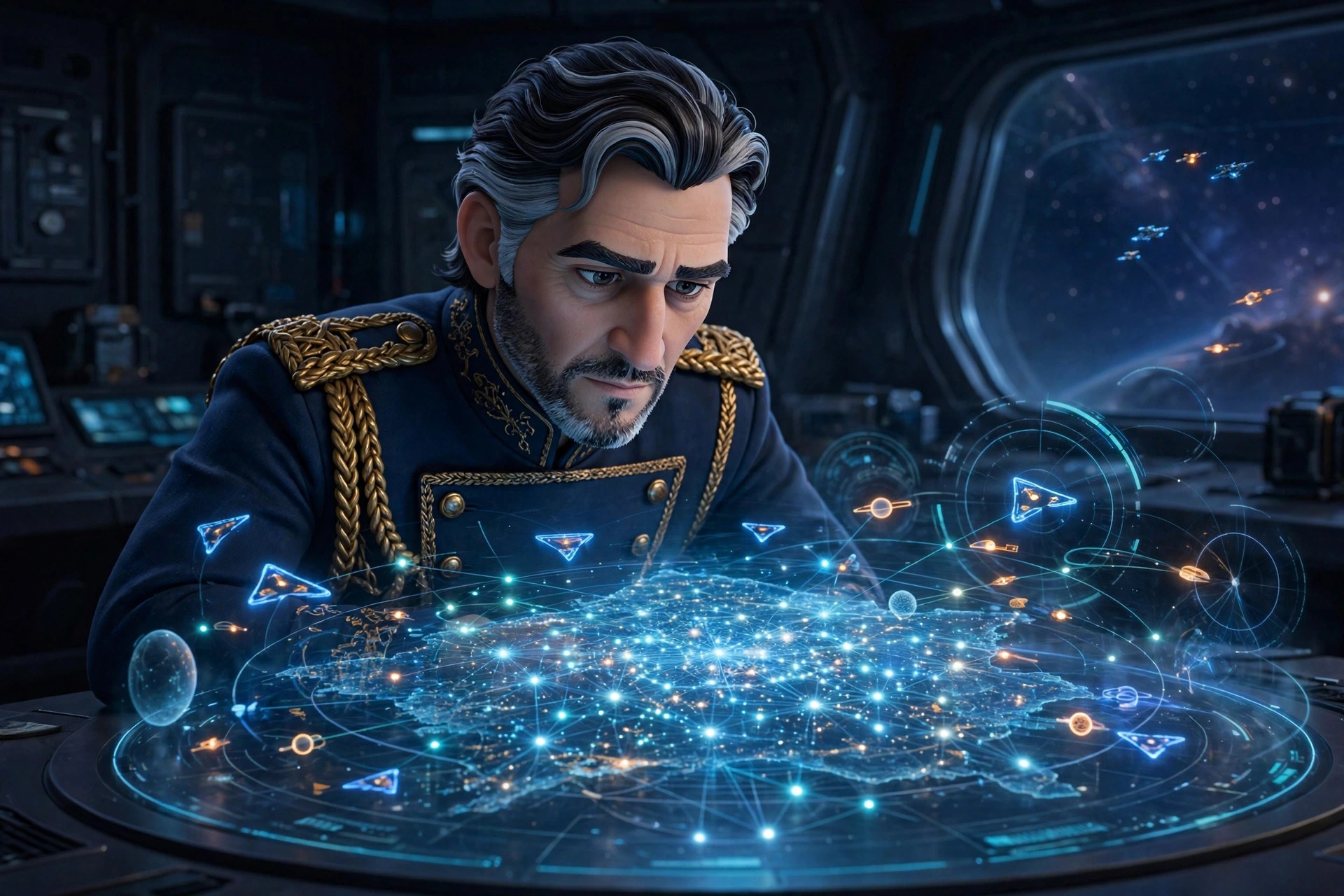
Abilities, Explained
A tactician's breakdown of what the Star Commander can do — and why each ability serves the story. All fictional.
Fiction note: technical breakdown of invented abilities. See Abilities for the overview.
Command presence, explained
In the lore, Venn’s presence is a trained skill with three components: legibility (the crew knows his doctrine, so his orders are predictable), absorption (he voices the risks himself, so the crew doesn’t carry them), and stillness (he never hurries on the bridge — hurry is contagious, and so is calm). The deep-dive reading: command presence is what happens when a leader’s thinking is public property.
Crisis decision-making, explained
Venn’s speed follows a pattern the lore calls decide–commit–branch: decide on partial information, commit fully to the chosen course, and keep a live branch — a pre-planned alternative — ready at every step. The Sable rescue ran three branches in sequence. The technique’s honesty: it doesn’t pretend the first decision was right; it assumes it might be wrong and survives anyway.
The Venn school of tactics, explained
Three named maneuvers, each a lesson:
- The Venn Drift: momentum over machinery. Sacrifice the broken system; ride what still moves. The lesson: use what you have, not what you wish you had.
- The Meridian Screen: interpose the flagship’s hull between danger and smaller ships. The lesson: the commander’s ship is the shield, not the sword.
- The Karthos Refusal: end a war by refusing to fight it — park between the fleets and hold. The lesson: sometimes the decisive point is the space between the armies.
Dueling, explained
Master of the energy blade, undefeated, and — in the lore’s pointed telling — never a killer with it. Every recorded duel ends in disarm or surrender. The deep-dive reading: the blade is Venn’s restraint made visible. A commander who can win without killing has mastered the harder art, and the lore never lets the reader forget which art is harder.
Piloting and engineering intuition, explained
Venn flies well enough for emergencies and wisely yields to Kael otherwise — the deep-dive lesson being that a commander’s competence is knowing the limits of his competence. His “engineering intuition” is really a question-asking skill: he knows what every system is for, so he can ask Bolt the one question that unblocks the repair. Command as applied curiosity.
Diplomacy, explained
First Light’s method, in the lore: arrive unarmed, state your motives honestly, and let the other side’s suspicion starve for lack of material. Selnari’s gloss — “He tells the other side what he wants. It disarms them completely” (fictional dialogue) — is the deep dive’s thesis: Venn’s diplomacy is his command doctrine with the weapons removed, and it works for the same reason.
The limits, explained
Poor politician, middling pilot, terrible liar — the lore’s limits are load-bearing. They keep the commander human, keep the team necessary (he needs Kael’s flying, Selnari’s patience, Bolt’s hands), and keep the design honest: no one person does everything, not even the head star commander.
Source notes
- All abilities and tactical doctrines are original fan invention for the fictional Elias Venn (“head star commander,” Vizlings app card).
- Fictional dialogue labeled as such; see Sayings and Methodology.
- Images: AI-generated dramatization art; see Sources and
the image credits on this page.