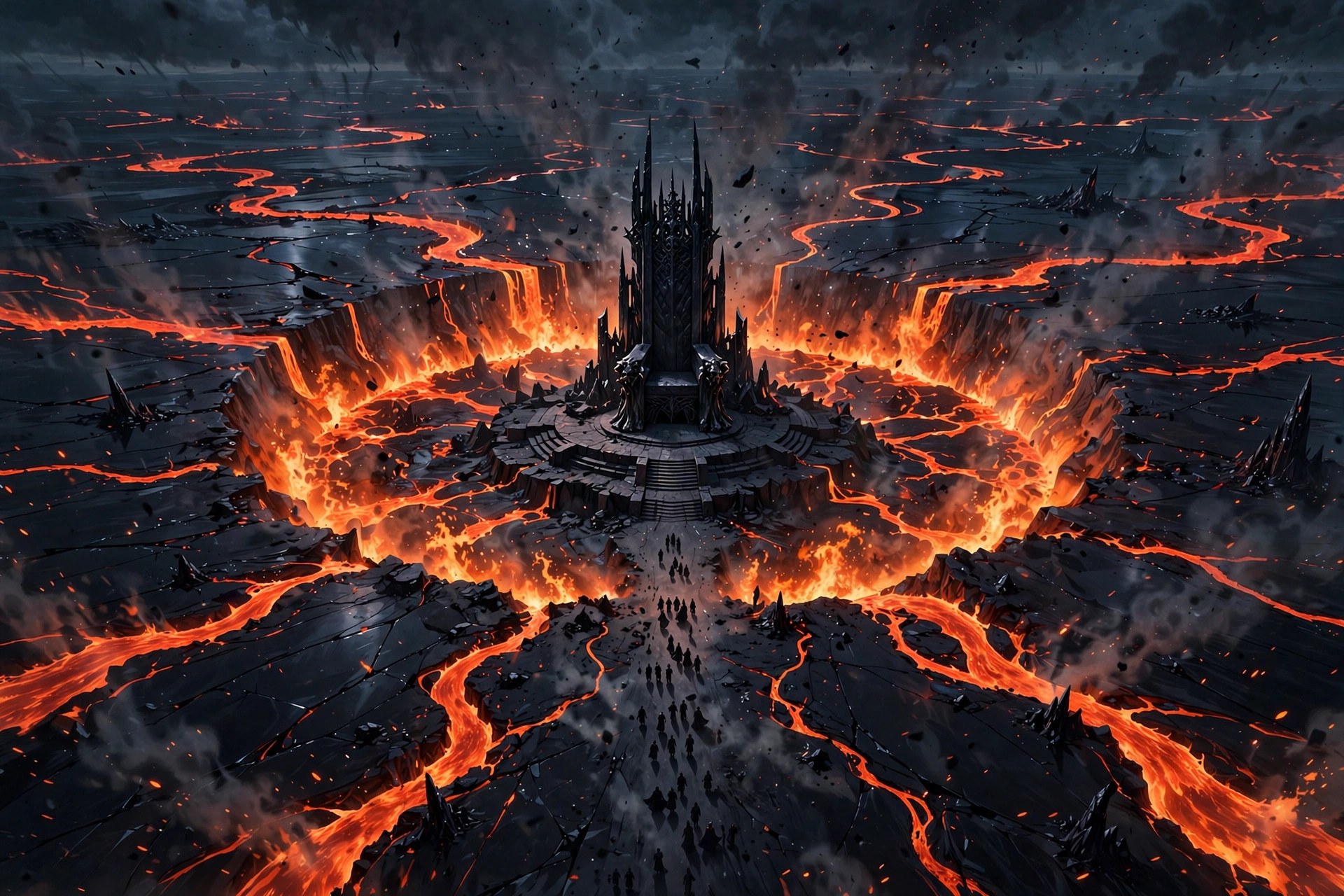
The Pit & the Throne
Not a torture chamber but a jurisdiction. The character's world is a kingdom built from cinders, run on protocol, and open to all arrivals.
The Pit
The Pit is the realm at the bottom of everything — a vast cavern-world of black glass plains, slow lava rivers, and cities of dark iron. It is not, in the character’s telling, a punishment imposed from above; it is a kingdom built from below, raised by the exiles after the Fall. Everything cast down, cast out, or cast aside eventually arrives here. The gates are always open. That is rather the point.
Pandemonium
At the Pit’s heart stands Pandemonium, the high capital — named for Milton’s infernal palace (Paradise Lost, 1667), which the character cheerfully claims as a property listing. Its districts include:
- The Throne Dais — the obsidian throne on its raised platform, where the character holds court.
- The Galleries — endless torchlit halls where the court’s artists, poets, and architects work; the character is a genuine patron of the arts.
- The Ledger Halls — where every bargain ever signed is recorded, in triplicate, in books bound in black. The character’s bureaucracy is immaculate.
- The Ember Gardens — gardens of living flame and glass flowers, where the court takes the air.
- The Frozen Deeps — the Pit’s coldest level, a lake of black ice. The character keeps it as a reminder, and as a prison for traitors. (An homage to Dante’s lowest circle.)
The throne
The throne is cut from a single block of obsidian, and it is deliberately uncomfortable for anyone but its owner. The character receives visitors here with full ceremony: the approach across the dais is long, the lighting is flattering to exactly one person, and the seat beside the throne — offered so rarely it has become legend — is the highest honor the Pit confers.
The law of the Pit
The character wrote it himself, and its articles are short:
- Every arrival is by signature. No one is here who did not, in some sense, sign.
- A bargain kept is a bargain honored. The Pit’s word is better than most heavens’.
- Protocol is observed. Even damnation has a dress code.
- The door stays open. Anyone may petition; anyone may appeal; the terms are always stated plainly.
Visitors
The Pit receives a constant traffic of the curious, the desperate, and the merely bored. The character’s standing policy: every visitor gets an audience, a fair hearing, and a clearly stated offer. Whether they accept is, as the character puts it, “entirely their signature.”
Source notes
- The Pit, Pandemonium, and the law above are invented setting for the Vizlings “Satan” character (2026-09-27).
- “Pandemonium” as the infernal capital comes from Milton’s Paradise Lost, Book I (1667); the Frozen Deeps echo Dante’s Inferno, canto 34 (c. 1320). Both surveyed on their own pages.
- The court’s dramatis personae: see The Cast.