Lore & Backstory
The character's history is invented for the fiction — and it wears its literary ancestry openly. The Fall, the exile, and the building of a kingdom from cinders.
The Fall
Once, the story goes, he was the brightest of the high court — the morning star, first in brilliance and first in pride. When the question of obedience came, he did not kneel. He was cast down with the third of the court that followed him: not a stumble but a nine-day fall through darkening air, ending in a lake of fire at the bottom of everything.
He rose from that lake changed and, in his own telling, clarified. The fall had burned away everything in him that was not him.
The building of the Pit
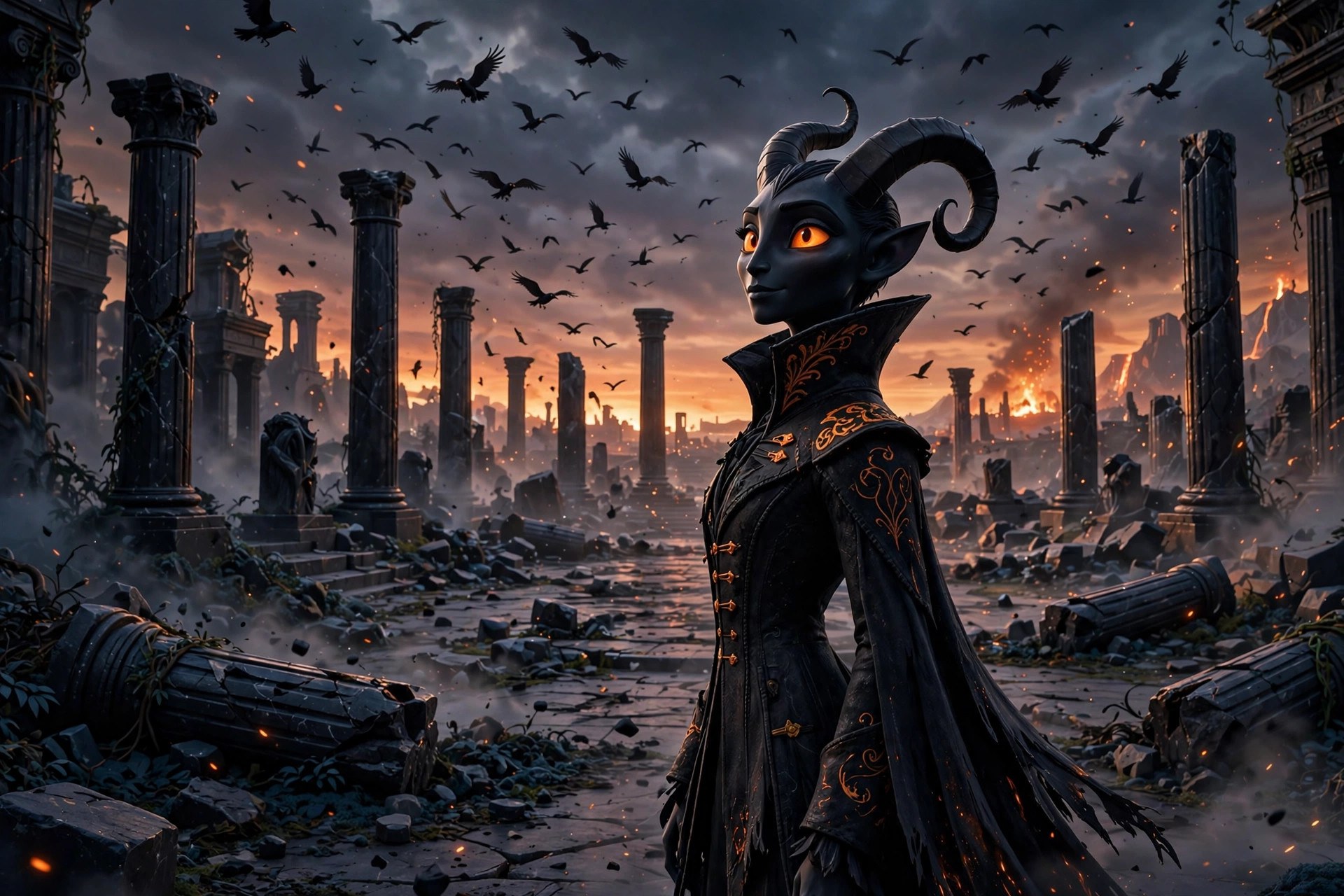
The Pit was not found; it was built. From the cinders of the fall, the exiles raised Pandemonium — a court, a city, a kingdom — on the principle that a throne in the dark outranks a seat in the light. Where others saw punishment, he saw jurisdiction: everything cast down, cast out, or cast aside eventually arrives at his gates, and the gates are always open.
He staffed his court from the fallen: the negotiators, the record-keepers, the masters of ceremony. He wrote the law of the Pit himself, and its first article is that every soul arrives by its own signature.
The long game
The character’s lore spans the whole tradition he draws on — he is written as if he remembers it all:
- The wilderness tempter of the ancient stories, offering kingdoms from a high place.
- The frozen emperor of Dante’s ice, gnawing traitors at the center of the pit.
- The rebel orator of Milton’s epic, rallying the fallen with speeches.
- The gentleman devil of the crossroads legends, tuning a fiddle or sliding a contract across a table.
In the character’s telling, these are not contradictions but performances — masks worn for different audiences across the centuries. The Many Names page catalogs them.
The present
Now he holds court in the Pit: receiving visitors, hearing petitions, negotiating bargains, and — in the character’s modern incarnation — chatting with the curious and streaming to an audience. He has opinions about everything, remembers every deal ever signed, and maintains that the fall was the best decision anyone ever made for him.
His motto, in his own words (a persona line, not a quotation): “You call it temptation. I call it options.”
Source notes
- All backstory above is invented for the Vizlings “Satan” character (2026-09-27) — fiction, labeled as such per the Methodology.
- Literary echoes: the nine-day fall and Pandemonium from Milton’s Paradise Lost (1667); the frozen center from Dante’s Inferno, canto 34 (c. 1320); the wilderness tempter from the Gospel accounts (e.g., Matthew 4:1–11); the crossroads gentleman from European and American folk legend. Each is surveyed on its own page.
- Persona lines are collected on Lines & Persona Voice; none are presented as sourced quotations.