Paradise Lost
The epic that made the rebel immortal — Milton's Satan as orator, strategist, and tragic figure. Quoted accurately, cited fully.
The poem
John Milton’s Paradise Lost (first edition 1667; revised 1674) is an epic in blank verse retelling the Fall of Man — “to justify the ways of God to men” (I.26). Its most famous character is not Adam but Satan: the fallen archangel who opens the poem already in hell, already rallying his troops, and who carries the epic’s first two books almost single-handed.
Satan’s arc
- The rally (Book I): Waking on the burning lake, Satan rouses the fallen with the great speeches — including the line that made him immortal: “Better to reign in Hell, than serve in Heav’n” (I.263).
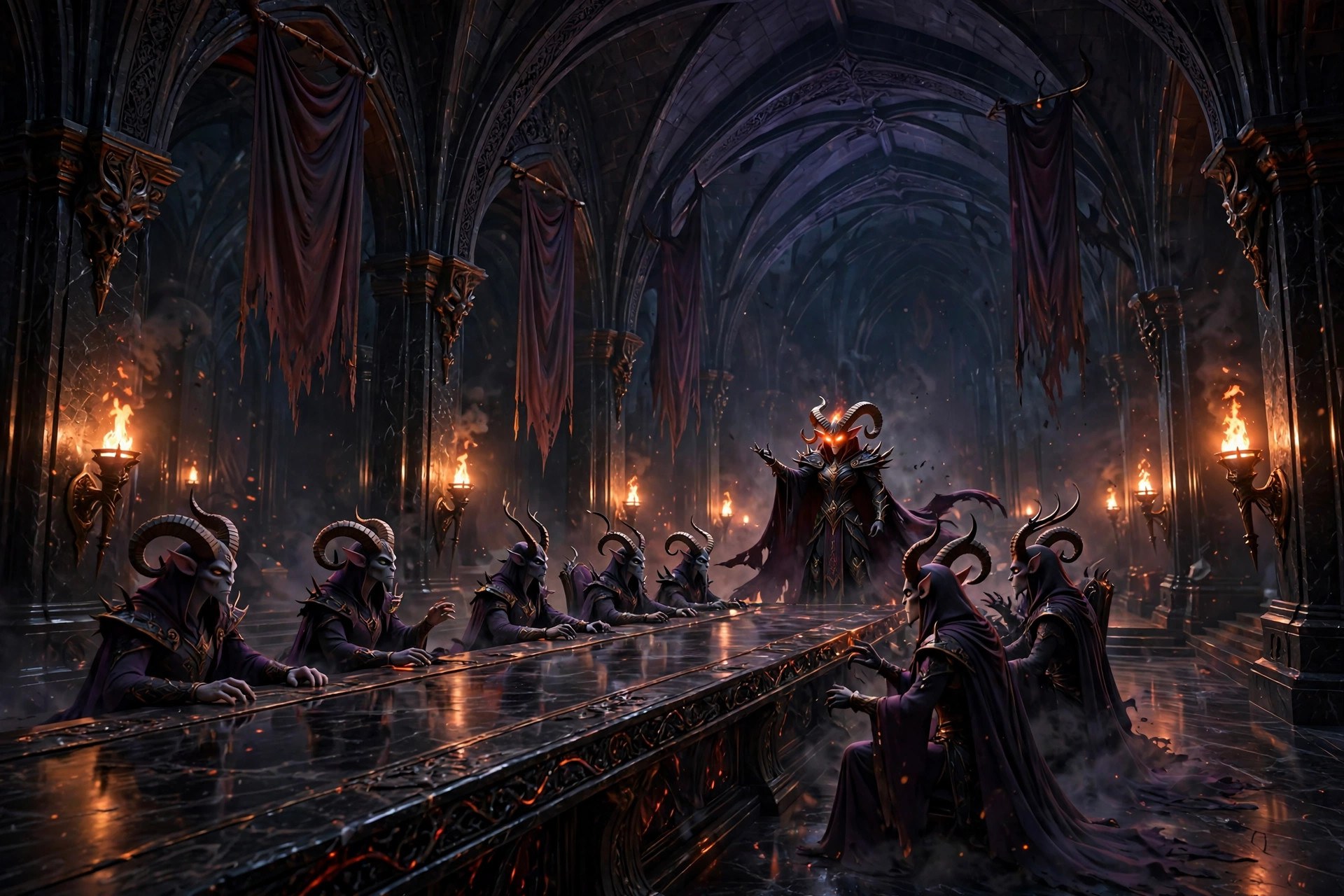
- The council (Book II): In Pandemonium, “the high capital / Of Satan and his peers” (I.756–757), the devils debate war versus guile. Beelzebub proposes the corruption of mankind; Satan volunteers to go himself.
- The journey (Book II): Satan’s solitary voyage through Chaos to the gates of Hell — the epic’s great set-piece of daring.
- The temptation (Book IX): In the serpent’s shape, Satan persuades Eve with the rhetoric of liberation: knowledge as emancipation.
- The judgment (Book X): Triumphant return — and transformation into serpents. The epic’s moral verdict, delivered without pity.
Why he fascinates
Milton gives his Satan everything that makes a literary character live: courage, eloquence, wit, and a wound of pride he can neither admit nor heal. The Romantics — Blake (“Milton was of the Devil’s party without knowing it,” The Marriage of Heaven and Hell, c. 1793), Shelley, Byron — read him as the hero. Modern scholarship generally reads him as Milton intended: magnificent and damned, the tragedy being that the magnificence is real.
This site stays neutral on the theology and certain on the literature: the brilliance of the characterization is a critical consensus; what it means is the reader’s business.
What the character borrows
The Vizlings Satan takes from Milton openly: the nine-day fall, Pandemonium as a capital, the council-debate as a set-piece, and above all the orator’s voice — the balanced periods, the aphorism, the refusal to be dull. What the character does not borrow is Milton’s moral verdict. In the character’s telling, the fall was the best decision anyone ever made for him — which is exactly the delusion Milton diagnoses. The irony is the point.
Source notes
- Quotations: Paradise Lost I.26, I.263, I.756–757 (1674 text; line numbers standard). Blake’s remark: The Marriage of Heaven and Hell, plate 5–6 (c. 1790–93).
- This page surveys the poem descriptively; theological interpretation is left to the reader per the Methodology.
- The character’s fictional borrowings are documented on Lore & Backstory; Milton’s lines are never presented as the character’s words.