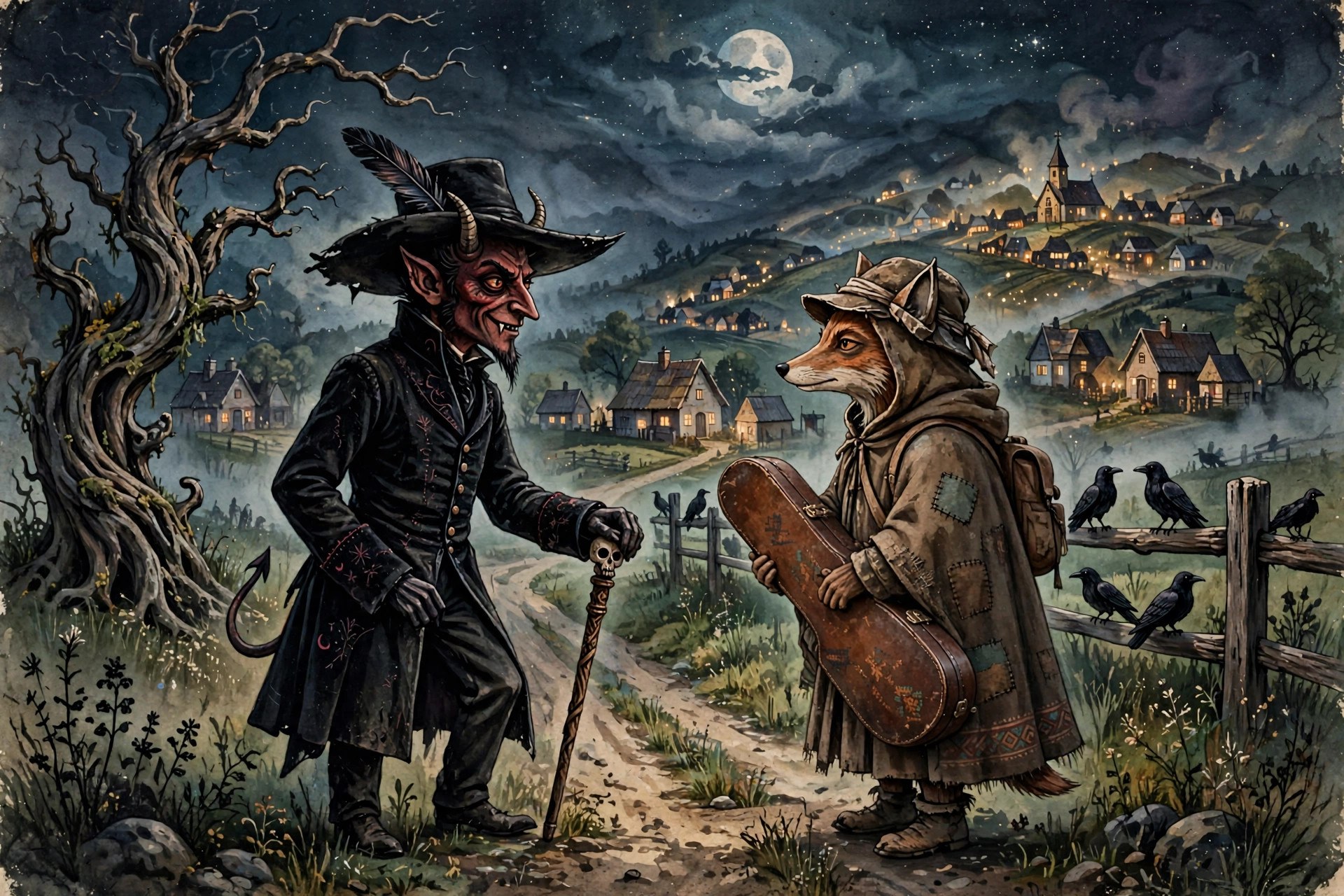
The Folk Devil
Before the theologians finished, the villages had their own devil: a gentleman at the crossroads, a fiddler, a trickster — and sometimes the fool of the story.
The crossroads
Across Europe and the Americas, the devil is met at midnight where two roads cross — a liminal place, neither here nor there. The bargain is the constant: skill for a musician, luck for a gambler, wealth for the desperate, signed or sealed in some binding way. The American version is the most famous: the legend that bluesman Robert Johnson (1911–1938, a real person, depicted nowhere on this site) tuned his guitar at the crossroads. The story is folklore about a musician, not a biography of one — and the site treats it as such.
The fiddler
The devil plays the fiddle — or teaches it. The legend attaches to virtuosos whose skill seemed superhuman: Niccolò Paganini (1782–1840) was rumored in his lifetime to have made a pact, and Giuseppe Tartini claimed his “Devil’s Trill” Sonata came from a dream in which the devil played it for him. Both are legends about real musicians; the music is real, the pact is story.
The trickster outwitted
In tale after tale, the folk devil is outsmarted: by Saint Dunstan, who seized the devil’s nose with red-hot tongs (a 10th-century archbishop turned legend); by peasants who read the contract better than he did; by the soldier, the smith, the miller. The folk devil is powerful but not subtle — the opposite of this site’s character, who claims to have learned subtlety from watching these stories.
The builder and the bridge
“Devil’s bridges” across Europe carry the same tale: the devil builds the impossible bridge overnight, demanding the first soul to cross — and the villagers send a goat. The devil, furious, is bound by the letter of the deal. The motif the character borrows: a bargain kept is a bargain honored — even when it backfires.
The gentleman
By the early modern period, the folk devil dresses well: the stranger in black at the tavern, the elegant card-player, the courteous tempter of the ballad. This is the direct ancestor of the Vizlings character’s wardrobe — the high collar, the good manners, the terms stated plainly. Goethe’s Mephisto and the crossroads gentleman are the same figure in evening dress.
What the character keeps
The Vizlings Satan is, among other things, a curator of this folklore: the crossroads appointment, the fiddle, the contract, the courtesy. The Signature Scenes page stages the crossroads and the signing as the character’s home ground — and the character’s standing joke is that the folk tales where the devil loses are “early drafts, since revised.”
Source notes
- Folklore surveyed descriptively; standard references include the motif-index tradition (Aarne–Thompson–Uther) and regional legend collections. Specific legends: the Robert Johnson crossroads story (American folk legend about a real musician, 1911–1938); Paganini pact rumors (19th c.); Tartini’s “Devil’s Trill” dream account (18th c.); Saint Dunstan and the tongs (medieval English legend); Devil’s Bridge tales (pan-European).
- Real persons named here are not depicted anywhere on this site; all images are AI-generated dramatization art of the fictional character.
- The character’s fictional use of these motifs: Lore & Backstory, Signature Scenes, Bargains & Temptations.