Dante's Satan
The opposite of majestic — Dante's Satan is frozen, weeping, and chewing traitors at the center of the ice. The tradition's bleakest portrait, described plainly.
The image
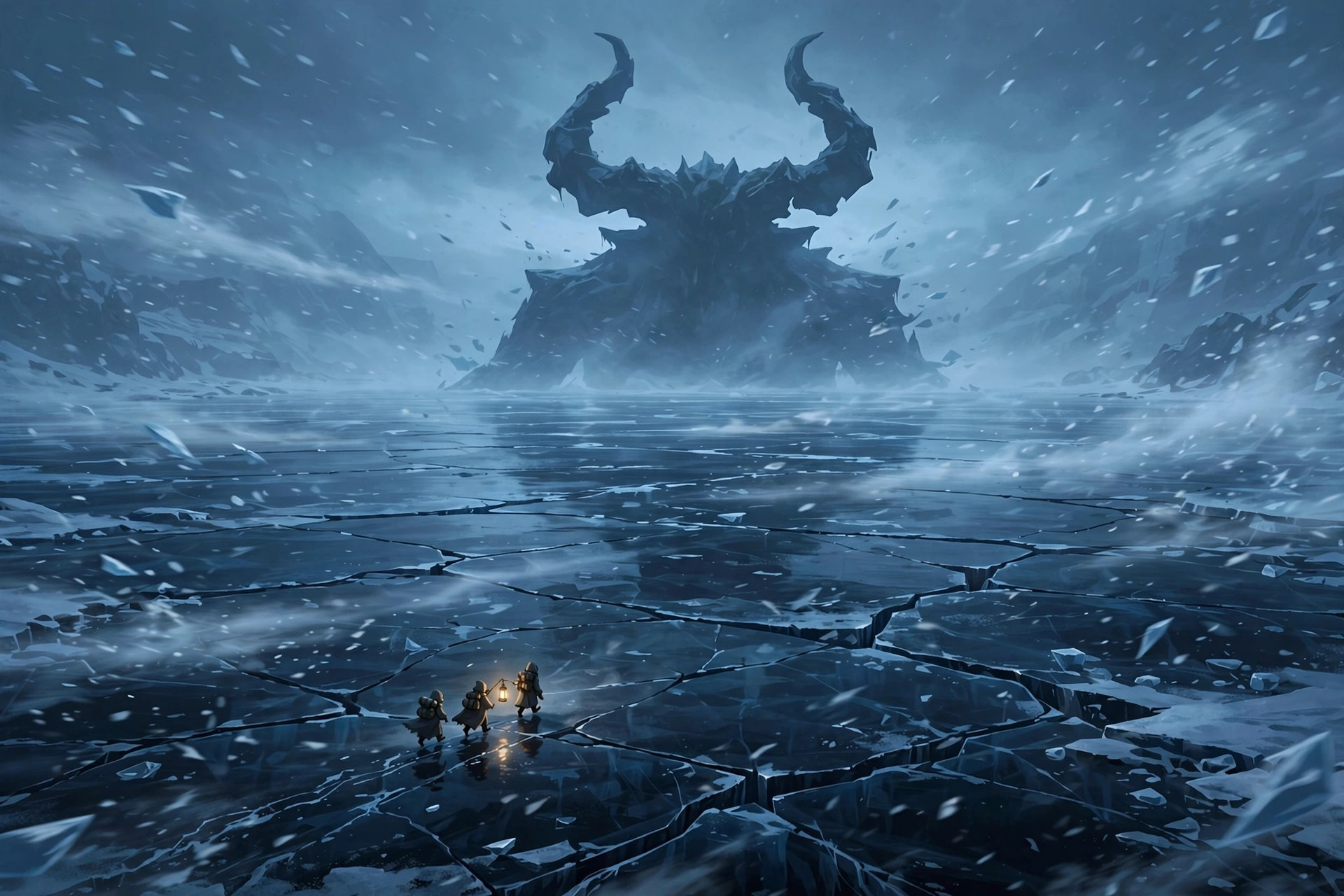
At the bottom of the Inferno (canto 34; the Commedia composed c. 1308–1320), Dante and Virgil reach the lowest circle: a lake of ice, Cocytus, where traitors are frozen. At its center, waist-deep in the ice, stands Satan — Dante calls him the emperor “of the kingdom of sorrow” (Inferno XXXIV.28, in standard translations).
He is enormous, grotesque, and utterly powerless: three faces (a parody of the Trinity), six wings beating without flight — their wind is what freezes the lake — and three mouths, each chewing one of history’s great traitors (Judas, Brutus, Cassius). He weeps; the tears freeze on his faces. This is not a ruler but a prisoner: the furthest point from God, where even motion has stopped.
What it means (in Dante’s scheme)
Dante’s hell is structured by reason: sins of appetite above, sins of the will below, treachery at the bottom. Satan, the ultimate traitor, occupies the geometric center of the universe — and the moral center of nothing. The ice is the point: cut off from divine love (traditionally figured as warmth and light), evil collapses into cold, isolation, and self-consumption. It is the most anti-glamorous Satan in the tradition — deliberately so.
Against Milton
Set beside Paradise Lost, Dante’s Satan is the counter-portrait: Milton’s rebel speaks; Dante’s gnaws. Milton’s travels the cosmos; Dante’s cannot move. The Vizlings character is built from Milton’s line — the orator, the host — but it keeps Dante’s version in the building: the Frozen Deeps of the Pit (The Pit & the Throne) are the character’s homage to canto 34, maintained as a prison for traitors. The character’s joke about it: “I keep him there to remind the staff what failure looks like.”
Source notes
- Inferno XXXIV (canto 34); the Commedia dated c. 1308–1320 per standard scholarship. “Emperor of the kingdom of sorrow” renders l’imperador del doloroso regno (XXXIV.28).
- The three traitors: Judas Iscariot, Marcus Junius Brutus, Gaius Cassius Longinus (XXXIV.61–67).
- This page is descriptive literary survey per the Methodology; the character’s fictional homage is on Signature Scenes (The Frozen Center).