The Art of Wrapping
Seventy days, natron salt, resins, and hundreds of yards of linen — the real chemistry and ritual of mummification. Real history, cited.
This page is real history. Sandy Wraps’ fictional wrapping (c. 1150 BC) riffs on these facts.
The classic account
Our most detailed ancient description comes from Herodotus, Histories 2.86–88 (5th century BC) — a Greek tourist’s report, secondhand and written two millennia after mummification began, but broadly consistent with the physical evidence. He describes three price tiers of embalming, from the full treatment to the budget option.
The process (New Kingdom elite version)
- Removal. The brain was extracted (often through the nose via the ethmoid bone) and discarded; the viscera were removed through an abdominal incision. The heart was left in place — seat of intellect and memory, needed for judgment.
- Desiccation. The body was packed in natron — a natural salt mixture — for about 40 days (Herodotus says 70 days for the whole process; modern Egyptology generally describes ~70 days total, with desiccation the longest phase).
- Anointing. Oils, resins, and perfumes (including myrrh — Sandy’s signature scent) were applied.
- Wrapping. Hundreds of yards of linen, layered with amulets placed at prescribed positions — including heart scarabs inscribed with protective spells (Book of the Dead spell 30B: “do not stand against me at the weighing”).
- Coffining. Nested coffins, then the stone sarcophagus, then the tomb.
Canopic equipment
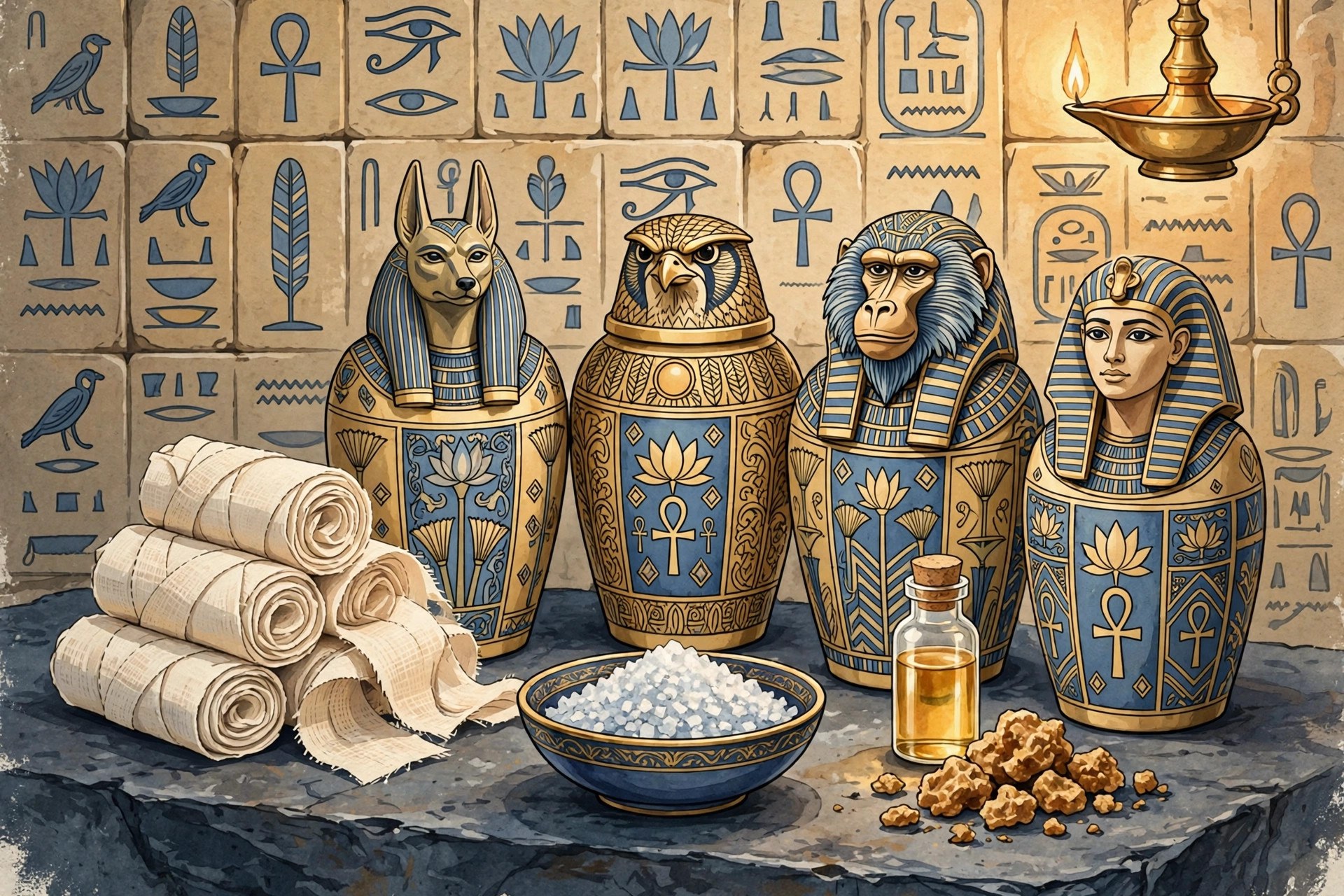
The viscera went into canopic jars under the Four Sons of Horus — Imsety (liver), Hapy (lungs), Duamutef (stomach), Qebehsenuef (intestines). (The Canopic Café in Sandy’s fictional Necropolis is named for these.)
Who got wrapped
Not just pharaohs: elites broadly, and by the Late Period, huge numbers of ordinary people — plus millions of votive animal mummies (cats, ibises, crocodiles). Quality varied wildly with wealth. Sandy’s fictional “remarkably well preserved” condition implies elite treatment.
What it wasn’t
Not magic, not instant, not curse-adjacent. It was expensive, skilled, smelly craft work by ritual specialists — and it worked: bodies survive 3,000+ years when the chemistry is right and the tomb stays dry.
Source notes
- Herodotus, Histories 2.86–88; Ikram & Dodson, The Mummy in Ancient Egypt (Thames & Hudson, 1998) — the standard modern study; Taylor (2001) on ritual context. Heart scarab spell 30B and canopic attributions per the Book of the Dead tradition. Full bibliography on sources.