Glossary
Twenty terms — real Egyptology and Sandy-speak side by side, each labeled so you always know which is which.
Ankh
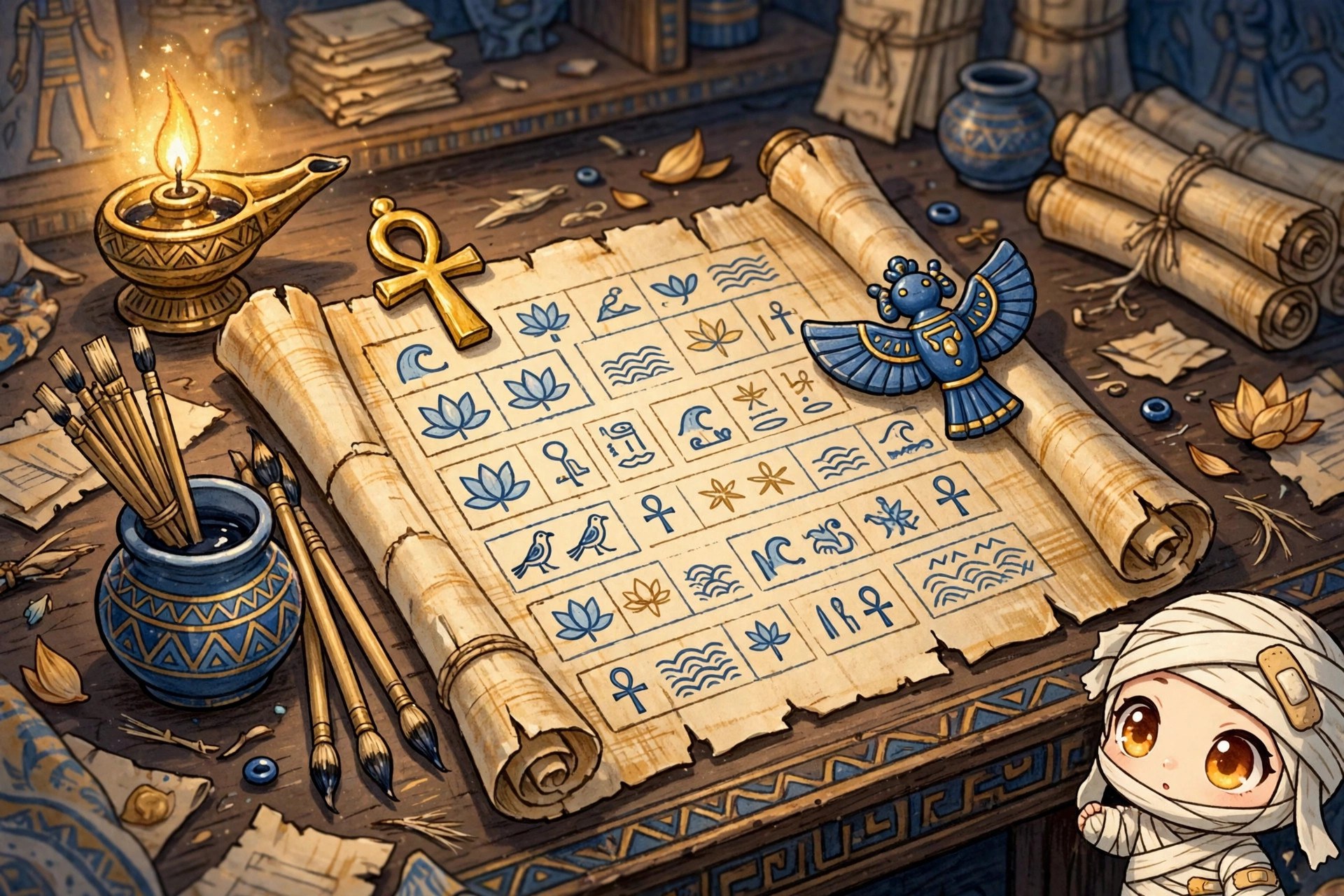
Real history. The hieroglyph for “life,” shaped like a cross with a loop. Gods are shown holding it to the nose of the deceased to grant life. (Source: standard Egyptology; see sources.)
Ba
Real history. One of the Egyptian concepts of the soul — the mobile, bird-like aspect that could travel between tomb and afterlife. (Source: Taylor, Death and the Afterlife in Ancient Egypt.)
Canopic jars
Real history. Four jars holding the mummy’s viscera, each under the protection of one of the Four Sons of Horus: Imsety, Hapy, Duamutef, Qebehsenuef. (Source: Ikram & Dodson, The Mummy in Ancient Egypt.)
Cartouche
Real history. An oval ring enclosing a royal name in hieroglyphs — the sign that the name inside belongs to a pharaoh.
The Curse (capital C)
Fiction. What the movies invented and Sandy debunks weekly: the idea that tombs carry lethal curses. Real tombs carried warnings and legal threats, not magic. See curse.
Duat
Real history. The Egyptian underworld — the realm the dead traveled through, described in funerary texts like the Amduat (“that which is in the afterlife”).
Field of Reeds (Aaru)
Real history. The Egyptian paradise: an idealized, fertile version of Egypt where the justified dead lived forever. (Source: Book of the Dead.)
Hieroglyphs
Real history. Egypt’s formal writing system — ~700 signs in the classic repertoire. Deciphered via the Rosetta Stone (found 1799; Champollion’s breakthrough 1822).
Ka
Real history. The life-force or “double” that needed the preserved body (and statues) as a home — a key reason mummification mattered.
Maat
Real history. Goddess and principle of truth, balance, and cosmic order. Her feather was weighed against the deceased’s heart.
Natron
Real history. A naturally occurring salt mixture used to desiccate bodies during mummification — the chemistry behind the “70 days.”
Necropolis
Real history / fiction blend. Real word: Greek for “city of the dead,” used for Egyptian cemeteries. Character canon: Sandy’s hidden monster district beneath the Valley of the Kings. (Fiction label applies to the district.)
Newfangled
Character canon. Sandy’s word for all modern technology, delivered with deep suspicion right before she masters it.
Pip
Character canon. Sandy’s best friend: a chatty blue scarab beetle who’s lived in her sarcophagus for decades. Fiction.
Sarcophagus
Real history. From Greek sarkophagos, “flesh-eater.” The stone outer coffin; Egyptian ones were often nested sets, richly decorated.
Scarab
Real history. The dung beetle, sacred to Khepri, god of the rising sun and rebirth. Heart scarabs were placed on mummies with protective spells (Book of the Dead spell 30B).
Shabti
Real history. Small funerary figurines placed in tombs to do labor for the deceased in the afterlife. Often inscribed with a spell (Book of the Dead spell 6).
Unwrap (verb, Sandy’s usage)
Character canon. To reveal one’s true self; also what her bandages do involuntarily when she’s nervous. “Time to unwrap” = time to be honest.
Valley of the Kings
Real history. The New Kingdom royal burial ground near Thebes (modern Luxor); 63 known tombs including Tutankhamun’s KV62 (discovered 1922).
Weighing of the Heart
Real history. The judgment scene: the heart weighed against Maat’s feather, witnessed by Osiris, recorded by Thoth, devoured-on-failure by Ammit. (Source: Book of the Dead, spell 125.)
Source notes
- Real-history definitions draw on Ikram & Dodson (1998), Taylor (2001), and standard Egyptological references; full list on sources. Character-canon terms (Necropolis district, newfangled, Pip, Sandy’s “unwrap”) are fiction invented 2026-09-27.