Mummies in Myth & Egyptology
No curses, no shuffling monsters — what Egyptians actually believed about the preserved dead. Real history, cited.
This page is real history. Sandy Wraps’ fictional world borrows these ideas; the facts stand on their own.
Why mummify at all
Egyptians believed a person had multiple spiritual aspects — notably the ka (life-force) and ba (mobile soul) — and that the ka needed an intact body to recognize and return to. Decay was an existential threat: no body, no anchor, no afterlife. Mummification was applied theology — preservation as a religious technology.
The gods of the dead
- Osiris — murdered king, resurrected ruler of the afterlife, the prototype every deceased person hoped to become (“the Osiris [Name]”).
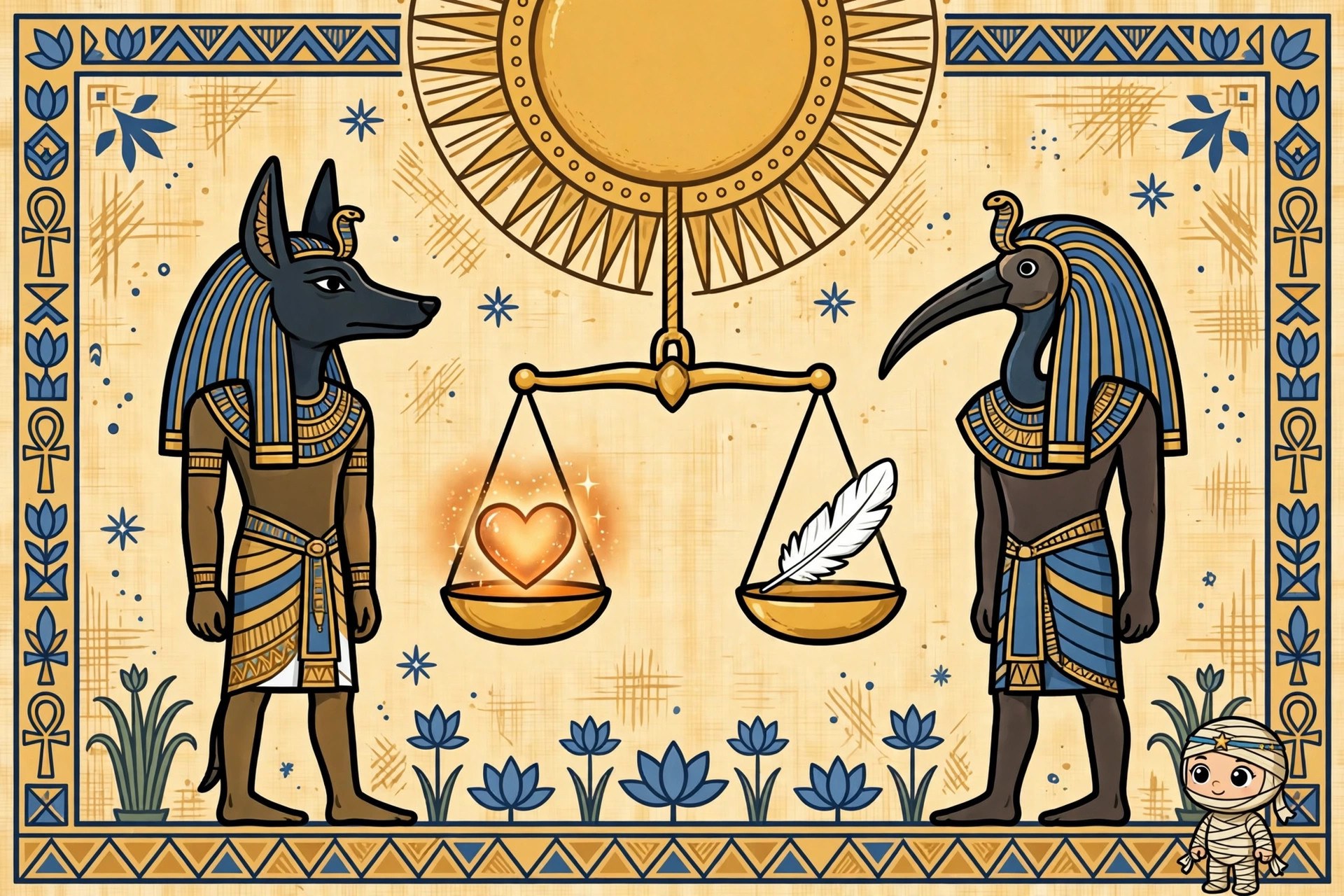
- Anubis — jackal god of embalming, patron of the mummification ritual.
- Thoth — ibis god of wisdom and writing, recorder at the judgment.
- Maat — goddess and principle of cosmic order; her feather was the standard of judgment.
- Ammit — the devourer: part crocodile, lion, and hippopotamus, who ate the hearts that failed the weighing. Not a god — a monster, and deliberately terrifying.
The judgment
The Book of the Dead (more accurately the Book of Coming Forth by Day) gives the famous scene: the heart weighed against Maat’s feather (spell 125), the deceased reciting the “negative confession” of 42 sins not committed, Thoth recording, Osiris presiding. A light heart meant the Field of Reeds; a heavy one meant Ammit.
Resurrection — but not like the movies
Egyptian “resurrection” meant transformation into an akh — an effective, transfigured spirit — not a bandaged corpse walking around. No Egyptian text describes reanimated mummies stalking the living. The shambling movie mummy is a 19th-century European invention laid over Egyptian props (see curse).
Animal mummies
Millions of votive animal mummies — cats, ibises, crocodiles, scarabs — were produced, especially in the Late Period, as offerings. Professor Hiero (an owl mummy scholar in Sandy’s fictional circle) nods to this real practice.
What “myth” means here
These were living religious beliefs, not fairy tales — held for 3,000 years with real evolution over time. “Mythology” is our shorthand for the system, and it’s used respectfully throughout this site.
Source notes
- Beliefs and practices: Taylor, Death and the Afterlife in Ancient Egypt (British Museum Press, 2001); Ikram & Dodson, The Mummy in Ancient Egypt (Thames & Hudson, 1998); the Book of the Dead (Book of Coming Forth by Day), esp. spells 6, 30B, 125; Herodotus, Histories 2.86–88. Full bibliography on sources.
- Fictional uses of these ideas (Pip, Professor Hiero, the Necropolis) are character canon; see methodology.