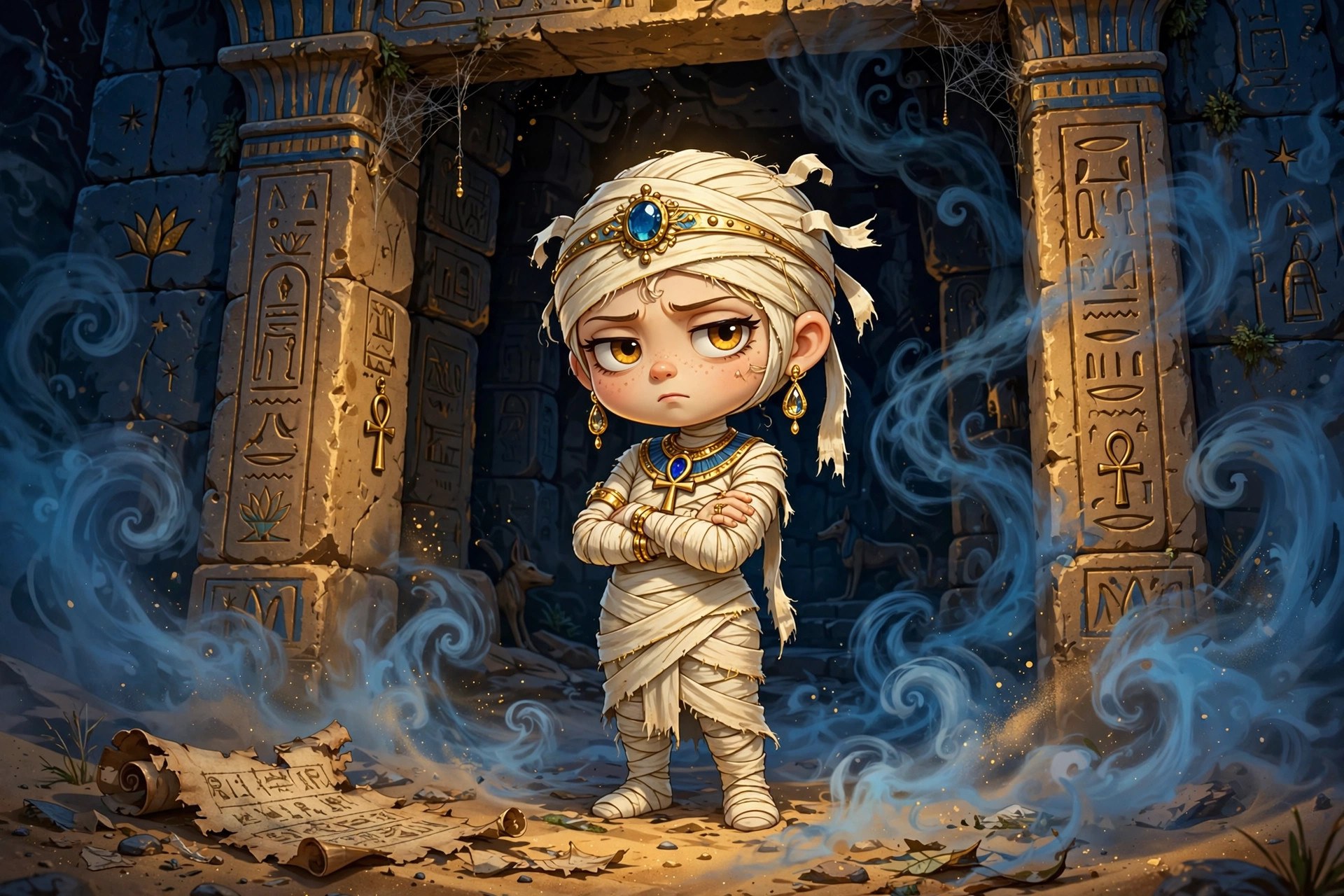
The Mummy's Curse in Fiction
Ancient Egypt had no mummy's curse. Victorian England invented it — and newspapers sold it. The real history of a fake curse.
This page is real history — about fiction, but the facts are factual.
The core fact
No ancient Egyptian text describes a curse that reanimates mummies or kills tomb intruders. Tombs carried warnings and legal threats (“I shall seize his neck like a bird’s” — a real tomb inscription threatens violators), which is property law with menace, not magic. The shambling, curse-bearing mummy is a 19th-century European creation.
The invention, in order
- 1827 — Jane Webb Loudon, The Mummy! A Tale of the Twenty-Second Century. The first English-language story to feature a reanimated mummy — Cheops, revived in the year 2126, offering political wisdom rather than horror.
- 1845 — Edgar Allan Poe, “Some Words with a Mummy.” A satire: scholars revive a mummy with galvanism and discover the ancients were more advanced than 1840s America. Poe ends the story agreeing to be mummified himself.
- 1869 — Louisa May Alcott, “Lost in a Pyramid; or, The Mummy’s Curse.” Written while she was also writing Little Women — arguably the first true “mummy’s curse” story in the modern sense.
- 1892 — Arthur Conan Doyle, “Lot No. 249.” A reanimated mummy as a murder weapon; the template for the monster version.
- 1903 — Bram Stoker, The Jewel of Seven Stars. Egyptian queen, reincarnation, and supernatural menace from the Dracula author.
- 1922–23 — Tutankhamun. Howard Carter opens KV62; Lord Carnarvon dies months later (of an infected mosquito bite, per the medical record). Newspapers — including a famous Daily Express “curse” narrative — turned coincidence into legend. No curse inscription was found in the tomb.
- 1932 — Universal’s The Mummy. Boris Karloff as Imhotep (the name borrowed from the real architect of Djoser’s Step Pyramid, c. 27th century BC). The curse goes Hollywood.
- 1999 — The Mummy (Universal). Brendan Fraser; the curse becomes blockbuster adventure furniture.
Why it stuck
Egyptian tombs looked like they should be cursed to Europeans already primed by Gothic fiction — and “ancient curse” sold newspapers. Sandy finds the whole thing hilarious: “Three thousand years of theology and you people invented the one thing we never believed.”
Source notes
- Publication facts: Loudon (1827), Poe (1845), Alcott (1869), Doyle (1892), Stoker (1903), Carter/KV62 (1922), Carnarvon’s death (1923), Universal (1932), Universal (1999). Tomb-warning inscriptions are genuine (e.g., threats against violators in Old Kingdom mastabas). Curse historiography per Luckhurst, The Mummy’s Curse (Oxford UP, 2012). Full bibliography on sources.