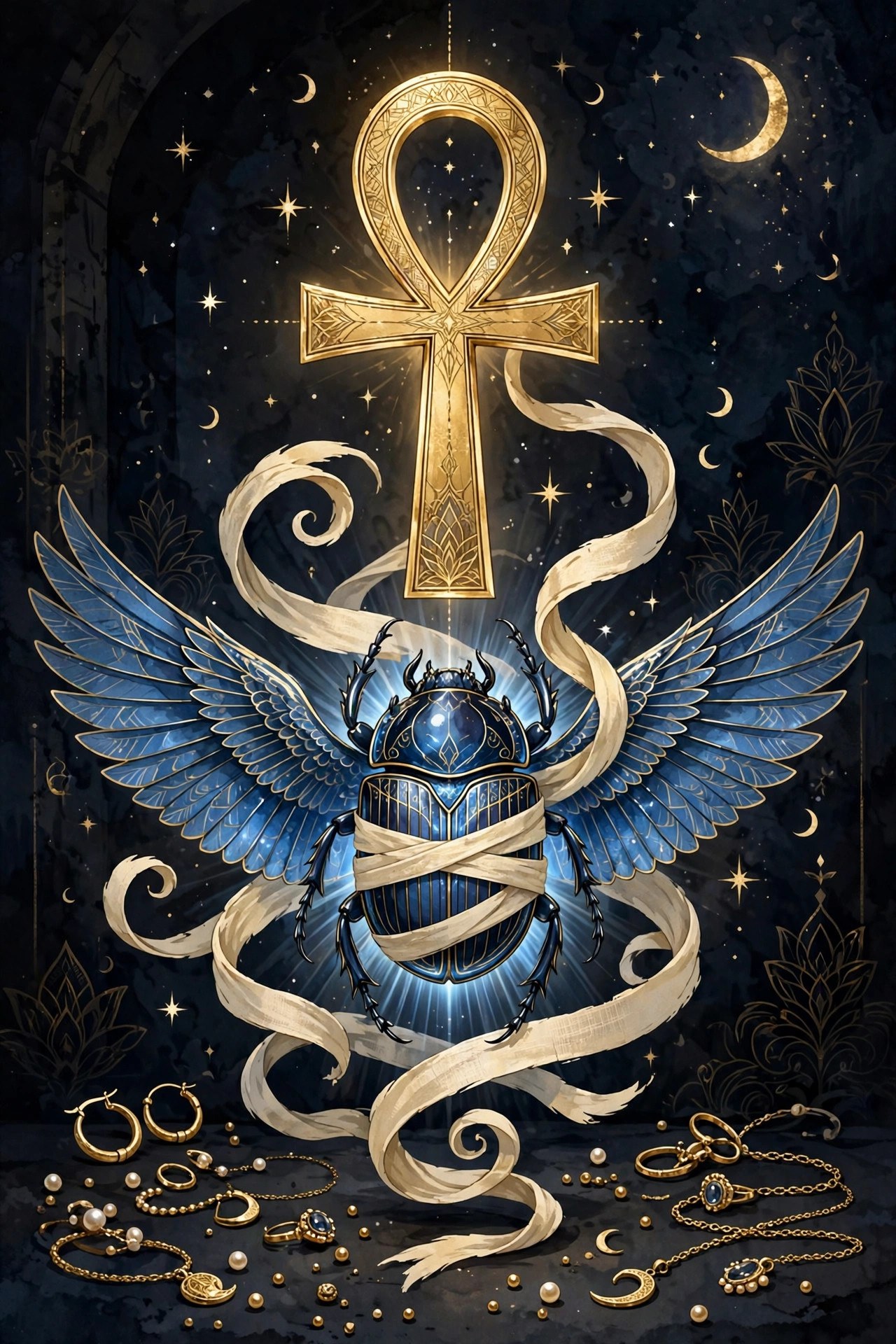
Themes & Motifs
Under the bandages, she's about identity, belonging, and laughing at 3,000 years of history. The themes of her character canon.
Themes of the character canon (fiction), with notes on the real history they echo.
Wrapping and unwrapping
The central motif. Wrapping = protection, privacy, the selves we present; unwrapping = honesty, vulnerability, revelation. Sandy’s wraps unravel involuntarily when she feels strongly — her body literally refuses to let her hide. It’s physical comedy with a thesis: you can’t stay wrapped forever.
Ancient vs. modern
She’s a walking collision of eras: knows the weighing-of-the-heart ceremony, can’t operate a microwave (she’s learning). The theme isn’t “old good, new bad” — it’s that people are continuous. A 3,000-year-old girl and a modern teen want the same things: friends, snacks, to be seen.
Found family
Her original family is dust; her new one is a scarab, a sphinx cub, a golem, a croc girl, and an owl. The Necropolis runs on chosen bonds, and Sandy’s arc is learning that belonging is built, not inherited. Real echo: Egyptian tombs were family projects too — the afterlife was a group effort (see afterlife).
Gold as armor
The jewelry isn’t vanity (okay, it’s partly vanity). Gold doesn’t tarnish — Egyptians associated it with the flesh of the gods and eternal incorruptibility. For Sandy, gold is continuity: the one thing that looked the same in 1150 BC and 2026. When she’s insecure, she adds a bracelet.
Humor as survival
She jokes about death constantly — she’s a mummy. The humor is how she processes 3,000 years of loss without drowning in it. The site follows her lead: the real history pages are respectful, but Sandy herself is allowed to be funny about being dead. She insists.
The curse that isn’t
Every “mummy’s curse” story gets debunked in her presence, gleefully. The theme: fear of the ancient dead says more about the living than the dead. (The real history of the curse invention: curse.)
Source notes
- Thematic analysis of character canon invented 2026-09-27. Real-history echoes (gold’s symbolism, family tomb cults) per Taylor (2001) and Ikram & Dodson (1998); see sources.