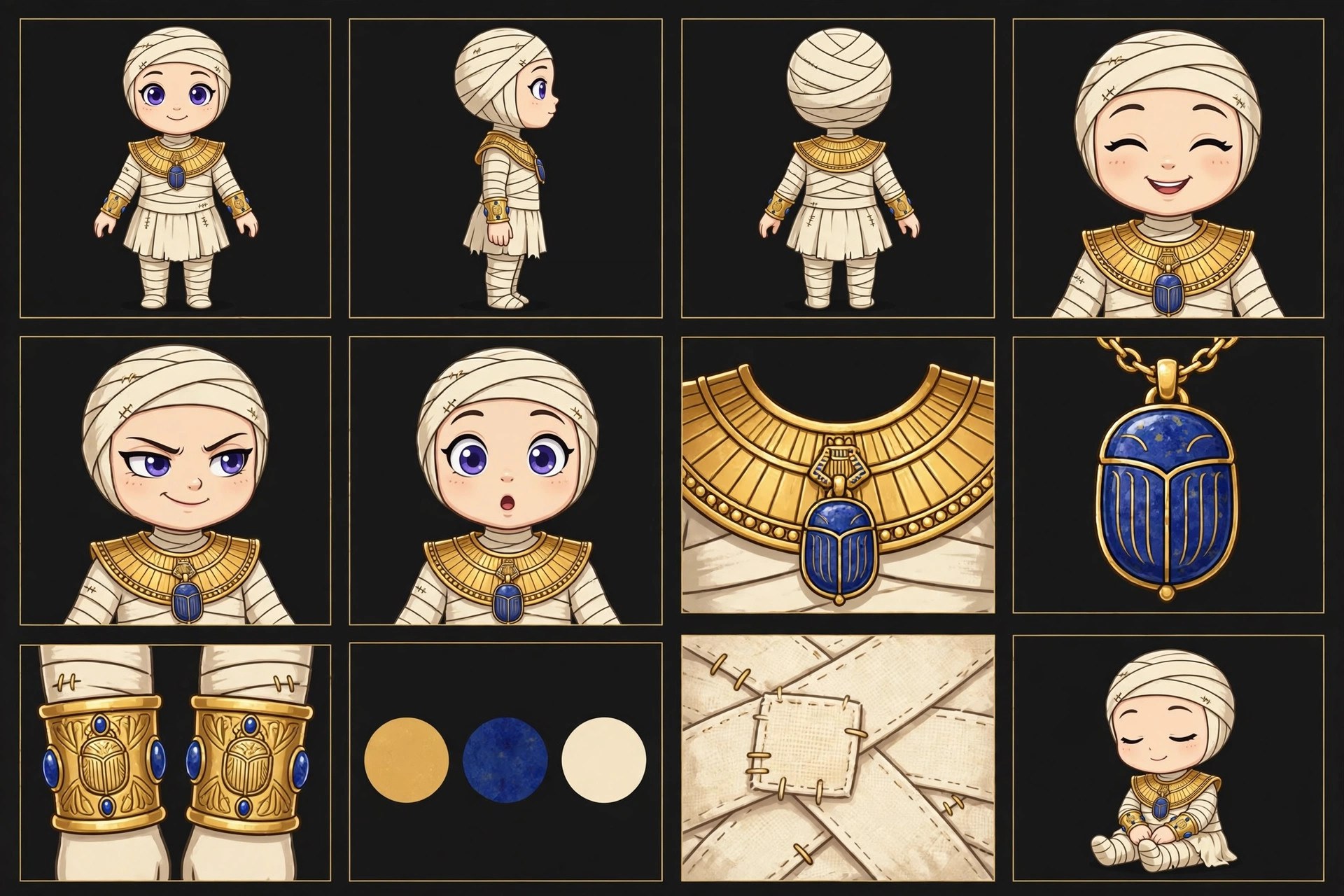
Visual Style Guide
Tomb-chic Egyptian revival — sand gold, lapis lazuli, and hieroglyph motifs. The design language of the mummy girl, and the honesty rules behind every image.
Palette
- Sand gold (#d9a441) — jewelry, accents, glamour. The color of incorruptibility.
- Lapis lazuli (#2743b8) — night skies, depth, the sacred blue of Egyptian art (real lapis was imported from Afghanistan at enormous cost).
- Linen cream (#e8dcc0) — her wraps.
- Natron white / papyrus (#f7f0dd) — light backgrounds.
- Tomb shadow (#0d0f1e) — dark backgrounds, “dark glamorous horror.”
Character design notes (character canon)
- Cream linen wraps, artfully draped, with loose trailing ends that move expressively.
- Big amber eyes; the wraps frame the face like a nemes headdress frames a pharaoh’s.
- Gold: broad collar necklace (wesekh style), cuff bracelets, anklets. Non-negotiable.
- Lapis accents: scarab amulet over the heart (her mother’s — see lore), eyeliner in the ancient style.
- Vibe: spooky-cute, glamorous, expressive — never scary, never sexualized, never a real person.
Motifs
Ankh, scarab, Eye of Horus, sun disk, hieroglyph bands, cartouche frames. Used as decoration and dividers across this site — all original SVG, all clearly ornamental.
Art honesty rules (binding)
- Every image on this site is AI-generated dramatization art, captioned as such, with provenance in
the image credits on this page. - No real people are depicted. No pharaoh portraits, no actor likenesses, no “reconstructed” faces presented as real.
- No fake artifacts. AI art never imitates a museum photograph or claims to show a real object.
- Real history pages use art, not evidence. Illustrations on history pages are decorative; the evidence is in the cited sources.
- Social-pack images with baked-in text keep text inside a central safe zone (~15% edge margins), verified by opening each image.