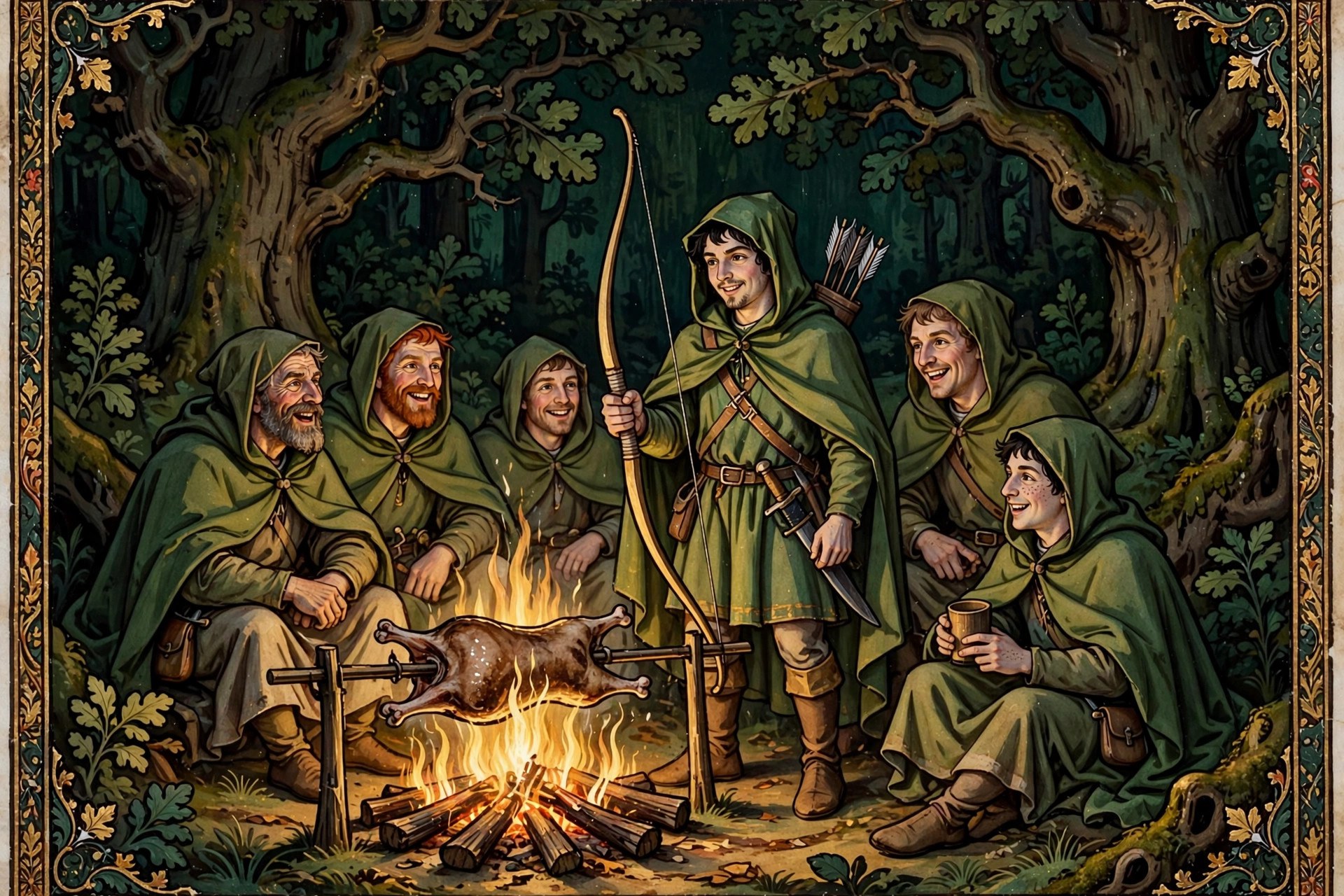
Who Is Robin Hood
The most famous outlaw in English: a yeoman archer of the greenwood, captain of the merry men, enemy of the Sheriff of Nottingham — and, in the medieval ballads, a very different figure from the films.
The legend, briefly
Robin Hood is the outlaw hero of English legend. The familiar version runs like this: a master archer in Lincoln green lives in Sherwood Forest with his band of merry men; he robs the rich, gives to the poor, outwits the Sheriff of Nottingham, loves Maid Marian, and defies the tyrannical Prince John until the true king, Richard the Lionheart, returns.
That version is mostly modern. It was assembled over centuries — from Tudor stage plays, Walter Scott's Ivanhoe (1819), Victorian children's books, and twentieth-century films and television. The medieval Robin, the one in the oldest ballads, is narrower and stranger.
What the medieval ballads say
Strip away the later additions and the early sources give us:
- A yeoman, not a nobleman. The Gest of Robyn Hode opens by calling Robin a "gode yeman." The dispossessed Earl of Huntingdon is a Tudor invention (see The Early Chronicles and Was He Real?).
- A devout outlaw. Robin hears three masses a day and will not harm any company that includes a woman — "Robyn loued Oure dere Lady."
- A selective robber. His stated targets are bishops, archbishops, and the Sheriff of Nottingham. Husbandmen, yeomen, and courteous knights are spared. His great act of generosity is not to the poor in general but to one ruined knight, Sir Richard at the Lee, to whom he lends 400 pounds.
- A trickster archer. The Gest's set pieces are disguises, ambushes, and the great archery contest at Nottingham.
- A band with a code. Little John, Will Scarlet (Scarlok), and Much the miller's son are the original company. Friar Tuck and Alan-a-Dale join centuries later (see The Merry Men).
- No Prince John, no Marian. Neither appears in any medieval ballad. Both are later additions.
What the legend does not say
No medieval source gives Robin a birthplace, a family, a surname that can be traced, or a date. The ballads set him in an out-of-time greenwood "when shawes beene sheene" — the summer forest — and later writers each chose their own century for him. The 1190s of Richard I and Prince John are a sixteenth-century choice (John Major, 1521), not a medieval one.
The three Robins
It helps to think of three Robins, layered like sediment:
- The ballad Robin (c. 1377–1500s). The yeoman of the rhymes and the Gest: devout, courteous, violent, loyal to the king.
- The Tudor and Stuart Robin (1500s–1700s). The Earl of Huntingdon, Maid Marian's lover, the May-game hero, the broadside outlaw who builds almshouses for the poor.
- The modern Robin (1819–present). Scott's Saxon patriot, Pyle's children's hero, Flynn's grinning archer, the television freedom fighter — and the crisp slogan "rob from the rich, give to the poor," which no medieval text states in those words (see The Outlaw Code).
All three are real in the only sense that matters for a legend: people believed in each of them. This site keeps them clearly distinguished, because each tells you what its own century wanted from an outlaw.
Source notes
- The "three Robins" framing is this site's editorial device for clarity, not a scholarly periodization.
- "Gode yeman" and Robin's devotions: A Gest of Robyn Hode, Child 117A, fytte 1, sts. 1–10 (see sayings).
- The 1190s setting as a sixteenth-century choice: John Major (Mair), Historia Majoris Britanniae (1521); see early chronicles.
Limitations
- Any summary of "the legend" must choose which version to tell; this page privileges the medieval ballads as the oldest stratum.
- Characterizations like "trickster" and "courteous" are interpretive labels applied to ballad behavior, not terms the ballads use.