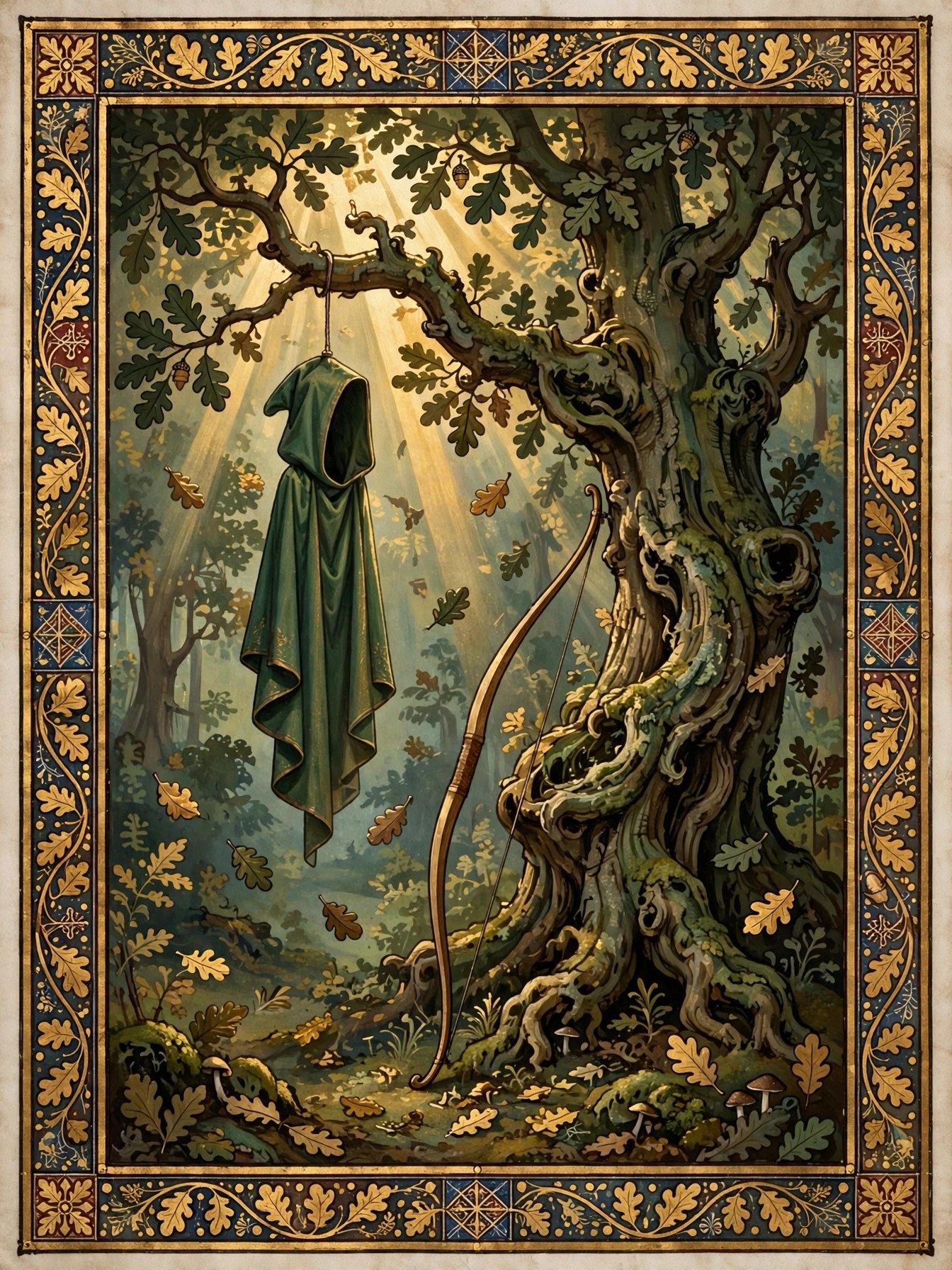
Symbols of the Greenwood
Lincoln green, the longbow, the oak, the arrow — the legend's symbols are older than its plot. Each one carries a history of its own.
Lincoln green
The ballads dress Robin's band in green — "grene" — and the specific shade history remembers is Lincoln green, the famous dyed woolen cloth of Lincoln, England, a major medieval textile center. In A True Tale of Robin Hood (1632) the outlaws wear "Lincoln green" explicitly, and the tradition has kept the phrase ever since.
Green is the forest's color and the outlaw's camouflage, but it is also a social signal: green cloth was the wear of yeomen and foresters, not of nobles (who wore scarlet and ermine) or of peasants (who wore undyed russet). Lincoln green says, at a glance, free man of the woods — respectable but outside the law. The legend's most famous costume is really a class uniform.
The longbow
The longbow is the legend's signature weapon and its most historically grounded symbol. The English longbow — a yew bow as tall as the archer — was the decisive weapon of Crécy (1346) and Agincourt (1415), and archery was a legally encouraged national skill: Edward III's proclamations and later statutes required able-bodied men to practice. A yeoman archer who could split a wand at a hundred yards was not a fantasy but a product of England's military culture.
In the ballads the bow does the legend's moral work: it is the poor man's equalizer — cheap, silent, and lethal at distance — the weapon with which a yeoman can humble a sheriff's men. The archery contest, the legend's great set piece from the Gest onward, is a ritual demonstration that skill outranks rank.
The oak
The oak is the greenwood made single: the Major Oak at Edwinstowe, Robin's supposed headquarters; the trysting trees of the ballads; the "grenewode tree" under which the band feasts. In English tradition the oak is the tree of endurance, of old England, of the navy and the common — the tree that outlasts kings. The legend's oaks are always ancient, always hollow or vast, always a shelter: the forest as mother and fortress at once.
The arrow
The arrow is the legend's punctuation mark: the cloth-yard shaft that wins the golden arrow, the letter shot into Nottingham, the last arrow at Kirklees that marks Robin's grave. In Robin Hood's Death (Child 120) the dying Robin shoots one final arrow and asks to be buried where it falls — the arrow becomes his will and testament, the outlaw's last signature. The broad arrow is also, historically, the crown's mark — the king's property stamped on his goods — which gives the symbol a quiet irony the ballads never spell out: the outlaw's weapon carries the king's sign.
The hood
"Robin Hood" — the name itself is a symbol, and its meaning is disputed. The Middle English hood is a head-covering, and the early ballads' Robin wears one; the Lincoln-green hood of the modern image descends from this. But some scholars have noted that Hood may have begun as a surname or byname (the thirteenth-century "Robert Hod" of the records) rather than a garment — the clothing then following the name, not the other way round. Either way, the hood is the legend's mask: the outlaw's anonymity, the disguise that lets a yeoman walk into Nottingham and win the Sheriff's own prize.
The feast
The greenwood feast — venison poached from the king's deer, served under the trees to whoever the ambush brings in — is the legend's recurring sacrament. The Gest's Robin refuses to dine until he has a guest (fytte 1); the feast is where enemies become company and company becomes the band. It is a parody of the lord's hall: no lord, no seating order, the forest for a roof. The feast says that the outlaws' society is complete — they lack nothing the shire has, except the law.
Source notes
- Lincoln green as Lincoln cloth: the standard textile-history account; the phrase in A True Tale (Child 154).
- The longbow's military history (Crécy 1346, Agincourt 1415) and the archery statutes: standard English military history.
- The Major Oak: see Sherwood Forest.
- The last arrow: Child 120A, st. 26 (see sayings).
- "Robin loued Oure dere Lady" and the greenwood feast: Child 117A, fytte 1.
- The hood-as-surname discussion: the standard onomastic debate; see was he real.
Limitations
- Symbolic readings are interpretive; the ballads never explain their own symbols.
- The hood's etymology is genuinely disputed; both readings are presented as open.