The Merry Men
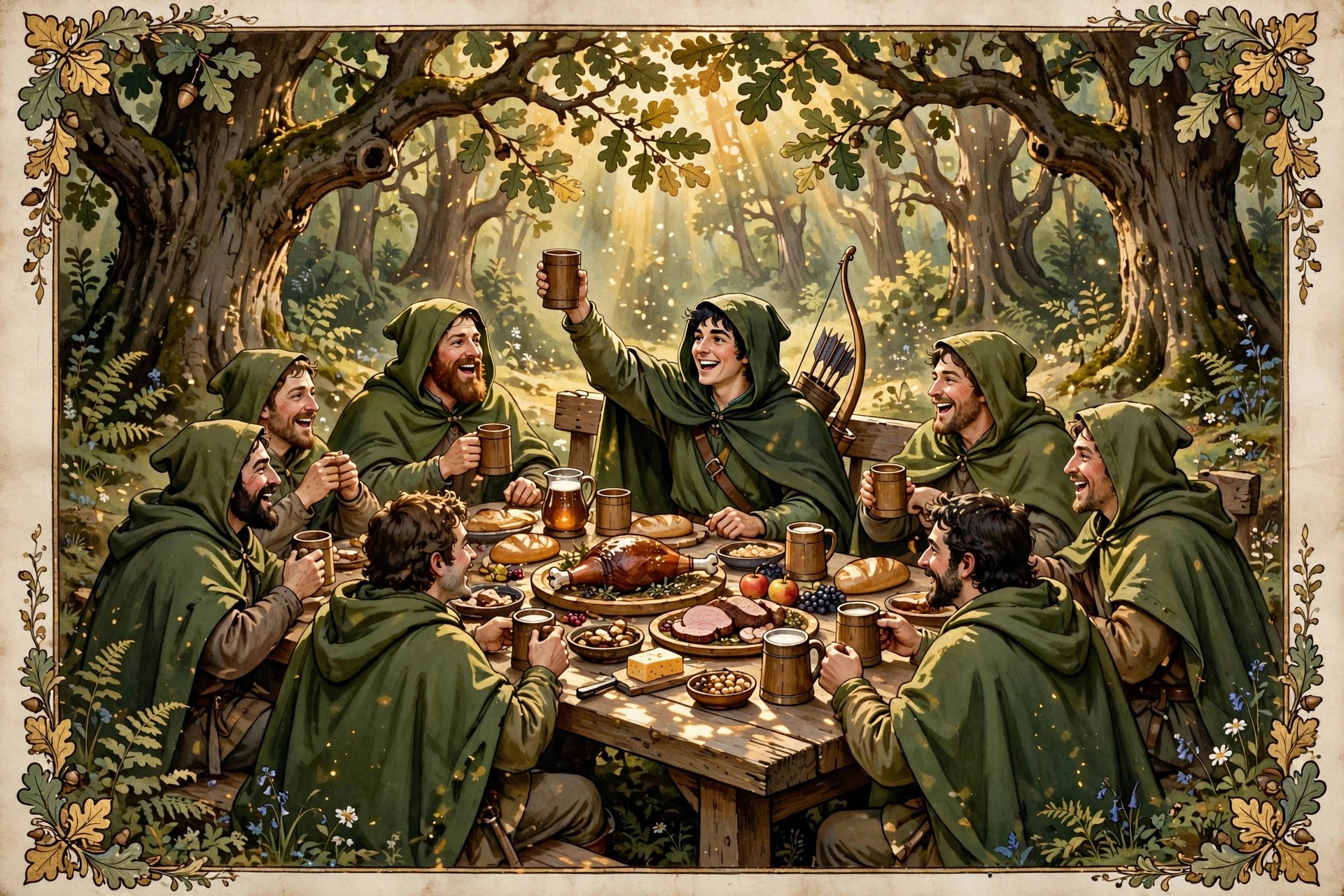
Robin never worked alone. The merry men — the "mery men" of the ballads — are the legend's second act: each one joined at a different century, and each one tells you what his age wanted in a companion.
The original company
The Gest of Robyn Hode (c. 1450) names Robin's core band: Little John, Scarlok, and Much the miller's son — "Robyn stode in Bernesdale... And bi hym stode Litell Johnn, / A gode yeman was he. / And alsoo dyd gode Scarlok, / And Much, the miller's son." The early ballads add others by name as needed; the band was never a fixed roster, but a repertory company.
Little John
The second in command from the very first references — Wyntoun (c. 1420) and Bower (c. 1440s) both name him beside Robin. In the ballads he is the giant with the quarterstaff: seven feet tall, the only man who ever beat Robin in a fair fight (the bridge contest of Child 125), the rescuer in Robin Hood and the Monk and Guy of Gisborne, and the man at Robin's deathbed at Kirklees. His name is itself the legend's oldest joke: "John Little" becomes "Little John." Loyal, shrewd, and — in the Monk — the only one of the band who keeps his head in a crisis.
Will Scarlet
In the Gest he is Scarlok — "gode Scarlok." The name shifts across the centuries: Scarlok, Scadlock, and finally the familiar Will Scarlet. He is the dandy of the band in later tradition, the fine dresser and swordsman, but in the early ballads he is simply one of the trusted three, present at the lending to the knight and the feasts. The "Will" and the scarlet are later elaborations; the Gest gives us only the man.
Much the Miller's Son
"Moche, the mylner sun" — Much appears in both the Gest and Robin Hood and the Monk, the junior member of the original three. In the Monk he goes with Little John to waylay the treacherous monk; in the Gest he is at Robin's side throughout. Later tradition largely drops him, but the medieval band is unthinkable without him.
The later arrivals
Friar Tuck
The fighting friar is not in the early ballads. His first company is a surviving play fragment, Robin Hood and the Sheriff (c. 1475), where a friar appears among the outlaws — and he enters the ballad tradition properly through Anthony Munday's plays of 1598 and the seventeenth-century broadside Robin Hood and the Curtal Friar (Child 123), in which Robin duels a brawling friar across a river and recruits him. The "curtal" (dock-tailed) friar is a comic type — the fat, fighting churchman — grafted onto the greenwood. Every film keeps him because he is irresistible; the medieval ballads never met him.
Alan-a-Dale
The minstrel enters in a seventeenth-century broadside, Robin Hood and Allen a Dale (Child 138): Robin rescues Allen's sweetheart from a forced marriage to an old knight, halts the bishop's ceremony, and — disguised in the bishop's robes — marries the lovers himself. Unlike most broadside inventions, Alan stuck: the romantic musician gave the Victorian legend its love songs and gave the films their troubadour. He has no medieval existence whatever.
The band as an institution
Across all the versions, the merry men have a consistent social meaning: they are a free company — yeomen, not peasants and not nobles — living by the bow under forest law, loyal to their captain, and bound by the code (see The Outlaw Code). The Gest's Robin commands "seven score of wyght yonge men" at the archery contest; the broadsides shrink the band to a handful of named friends. The number changes; the fellowship doesn't.
Source notes
- The Gest's company: Child 117A, fytte 1, sts. 3–4 (Little John, Scarlok, Much).
- Little John in Wyntoun (c. 1420) and Bower (c. 1440s): see early chronicles.
- The bridge contest: Robin Hood and Little John, Child 125.
- The play fragment Robin Hood and the Sheriff, c. 1475 (Paston papers): the earliest Friar Tuck company, per Dobson & Taylor.
- Robin Hood and the Curtal Friar: Child 123. Robin Hood and Allen a Dale: Child 138 (seventeenth-century broadside).
Limitations
- "First appearance" claims for Tuck and Alan-a-Dale rest on surviving texts; lost performances and ballads may have introduced them earlier.
- The evolution "Scarlok → Scadlock → Will Scarlet" is the standard account; the exact first use of "Will Scarlet" is not pinned to a single text on this site.