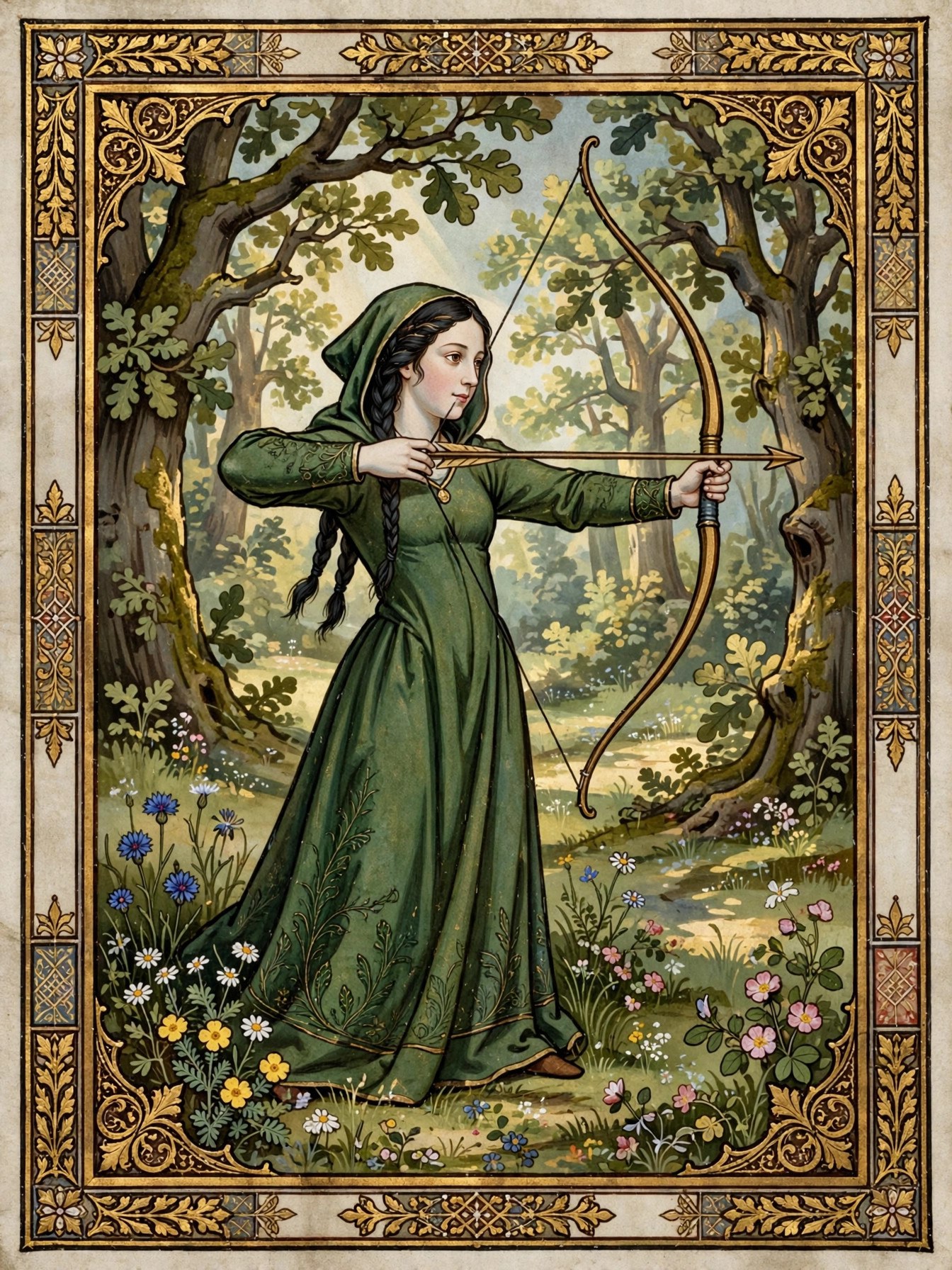
Maid Marian
Robin's lady — archer, noblewoman, May queen. She is also, like Prince John, absent from every medieval ballad: Marian joined the legend centuries after Robin did.
Before Robin: the May games
"Maid Marian" predates her connection to Robin Hood. She was a figure of the May games — the spring festivities of morris dancing, pageantry, and mock courts that swept England in the fifteenth and sixteenth centuries. The name likely descends from the French pastourelle tradition (the shepherdess Marion), and "Marian" was the May queen to Robin's May king in village celebrations. Churchwardens' accounts and civic records show Robin Hood and Maid Marian presiding together over Whitsun ales and May games by the early sixteenth century — but as festival figures, the king and queen of summer, not yet as outlaw and lady.
Entering the legend: 1598
Marian becomes Robin's beloved in Anthony Munday's plays of 1598, The Downfall and The Death of Robert, Earl of Huntington. Munday's Marian is secretly Matilda Fitzwater, a noblewoman pursued by the lustful King (then Prince) John; she follows Robin into the greenwood in boy's clothes. This is the Marian the later tradition kept: the high-born lady who chooses the outlaw, the cross-dressing archeress, the moral center of the band.
The seventeenth-century broadside Robin Hood and Maid Marian (Child 150) gives her a ballad of her own — she meets Robin in the forest disguised as a page, they fight, and only at the end does he recognize her. It is a late, romantic invention, and the ballad tradition knows it is playing a game.
The Victorian and modern Marian
The nineteenth century made Marian the respectable heroine the children's books required: Howard Pyle's Merry Adventures (1883) gives her grace and spirit; Tennyson's play The Foresters (1892) centers the love story. The twentieth century then armed her — film and television Marians are routinely archers and swordswomen in their own right, from the 1938 Adventures to the BBC series. Each generation's Marian is a portrait of its own ideal of womanhood, dressed in Lincoln green.
What the ballads say about her
Nothing. No medieval Robin Hood ballad mentions Marian — not the Gest, not the Monk, not Guy of Gisborne. The early Robin's romantic life, such as it is, consists of his devotion to the Virgin Mary ("Robyn loued Oure dere Lady") and his refusal to harm any company that includes a woman. The love story is a Tudor addition to a legend that, for its first two centuries, was about male fellowship, not romance.
Why she was needed
The same structural logic that created Prince John created Marian: the legend, as it moved from ballad episodes to novels and films, needed a love interest and a feminine presence in the greenwood. The May games had already paired the names; Munday made the pairing narrative. She has been indispensable ever since — which is itself evidence that legends are shaped by the needs of their tellers.
Source notes
- The May games: Robin and Marian as festival figures appear in early-sixteenth-century churchwardens' accounts; the French pastourelle derivation is the standard scholarly account.
- Munday's plays (1598): Marian as Matilda Fitzwater.
- Robin Hood and Maid Marian: Child 150 (seventeenth-century broadside).
- No Marian in the medieval ballads: verified against Child 117–121.
- Pyle (1883), Tennyson's The Foresters (1892): standard publication facts.
Limitations
- The exact route from French Marion to English May-game Marian is a scholarly reconstruction, not a documented borrowing.
- "What each generation wanted" is interpretive framing, flagged as such.