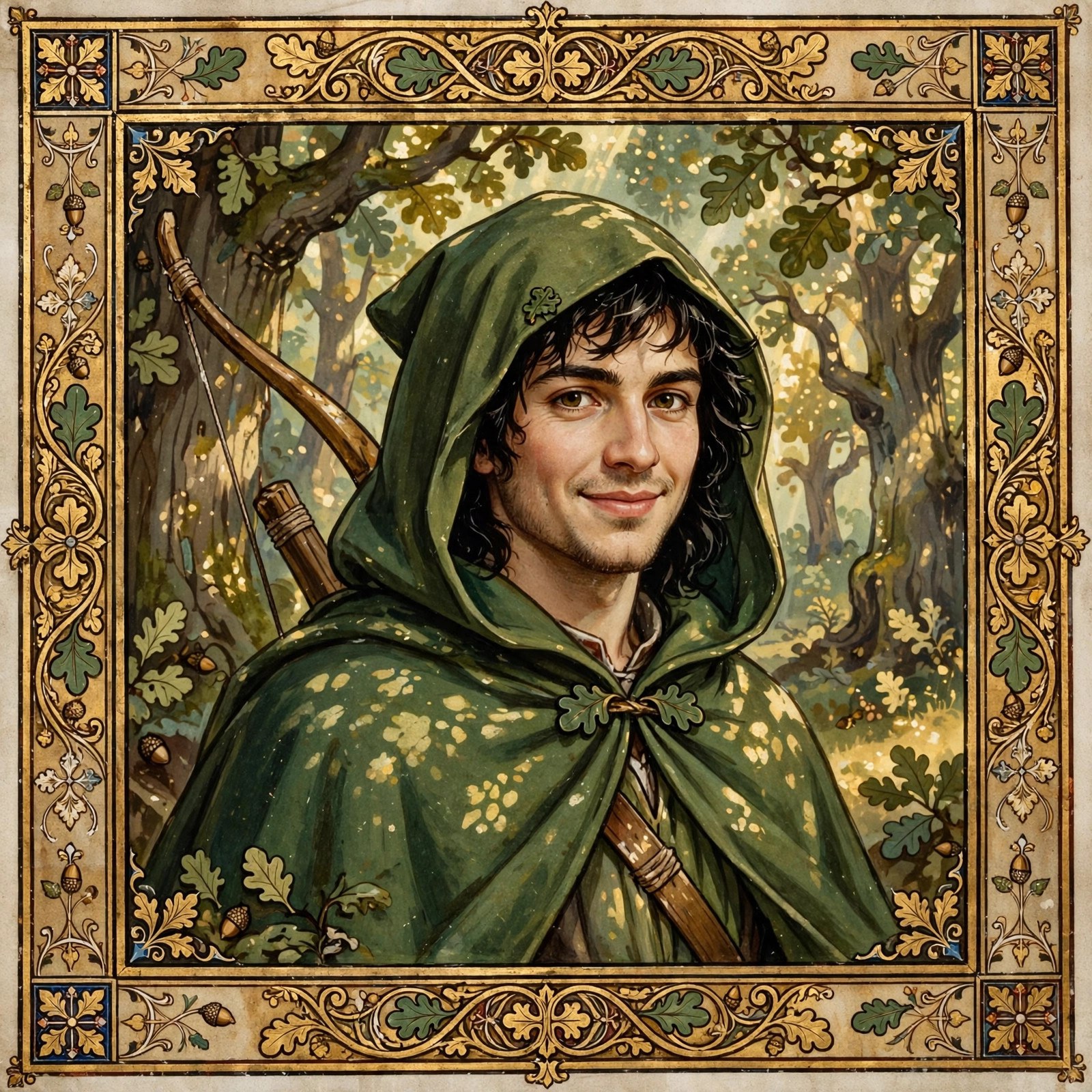
Robin Hood — the animated character of the owner's Vizlings app, re-imagined in manuscript-illumination style. AI-generated illustration (2026-09-26). AI-generated dramatization art — not a historical depiction.
Start Here
New to the greenwood? This page gives you the legend in five minutes and points you to the deep dives — the ballads, the history debate, and the films that remade the outlaw.
The legend in five minutes
Robin Hood is the outlaw of Sherwood Forest: a peerless archer in Lincoln green who, with his band of merry men, robs the rich, defies the Sheriff of Nottingham, and — in the modern version — gives to the poor. That is the legend. The evidence is narrower and more interesting:
The first mention (c. 1377). A lazy priest in William Langland's Piers Plowman knows "rymes of Robyn Hood" better than his prayers. The rhymes themselves are lost — only the name survives.
The medieval ballads.A Gest of Robyn Hode (composed around the mid-1400s, first printed in the 1490s–1500s) is the great epic: Robin the yeoman, Little John, the poor knight he lends 400 pounds, the archery contest, the king's pardon. Around it cluster shorter ballads — Robin Hood and the Monk, Robin Hood and Guy of Gisborne, Robin Hood and Little John, and the death ballad at Kirklees.
The history debate. Candidates for a real Robin have been proposed for 170 years — the Wakefield theory, the 1225 fugitive Robert Hod, the York archer, Roger Godberd. None is proven. See Was He Real? for the honest state of play.
The modern Robin. The dispossessed earl, Maid Marian as his lady, Prince John as the villain, and the crisp slogan "rob from the rich, give to the poor" are later additions — Tudor plays, Walter Scott's Ivanhoe (1819), and twentieth-century film. The medieval Robin never met Prince John.