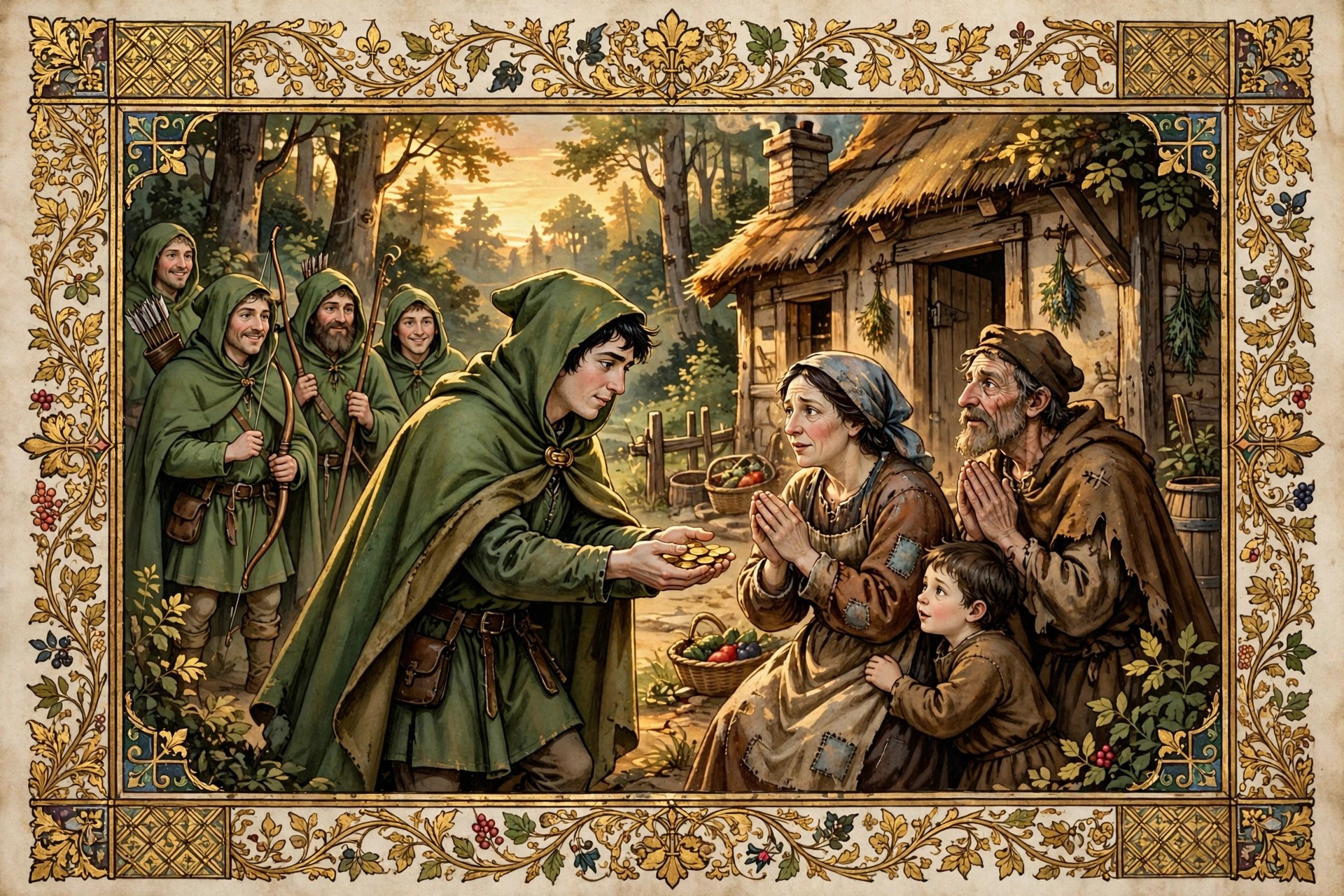
The Outlaw Code
"Rob from the rich, give to the poor" — the most famous sentence in the legend. No medieval text says it in those words. This is the honest history of the idea.
What the Gest actually says
The closest the medieval tradition comes to a Robin Hood code is in the Gest of Robyn Hode, fytte 1, when Robin instructs Little John before the ambush on Watling Street:
But loke ye do no husbonde harme, That tylleth with his ploughe. No more ye shall no gode yeman That walketh by grene-wode shawe; Ne no knyght ne no squyer That wol be a gode felawe.
("But see that you do no harm to a husbandman who tills with his plough. No more shall you harm any good yeoman who walks by the greenwood shade; nor any knight nor squire who will be a good fellow.")
And then the targets:
These bisshoppes and these archebisshoppes, Ye shall them bete and bynde; The hye sherif of Notyingham, Hym holde ye in your mynde.
("These bishops and these archbishops, you shall beat and bind; the high sheriff of Nottingham, keep him in your mind.")
This is a code of selective robbery, not redistribution. The poor are spared, not paid. Robin's great act of generosity in the Gest — lending 400 pounds to the ruined knight — is courtesy to a fellow gentleman, not charity to the poor. The modern slogan's second half, "give to the poor," is simply not in the medieval text.
1521: John Major's formulation
The earliest clear statement of the Robin Hood economic idea comes from the Scottish historian John Major in 1521 (see The Early Chronicles):
"Faeminam nullam opprimi permisit nec pauperum bona surripuit, verum eos ex abbatum bonis sublatis opipare pavit."
("He permitted no woman to be oppressed, nor did he steal the goods of the poor, but rather feasted them sumptuously on goods taken from the abbots.")
Major gives us: spare the poor + plunder the abbots + feed the poor from the plunder. This is the ancestor of the slogan — redistribution as feasting, and the redistribution flows from the corrupt church to the poor, not from "the rich" in general. Major's Robin is still not the modern slogan, but he is recognizably on the road to it.
1632: Martin Parker's poor
Martin Parker's broadside A True Tale of Robin Hood (1632, Child 154) makes the charity explicit and central:
But Robbin Hood so gentle was, And bore so brave a minde, If any in distresse did passe, To them he was so kinde That he would give and lend to them, To helpe them at their neede: This made all poore men pray for him, And wish he well might speede.
Parker's Robin builds eight almshouses for the poor from his plunder. The redistribution is now direct, personal, and institutional — but the phrasing is still Parker's own, not the crisp modern slogan.
The modern slogan
The exact formula "rob from the rich to give to the poor" (and its variants) is a product of the nineteenth and twentieth centuries — the children's books, the stage, and above all the films, which needed the legend's economics in a single sentence. No scholar has found it in those words before the modern era, and this site will not claim a "first use" it cannot document. What can be said honestly:
- The medieval Robin spares the poor and plunders bishops (Gest, fytte 1).
- The Tudor Robin feeds the poor from the abbots' goods (Major, 1521).
- The Stuart Robin gives and lends to the distressed (Parker, 1632).
- The modern Robin robs from the rich and gives to the poor — a slogan the films made canonical.
Each stage is real; the slogan is the last stage's summary of all the earlier ones. The idea has a genuine medieval pedigree. The sentence does not.
The code's other articles
The ballads' code, taken together, amounts to this:
- Spare the working poor — husbandmen, yeomen (Gest, fytte 1).
- Spare courteous knights — "that wol be a gode felawe" (Gest, fytte 1).
- Harm no woman — "Robyn loued Oure dere Lady" (Gest, fytte 1); repeated at his death in Child 120.
- Rob bishops, archbishops, and the Sheriff (Gest, fytte 1).
- Keep faith with the king — the Gest's Robin is pardoned by Edward and serves at court; loyalty to the crown survives even outlawry.
- Loyalty to the fellowship — Little John's rescues; the band's shared feasts.
Source notes
- Gest, fytte 1, sts. 10–15 (the code): Child 117A. Quoted from Child's text; translation this site's.
- Major (1521): Historia Majoris Britanniae; the "ex abbatum bonis" passage.
- Parker, A True Tale of Robin Hood (1632): Child 154, the "so gentle was" stanza.
- "No medieval text states the slogan": verified against Child 117–121 and the early prints; the claim is negative and therefore provisional (see methodology).
Limitations
- The four-stage history is this site's editorial summary; specialists distinguish more stages and dispute the transitions.
- The claim that the exact slogan is nineteenth/twentieth-century rests on the absence of earlier attestations found to date — a reported position, not a proven first-use date.