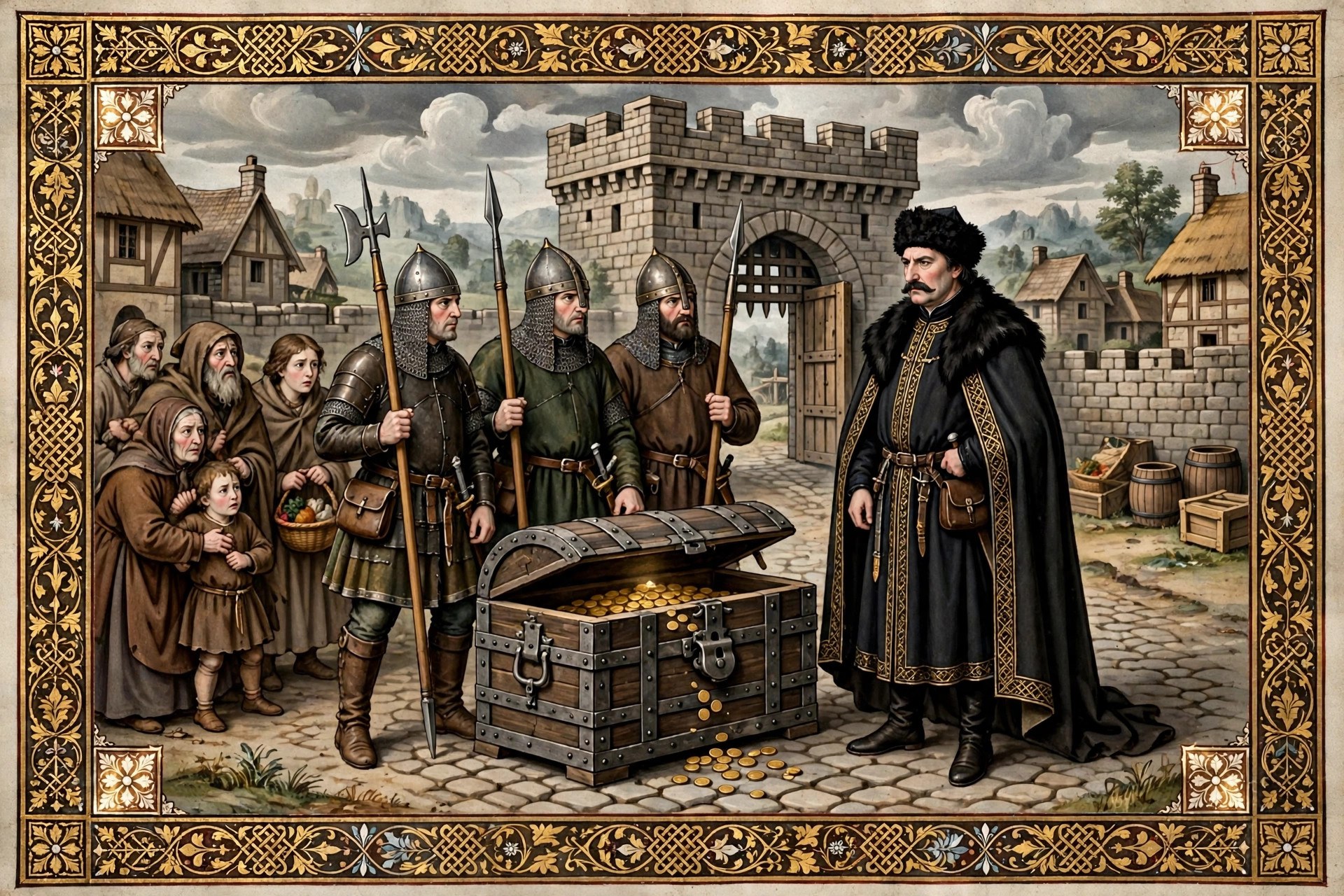
The Sheriff of Nottingham
Before Prince John, before Guy of Gisborne, there was the Sheriff — the legend's first and most constant villain, the "proud sheryfe of Notyngham" of the ballads.
The ballads' villain
The Sheriff is the only antagonist the medieval tradition needs. In the Gest he proclaims the archery contest that is meant to trap Robin (fytte 5), captures him at the wrestling (fytte 6), and is humiliated at every turn. In Robin Hood and the Monk it is the Sheriff who marches on St. Mary's with his men to take Robin. In Guy of Gisborne he hires the bounty hunter and ends the ballad fleeing for Nottingham with Little John's arrow in his heart.
He is never given a personal name in the early ballads — he is an office, not a man: "the hye sherif of Notyingham." That is the point. The Sheriff embodies the local machinery of law — the forest courts, the taxes, the gallows — against which the greenwood defines itself. He is corrupt, cowardly, and repeatedly outwitted, but he is also, within the stories' logic, doing his job: Robin is an outlaw.
What a sheriff was
A medieval sheriff was the crown's chief officer in a shire: he collected revenues, held the county court, raised the hue and cry, and executed writs — including writs of outlawry. The Sheriff of Nottingham and Derby administered a region that included the royal forest of Sherwood, where forest law made Robin's venison feasts a crime. The ballads' Sheriff is therefore not a random villain but the precise official whose duties put him at odds with forest outlaws. The legend's politics are local before they are national.
The later Sheriff
The broadside and stage traditions gave the Sheriff color without changing his function. By the eighteenth and nineteenth centuries he is the fat, blustering comic villain of pantomime and children's books. The twentieth century split him in two directions: the 1938 film's Sheriff is a preening coward; later versions — notably the BBC's Robin Hood (2006–2009) — made him the series' charismatic center, a villain with genuine menace. Through all of it, he remains what the Gest made him: the man who sets the trap and walks into it.
Why he endures
Prince John comes and goes with the politics of the retelling; the Sheriff never leaves, because he is structural. Every outlaw story needs the law, and the Sheriff is the law — close enough to be hated, small enough to be beaten. Robin can never finally defeat a king without breaking the legend's loyalty to the crown; but he can defeat the Sheriff every week, in every episode, forever.
Source notes
- The Sheriff in the Gest: fyttes 5–6 (the archery contest and the capture); "the hye sherif of Notyingham," fytte 1, st. 15.
- Robin Hood and the Monk (Child 119): the Sheriff's march on St. Mary's.
- Robin Hood and Guy of Gisborne (Child 118): the Sheriff's flight, st. 58.
- The sheriff's office and forest law: standard medieval administrative history; see sources.
Limitations
- The Sheriff is unnamed in the early ballads; any personal name attached to him in a retelling is that retelling's invention.
- Modern portrayals are summarized broadly; this page does not adjudicate individual performances.