The Ballads
The legend is made of ballads. For five hundred years, rhymes about Robin Hood were sung, printed, and reprinted — this is the tradition that carried the outlaw, ballad by ballad.
What "the ballads" means
When scholars say "the Robin Hood ballads," they mean the body of narrative verse about the outlaw collected by Francis James Child in The English and Scottish Popular Ballads (1882–1898) — the great Harvard anthology that numbers the ballads 1 to 305. Robin Hood occupies numbers 117 through 154: nearly forty ballads, from the medieval Gest to seventeenth-century broadsides.
The ballads fall into three rough strata:
- The medieval ballads (1400s). The Gest of Robyn Hode (Child 117), Robin Hood and the Monk (Child 119), Robin Hood and Guy of Gisborne (Child 118), Robin Hood and the Potter (Child 121). Manuscript or early-print survival; Middle English; the yeoman Robin.
- The Tudor broadside ballads (1500s). Shorter, punchier, often printed as single sheets: Robin Hood and Little John (Child 125), Robin Hood and the Curtal Friar (Child 123).
- The seventeenth-century broadsides (1600s). The tradition's long tail — dozens of short ballads in modernized English: Robin Hood and Allen a Dale (Child 138), Robin Hood and the Golden Arrow (Child 152), Robin Hood's Death (Child 120), A True Tale of Robin Hood (Child 154).
Child's numbering is by editorial order, not by age — Child 154 (1632) is younger than Child 117 (c. 1450).
The great ones
A Gest of Robyn Hode (Child 117)
The epic: some 450 stanzas in eight "fyttes," composed around the mid-fifteenth century and first printed in the 1490s–1500s. Robin the yeoman, Little John, Scarlok, Much; the ruined knight Sir Richard at the Lee; the archery contest; the king's pardon. It has its own page: A Gest of Robyn Hode.
Robin Hood and the Monk (Child 119)
One of the two oldest surviving Robin Hood ballads, existing in manuscript from about 1450. Robin goes to mass at Nottingham against advice, is betrayed by a monk he once robbed, and is rescued by Little John and Much in a daring jailbreak. It calls itself a "talkyng" — a tale told, perhaps recited rather than sung. Its opening is among the most famous verses in the tradition (see sayings).
Robin Hood and Guy of Gisborne (Child 118)
The darkest of the early ballads, surviving in the seventeenth-century Percy Folio manuscript but clearly old. Robin meets the bounty-hunter Guy of Gisborne in the forest, kills him in single combat, disfigures the corpse, and wears Guy's horse-hide coat to trick the Sheriff — then frees Little John, bound to a tree. Grim, violent, and magnificent.
Robin Hood and the Potter (Child 121)
A comic early ballad (manuscript c. 1500): Robin waylays a potter, trades clothes with him, sells pots in Nottingham, gives the takings to his men, and tricks the Sheriff into the forest. The trickster Robin at his most playful.
Robin Hood and Little John (Child 125)
The famous quarterstaff fight on the narrow bridge: Robin meets a seven-foot stranger, is knocked into the brook, and recruits him — "John Little" becomes "Little John." A sixteenth-century broadside, endlessly reprinted; the movies still stage this scene.
Robin Hood and Allen a Dale (Child 138)
A seventeenth-century broadside: Robin rescues the minstrel Allen's sweetheart from a forced marriage to an old knight, stops the bishop's ceremony, and — dressed in the bishop's robes — marries the lovers himself. This is where Alan-a-Dale enters the legend (see The Merry Men).
Robin Hood and the Golden Arrow (Child 152)
The archery-contest ballad in its classic broadside form: the Sheriff proclaims a shooting match with a golden arrow as prize, Robin wins it in disguise, and Little John shoots the taunting letter into Nottingham. The movies still stage this one too.
Robin Hood's Death (Child 120)
The end of the legend: Robin, aging, goes to Kirklees (Churchlees) to be bled by his kinswoman the prioress; she treacherously bleeds him to death. Dying, he refuses Little John's offer to burn the priory — "I never hurt woman in all my life" — and shoots one last arrow to mark his grave. Survives in the Percy Folio (c. 1650) and broadside versions.
A True Tale of Robin Hood (Child 154)
Martin Parker's 1632 broadside "biography": Robin as the Earl of Huntingdon, outlawed by a wicked abbot, robbing the rich clergy, building eight almshouses for the poor with his loot, and dying in Richard I's reign. It claims to be "carefully collected out of the truest writers of our English chronicles" — it is, in fact, assembled from the ballads and plays. But it is a landmark: the first full life of Robin, and the first text to make his charity to the poor central (see The Outlaw Code).
How the ballads traveled
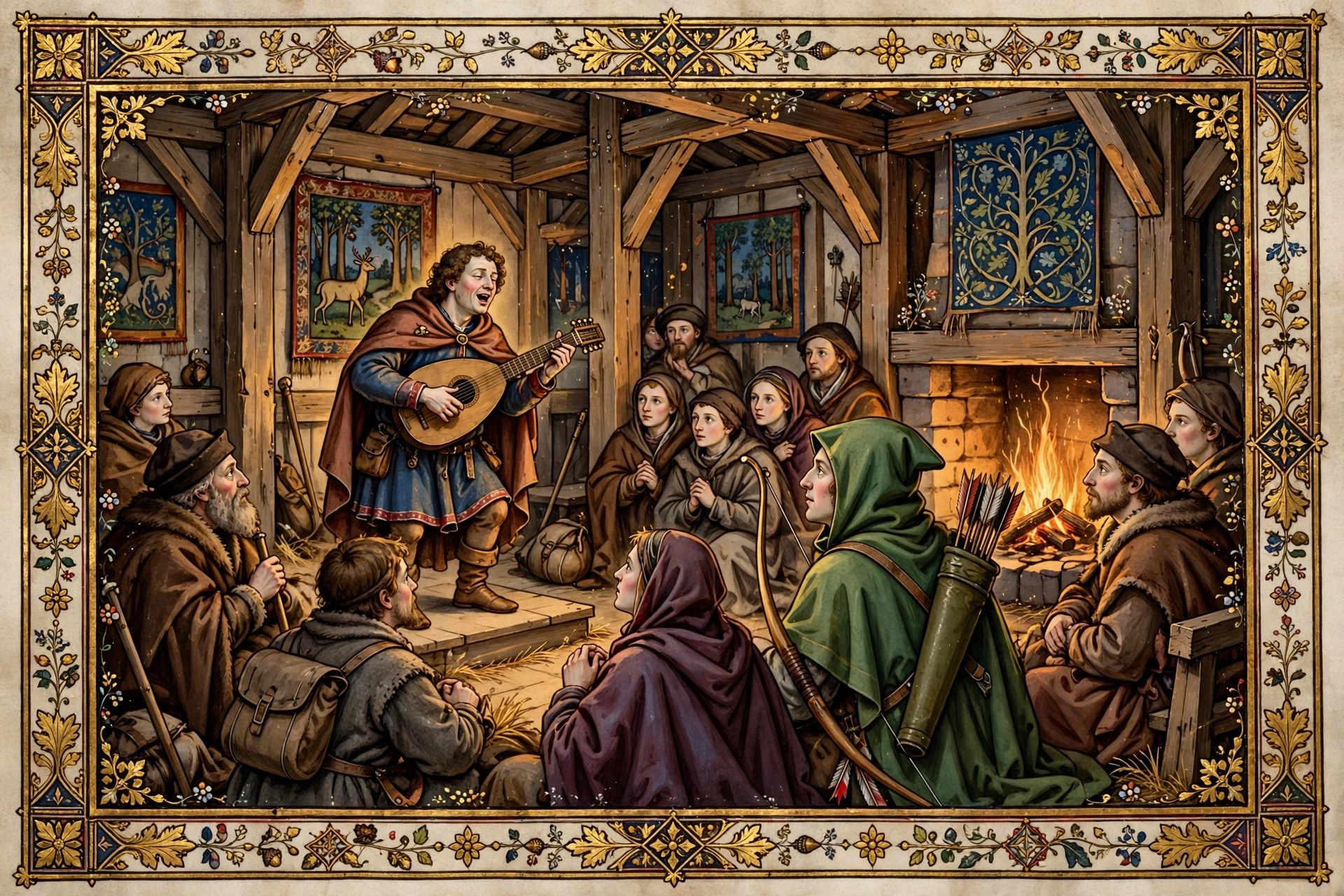
The early ballads were probably sung or recited in halls and at fairs; the Gest was long enough to be a evening's entertainment. From the 1490s, printers saw a market: Wynkyn de Worde and others printed Robin Hood ballads as cheap quartos. In the seventeenth century the broadside presses turned out dozens of short Robin Hood ballads for a penny — the Gest's epic gave way to the broadside's episode. In the eighteenth century the antiquarians — Percy, then Ritson (1795) — collected and printed them as national heritage. In the nineteenth century they became children's literature. The tradition never died; it changed medium.
What the ballads are not
They are not history, and they were not trying to be. They contradict each other cheerfully: Robin is pardoned by a King Edward in the Gest and dies in Richard I's reign in the broadsides; he is a yeoman in the old ballads and an earl in the new ones. The ballads are a repertory, not a canon — each singer and printer took what the audience wanted.
Source notes
- Child numbers and datings follow Francis James Child, The English and Scottish Popular Ballads (1882–1898), vols. III and V.
- "Some 450 stanzas in eight fyttes": the Gest as printed by Child (117A); stanza counts vary slightly by edition.
- The Percy Folio (British Library, Additional MS 27879), c. 1650: the manuscript source for Guy of Gisborne and Robin Hood's Death.
- The play-fragment and printing history: see A Gest of Robyn Hode and sources.
Limitations
- Datings of individual ballads (especially the broadside stratum) are often approximate; printers rarely dated their sheets.
- Child's collection, while foundational, reflects nineteenth-century editorial choices; the Roud Folk Song Index now supplements it.