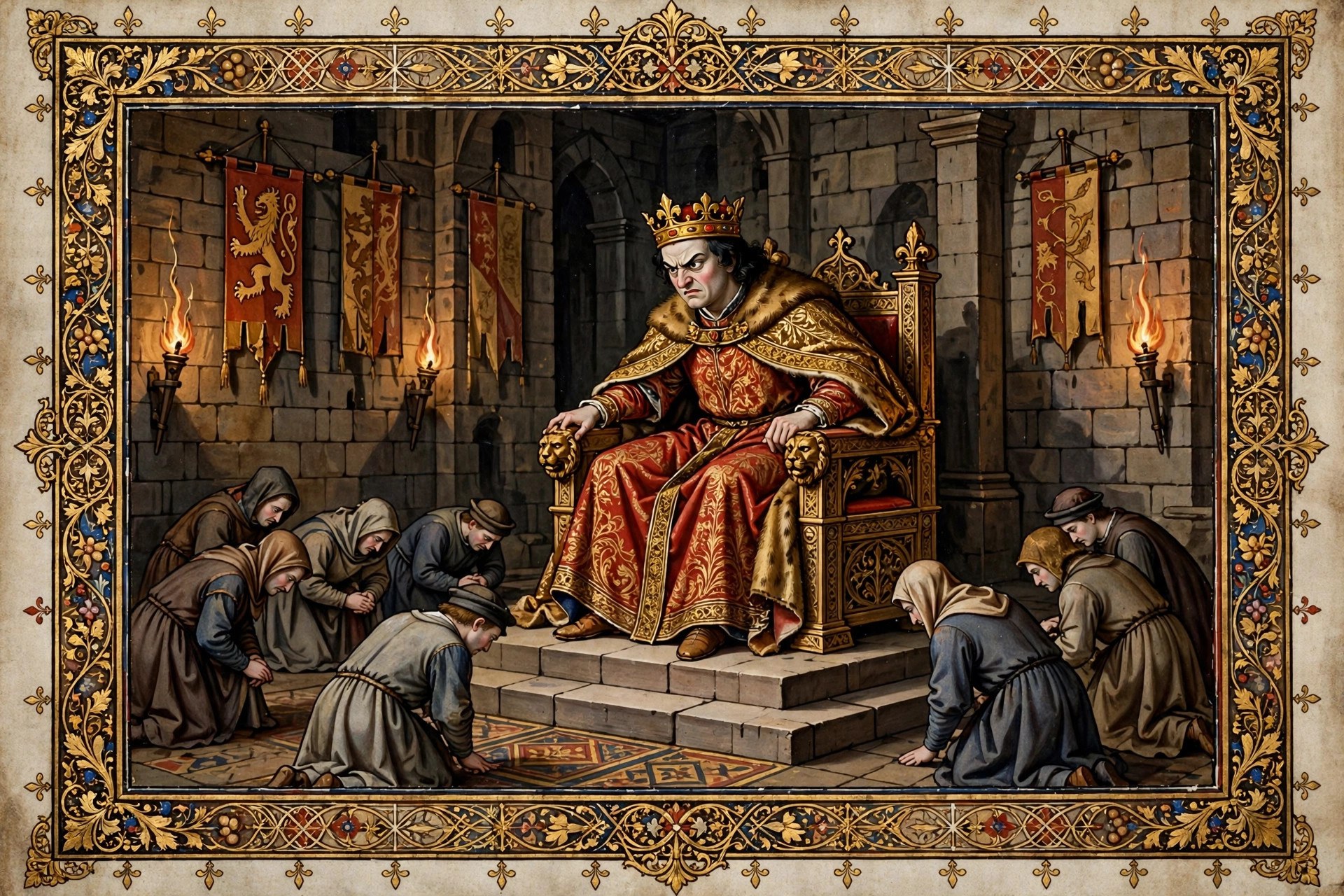
Prince John
The legend's great villain — the grasping prince who taxes England while Richard is away. He is also the legend's great anachronism: no medieval ballad ever mentions him.
The honest chronology
Prince John does not appear in any medieval Robin Hood ballad. The Gest's king is "Edwarde, our comly kynge" — an Edward, not a John and not a Richard. The Sheriff of Nottingham is the ballads' villain; the crown, when it appears, is the outlaw's eventual pardoner, not his enemy.
John enters the legend in 1598, with Anthony Munday's two plays, The Downfall of Robert, Earl of Huntington and The Death of Robert, Earl of Huntington. Munday needed a royal villain for his noble outlaw, and the historical John's reputation — the king who lost Normandy, quarreled with the barons, and died under the shadow of Magna Carta — was ready-made. In Munday, John is a lustful tyrant pursuing Matilda (Maid Marian).
Walter Scott then made John indispensable. In Ivanhoe (1819), Prince John is the Norman oppressor holding England while Richard the Lionheart is captive abroad; Robin — as "Locksley" — is the Saxon yeoman who humbles him at the Ashby tournament. Scott's Saxon-versus-Norman frame, which has no medieval basis, became the default setting of every retelling after him. The films inherited Scott's John wholesale: the sniveling tax-collector of the 1938 Adventures, the scheming regent of the 1950s television series, the petulant prince of Disney's 1973 lion.
The historical John
The real John (1166–1216), youngest son of Henry II, ruled England from 1199 to 1216. His reign is genuinely one of the most troubled in English history — the loss of Normandy, crushing financial exactions, the baronial revolt, Magna Carta (1215), and civil war at his death. The legend's portrait of a bad ruler draws on a real reservoir of grievance.
But the legend's use of John is fiction twice over: first, because the medieval Robin never met him; second, because the popular image of John — the effete schemer taxing the poor while good King Richard is away — is itself a later simplification. Richard I spent roughly six months of his ten-year reign in England and was, by modern estimates, at least as heavy a taxer as his brother; John's exactions fell hardest on the barons and the church, not the peasantry. The legend reversed the historical tax burden to make its moral work.
Why John stuck
John solved a structural problem. The medieval ballads' villain, the Sheriff, is a local official — good for episodes, weak for an epic. A prince gives the story a national stakes: England itself, held hostage. Once Munday and Scott had installed him, no retelling could remove him without the story feeling oddly empty. He is the proof that legends keep what works, not what is true.
Source notes
- No Prince John in the medieval ballads: verified against Child 117–121; the Gest's king is "Edwarde, our comly kynge" (117A.354).
- Munday's plays (1598): The Downfall and The Death of Robert, Earl of Huntington.
- Scott, Ivanhoe (published December 1819): the Locksley/Prince John frame.
- The historical John (r. 1199–1216): standard regnal facts; the "six months" figure for Richard I's time in England is the commonly cited estimate.
Limitations
- Characterizations of film and television Johns are broad summaries; individual portrayals vary.
- The claim that John's exactions fell hardest on barons and church reflects modern historiography's revision of the Victorian "bad king" image; it is a scholarly position, not a settled fact.