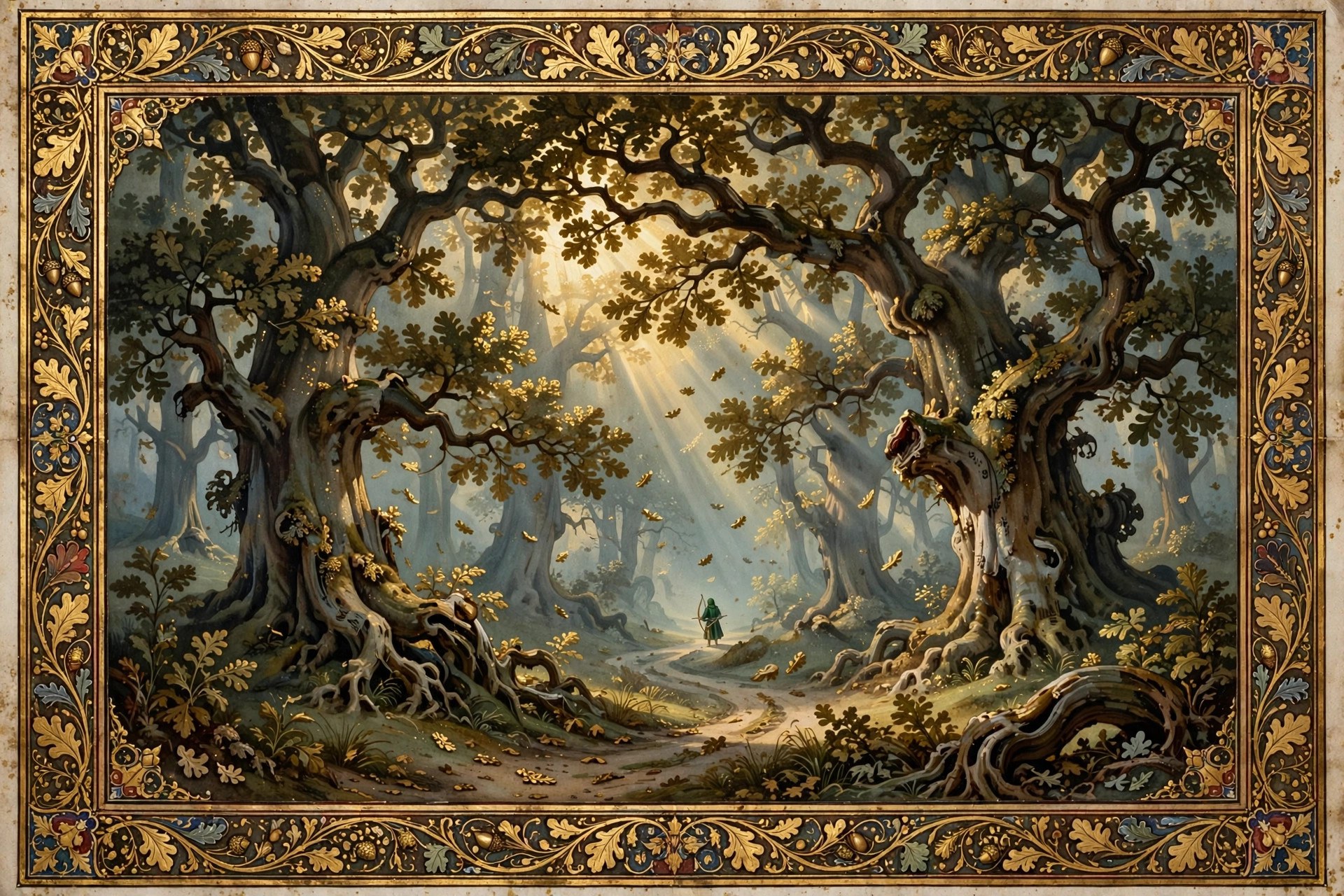
Sherwood Forest
The greenwood is the legend's real home — more constant than any character. This is a guide to the places Robin Hood is said to have haunted, and what each one can honestly claim.
Sherwood Forest, Nottinghamshire
Sherwood was a royal hunting forest — a legal status, not just a wood. Under the forest law, the king's deer were protected by savage penalties, and living by the bow in the forest was, by definition, outlawry. That is the whole economic engine of the legend: Robin's venison feasts are crimes against the crown's hunting rights.
The historical Sherwood covered a large sweep of Nottinghamshire. The surviving fragment, now a national nature reserve, centers on Edwinstowe. Its most famous tree is the Major Oak — a vast hollow oak traditionally called Robin's headquarters. Honesty requires the caveat: the tree was named the "Major Oak" in the Victorian era (after Major Hayman Rooke, the antiquarian who described it), and while it is genuinely ancient — commonly estimated at 800 to 1,000 years old — there is no medieval evidence connecting it to any outlaw. It is a magnificent tree with a Victorian legend attached.
Barnsdale, South Yorkshire
Here is the awkward fact for Nottingham tourism: the early ballads point to Barnsdale, not Sherwood. The Gest opens with "Robyn stode in Bernesdale"; Guy of Gisborne sets its action there. Barnsdale was the stretch of the Great North Road (Watling Street) in South Yorkshire — prime ambush country for the Gest's highway robberies. Scholars of the early tradition (notably Dobson and Taylor) have argued that the medieval Robin belongs to Yorkshire, and that Sherwood's dominance is the work of later retellings. Both forests can claim him; the older texts favor Barnsdale.
Robin Hood's Well, a small stone well-house by the A1 at Barnsdale Bar, marks the Yorkshire claim — a historic site, though its current structure is much restored.
Nottingham
The Sheriff's town, and the legend's urban anchor. The Gest and the ballads stage the archery contest, the wrestling, and the jailbreaks at Nottingham; the castle — a royal fortress — looms over the stories. The city's modern Robin Hood tourism (the statue by the castle walls, the "Robin Hood" everything) is twentieth-century civic branding, but the town's place in the ballads is genuinely medieval.
Kirklees, West Yorkshire
The legend's end: Kirklees Priory, where the prioress treacherously bleeds the aging Robin to death in Child 120, Robin Hood's Death. A grave in the priory grounds — the so-called Robin Hood's grave, with its worn inscription naming "Robert Earl of Huntingdon" — has been a pilgrimage site for centuries. The stone and its inscription are later monuments to the tradition, not medieval evidence: they mark where the legend says he lies, which is a different thing from where a man lies. The priory grounds are private land; the grave is not routinely accessible.
The geography of a legend
Put the sites together and a pattern emerges: the legend's map is a palimpsest. The medieval layer is Yorkshire — Barnsdale, the Sayles, St. Mary's Abbey at York, Kirklees. The Tudor and modern layer is Nottinghamshire — Sherwood, Nottingham Castle, Edwinstowe, the Major Oak. Neither layer is "wrong"; legends accrete real places as they travel. But anyone selling you the one true Robin Hood location is selling tourism, not history.
Source notes
- Sherwood as a royal forest and the forest law: the legal context is standard medieval history; see sources.
- Barnsdale in the Gest (117A.3, "Robyn stode in Bernesdale") and in Guy of Gisborne (118A).
- The Yorkshire thesis: Dobson & Taylor's work on the early tradition.
- The Major Oak: named for Major Hayman Rooke (18th century); age estimates of 800–1,000 years are modern arboricultural estimates, not documented facts.
- Kirklees grave: the "Robert Earl of Huntingdon" inscription is an early-modern monument; the priory site is private.
Limitations
- Tree ages, well restorations, and grave inscriptions are given as the current state of knowledge; local traditions vary and are not adjudicated here.
- Distances and modern administrative boundaries are not mapped on this page; it is a literary gazetteer, not a travel guide.