A Gest of Robyn Hode
The longest and greatest of the Robin Hood ballads — some 450 stanzas in eight fyttes, composed in the mid-1400s and first printed around 1495. Nearly everything the legend became starts here.
What it is
The Gest (from the Old French geste, a tale of deeds) is really several ballads stitched into one continuous narrative — scholars can see the seams. It runs to roughly 450 stanzas in eight sections called "fyttes," and it tells, in order:
- Fyttes 1–2: The poor knight. Robin refuses to dine until he has a guest; his men bring in Sir Richard at the Lee, a knight ruined by debt to the abbot of St. Mary's, York. Robin lends him 400 pounds on the security of the Virgin Mary, outfits him like a lord, and sends him to pay the abbot.
- Fyttes 3–4: The monk's gold. A year later Robin's men waylay a monk of St. Mary's carrying 800 pounds — the Virgin, Robin says, has repaid the loan with interest. The knight returns to repay Robin, who refuses the money: Our Lady has paid already.
- Fytte 5: The archery contest. The Sheriff of Nottingham proclaims a shooting match; Robin enters in disguise, splits the wand ("Thryes Robyn shot a bout, / And alway he slist the wand"), wins the silver arrow, and escapes the ambush.
- Fytte 6: The rescue. The Sheriff captures Robin at a wrestling match; Little John tricks the king's men and breaks him out.
- Fyttes 7–8: The king. "Edwarde, our comly kynge" comes to Nottingham, meets Robin in disguise in the forest, is feasted and then recognized; Robin is pardoned, serves at court, grows homesick, and returns to the greenwood — where, the Gest says, he lived twenty-two years before dying at Kirklees.
The opening
The most famous stanza in the Robin Hood tradition opens the Gest, and every later version of the legend echoes it:
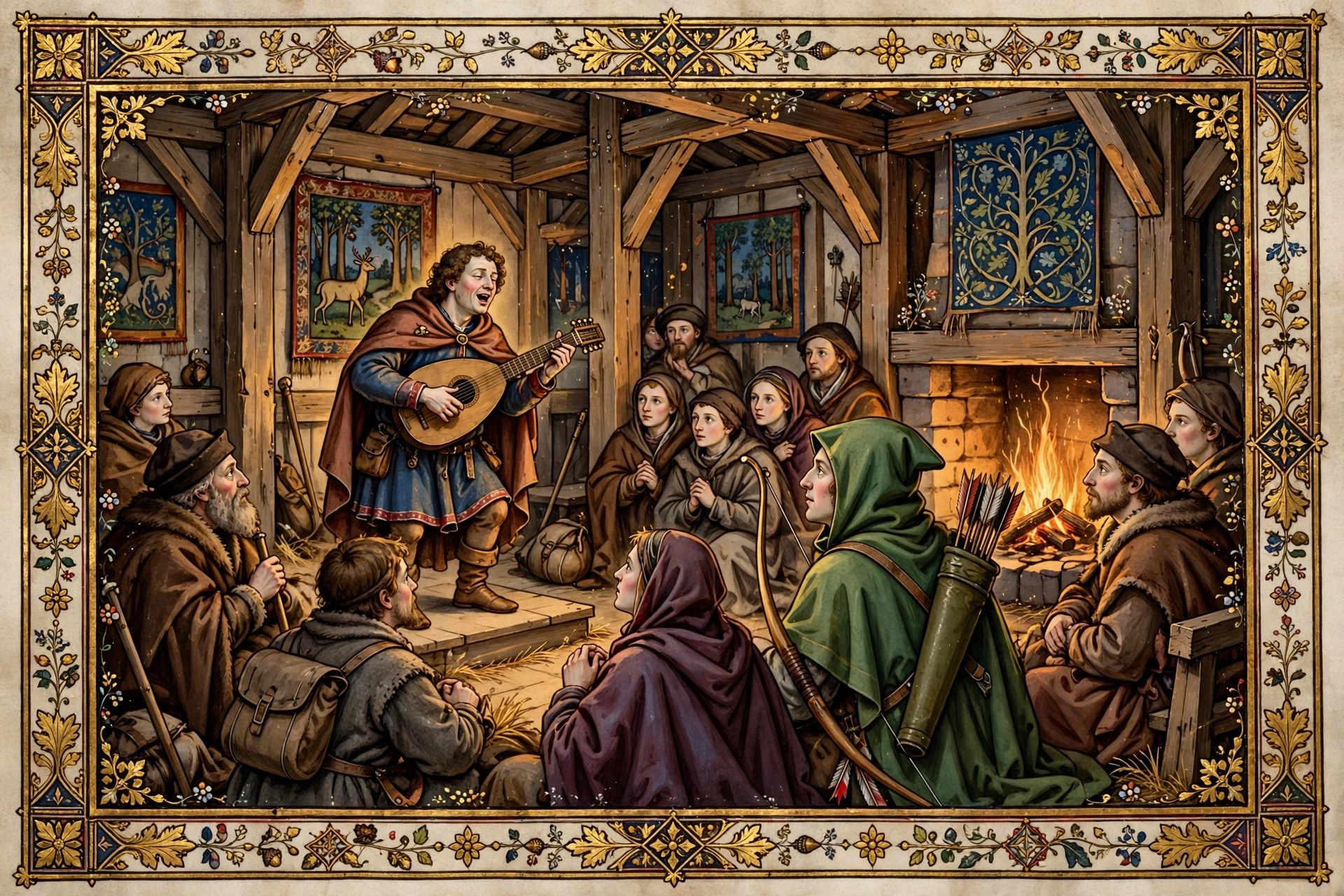
LYTHE and listin, gentilmen, That be of frebore blode; I shall you tel of a gode yeman, His name was Robyn Hode.
("Listen, gentlemen of freeborn blood; I shall tell you of a good yeoman; his name was Robin Hood.") The full verse is on the sayings page.
When it was made — and printed
The Gest was composed around the mid-fifteenth century (Child's dating, c. 1450; the language and the stitching-together of older lays point to the 1400s). It survives in early printed editions, not manuscripts — which is unusual and important:
- Fragments printed by Richard Pynson survive from the 1490s — the earliest printing of any Robin Hood text.
- Wynkyn de Worde printed an edition around 1506; Chepman and Myllar printed one in Scotland around 1508.
- No complete early copy survives; the text is reconstructed from fragments.
So the Gest as we have it is a printed book of the 1490s–1500s preserving a poem of the 1400s, which itself stitches lays that may be older still. Three layers of transmission — and the poem was already a classic when the printers got it.
The world of the Gest
The Gest's England is specific in a way the later ballads are not: Barnsdale (South Yorkshire) more than Sherwood; the Sayles and Watling Street as the ambush roads; St. Mary's Abbey, York, as the institutional villain; Nottingham as the sheriff's town. The king is Edward — "Edwarde, our comly kynge" (fytte 8) — which is one reason scholars have hunted for a real Robin in the reigns of the Edwards rather than Richard I. The 1190s setting of the modern legend comes from John Major's 1521 conjecture, not from the Gest.
Why it matters
Almost every durable element of the legend is in the Gest first: the greenwood band with its code ("loke ye do no husbonde harme"), the disguise-and-trick structure, the archery contest, the corrupt churchmen, the pardon plot, the death at Kirklees. The later tradition — the plays, the broadsides, Scott, the films — is largely a matter of selecting from the Gest, rearranging it, and adding Marian and Prince John. Read the Gest and you have read the source code of Robin Hood.
Source notes
- Text: Child 117A, The English and Scottish Popular Ballads, vol. III; quoted stanzas are fytte 1, st. 1 ("Lythe and listin") and fytte 5 (the archery contest); "Edwarde, our comly kynge," fytte 8, st. 354.
- Composition date c. 1450: Child's dating; modern scholarship broadly accepts a mid-fifteenth-century date.
- Printings: Pynson fragments (1490s, the earliest surviving Robin Hood print); Wynkyn de Worde (c. 1506); Chepman and Myllar, Edinburgh (c. 1508).
Limitations
- The Gest's text is reconstructed from fragmentary early prints; stanza numbering follows Child and varies slightly between editions.
- "Some 450 stanzas" is approximate; editions count between 447 and 456.
- The claim that the Gest stitches older lays is a scholarly inference from narrative seams, not a documented fact.