Works
The physics made him famous. The alchemy and theology manuscripts — most unpublished in his lifetime — show what he actually spent his time on.
De Motu Corporum in Gyrum (1684)
“On the motion of bodies in an orbit” — the short treatise Newton wrote for Halley after the August 1684 visit, deposited with the Royal Society that November. The Principia in embryo: it already proves that an inverse-square attraction yields Kepler’s elliptical orbits.
Source: Manuscript copies in the Royal Society archives; printed in A. R. Hall and M. B. Hall, Unpublished Scientific Papers of Isaac Newton (1962).
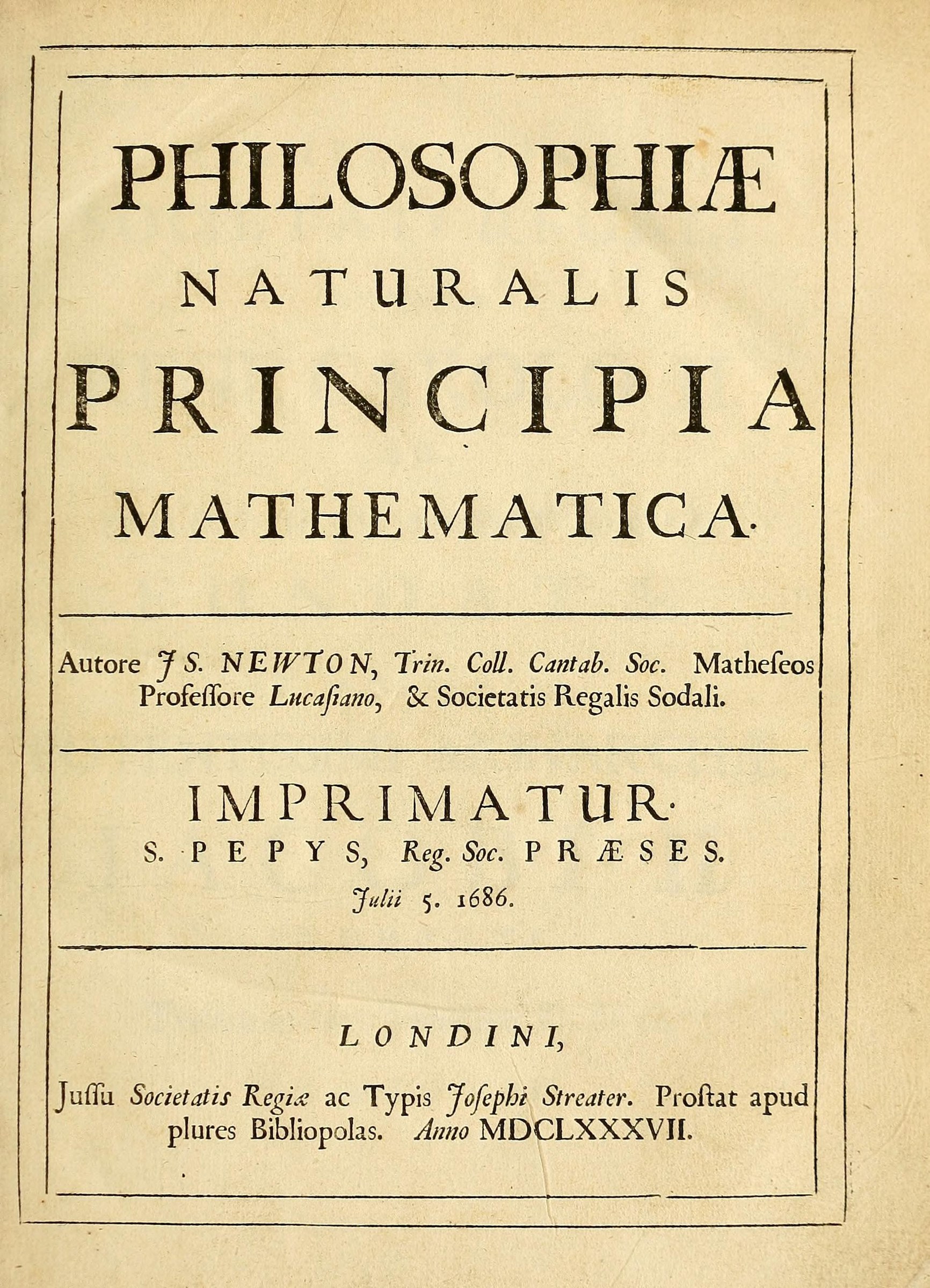
Philosophiæ Naturalis Principia Mathematica (1687)
The Mathematical Principles of Natural Philosophy: three books setting out the laws of motion, universal gravitation, and their application to the tides, comets, lunar motion, and the shape of the Earth. Written in dense geometrical style (deliberately difficult, Newton later admitted, “to avoid being baited by little smatterers in mathematics” — a reported remark). Halley funded the printing when the Royal Society’s funds were exhausted.
Revised second edition 1713 (edited by Roger Cotes, adding the General Scholium); third edition 1726.
Source: First edition, London: Joseph Streater for the Royal Society, 1687; modern translation by I. B. Cohen and A. Whitman (1999).
Opticks (1704)
A treatise of the reflexions, refractions, inflexions and colours of light — published in English, not Latin, and in Newton’s own name (the Principia had carried Halley’s imprimatur). Three books of experiments, including the experimentum crucis proving white light is a mixture of refrangible rays, followed by the speculative Queries — sixteen in the first edition, thirty-one by 1717 — musing on forces, aether, and the nature of matter.
Source: First edition, London: Samuel Smith and Benjamin Walford, 1704; Dover reprint of the 4th edition (1952).
The calculus: De analysi and the Method of Fluxions
Newton developed his calculus (“the method of fluxions”) by the late 1660s but published almost nothing. De analysi per aequationes numero terminorum infinitas (1669) circulated in manuscript among a few mathematicians; De methodis serierum et fluxionum (1671) stayed unpublished until 1736, after his death. Leibniz published his own version in 1684 — setting up the priority dispute.
Source: Manuscripts in the Newton Project; D. T. Whiteside (ed.), The Mathematical Papers of Isaac Newton (8 vols., 1967–81).
Optical lectures and papers
Newton’s Lucasian lectures on optics (1670–72) and his 1672 Philosophical Transactions paper “New Theory about Light and Colours” — the work that made his reputation and his enemies. The disputes with Hooke, Huygens, and Pardies that followed taught him to dread publication.
Source: Philosophical Transactions of the Royal Society, no. 80 (19 Feb 1672).
Arithmetica Universalis (1707)
Newton’s Cambridge algebra lectures, published without his consent by William Whiston from student notes. Newton was furious at the unauthorized edition.
The Chronology of Ancient Kingdoms Amended (1728)
Newton’s attempt to date ancient history by astronomy — shortening the conventional chronology by centuries. Published posthumously; scholars found the method ingenious and the conclusions mostly wrong.
Source: London: J. Tonson, 1728.
Observations upon the Prophecies of Daniel and the Apocalypse of St. John (1733)
Newton’s biblical prophecy commentary, published six years after his death. He treated prophecy as a code to be deciphered with the same rigor as nature: “He gave this and the Prophecies of the Old Testament, not to gratify mens curiosities by enabling them to foreknow things, but that after they were fulfilled they might be interpreted by the event.”
Source: London: J. Darby and T. Browne, 1733.
An Historical Account of Two Notable Corruptions of Scripture (1754)
Newton’s textual criticism of the Trinity proof-texts (1 John 5:7 and 1 Timothy 3:16) — the scholarly arm of his anti-Trinitarianism. Circulated privately for decades; published twenty-seven years after his death.
Alchemical manuscripts
Decades of laboratory notebooks and treatises — hundreds of thousands of words, some in cipher — on transmutation, the philosopher’s stone, and the secret fire. Newton experimented seriously from the 1670s into the 1690s. Scattered after his death; much of it bought by John Maynard Keynes at the 1936 Sotheby’s sale, now divided between Cambridge and Jerusalem.
Source: The Chymistry of Isaac Newton project (Indiana University); Newton Project transcriptions.
Theological manuscripts
Private treatises on the Trinity (which he rejected), the interpretation of prophecy, and church history — heretical by the standards of his day and never published in his lifetime. Their survival is why we know the “rational scientist” image is incomplete.
Source: Newton Project; Yahuda manuscripts at the National Library of Israel.
Correspondence
Over a thousand surviving letters — to Hooke, Halley, Leibniz (via Oldenburg), Locke, Bentley, Flamsteed, Cotes, and dozens more — the richest record of Newton’s working mind and his feuds.
Source: H. W. Turnbull et al. (eds.), The Correspondence of Isaac Newton (7 vols., 1959–77); Newton Project.
Source notes
- Bibliography: A Catalogue of the Portsmouth Collection (1888) for the manuscripts; Whiteside’s Mathematical Papers for the mathematics.
- Principia publication details: Cohen’s introduction to the 1999 translation.
- Alchemy manuscripts and the Keynes purchase: the Newton Project and the Chymistry of Isaac Newton project.
- “Smatterers in mathematics”: reported by Newton to William Derham; quoted in Westfall, Never at Rest.