The Alchemist
For thirty years Newton ran a private alchemical laboratory at Cambridge — and wrote about a million words on the subject. This is what the manuscripts actually contain, and what they don't prove.
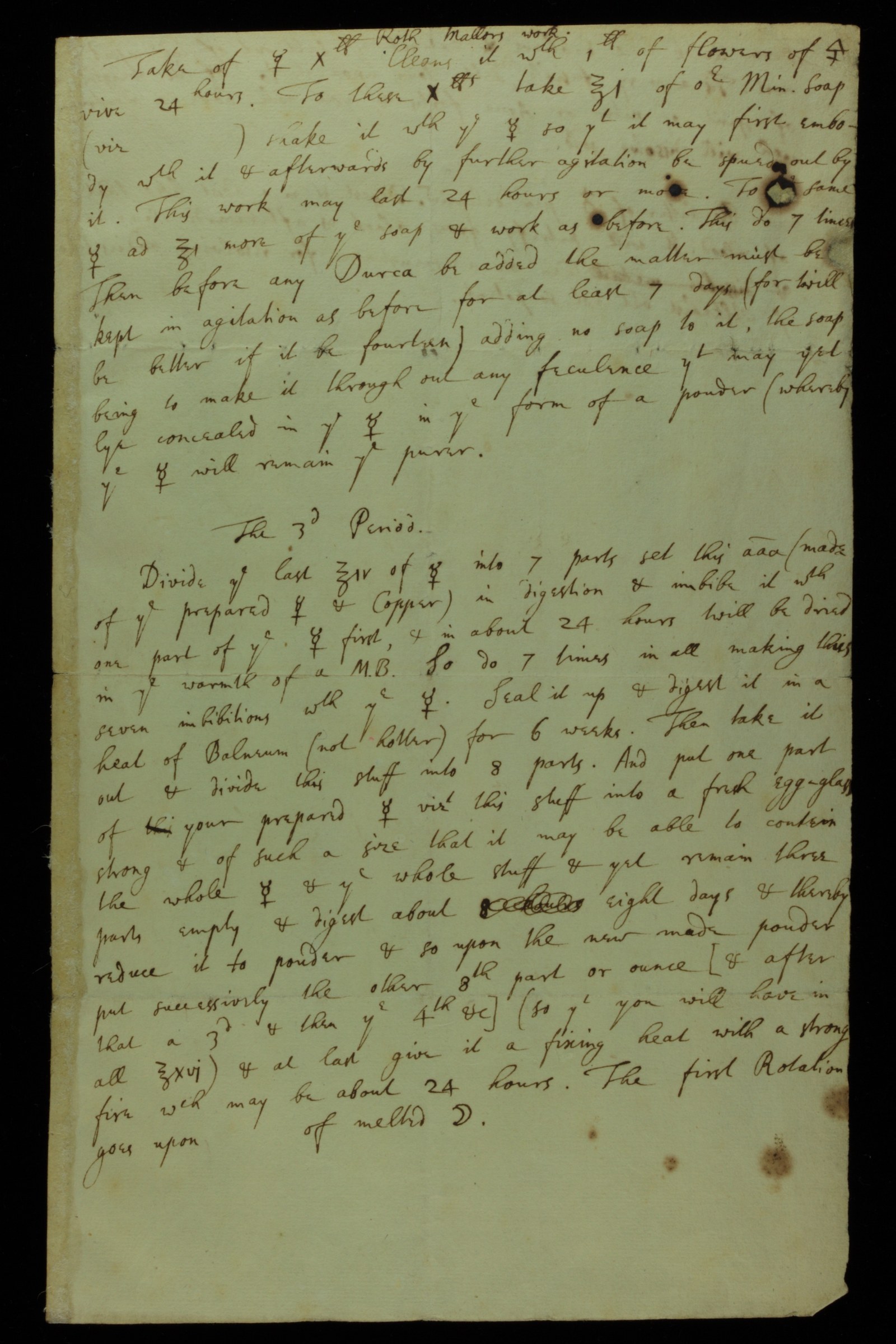
Newton’s published science is a fraction of what he wrote. Among his papers are roughly a million words on alchemy — transcriptions of other men’s books, a vast topical index, laboratory notes, and drafts of his own treatises. He printed none of it. When his papers were sorted after his death, the executors’ verdict was written across them: they were judged “not fit to be printed.” Cambridge University, offered the manuscripts, handed the alchemical and theological residue back as of little interest. In 1936 they were sold at Sotheby’s in parcels for a few pounds each. The economist John Maynard Keynes, arriving late, bought back what he could — and announced that Newton had been “not the first of the age of reason” but “the last of the magicians.”
Keynes meant to shock, and the phrase stuck. It is worth asking what it actually means.
The laboratory in the garden
Newton worked at a furnace in Trinity College through the 1670s and 1680s — the same years he was writing the Principia. His assistant Humphrey Newton, writing to John Conduitt in January and February 1728, described the fire kept through the night and the experiments that filled the chambers. This was not dabbling: Newton bought furnaces, chemicals, and metals, kept a secretary to mind the fire, and corresponded with Robert Boyle about “red earth” — alchemical materials sent after Boyle’s death.
What the manuscripts contain
The surviving material, now transcribed online by the Chymistry of Isaac Newton project at Indiana University, falls into several kinds:
- The Index Chemicus — a vast topical index cross-referencing hundreds of alchemical authors under thousands of headings (Keynes MS. 30 at King’s College, Cambridge). Newton read the literature exhaustively before he experimented.
- Transcriptions and translations — including Newton’s own English translation of the Emerald Tablet, the foundational Hermetic text.
- Laboratory notes — records of distillations, dissolutions, and amalgamations, in the same dense hand as the physics manuscripts.
- Original treatises — drafts pursuing a “sophic mercury” that would open metals to reorganization, and close study of the mysterious author “Eirenaeus Philalethes” (a pseudonym now identified with the American alchemist George Starkey — established only in the 1990s).
What scholars argue about
The older story was simple: the alchemy was an embarrassment, a separate and irrational hobby. Since Betty Jo Teeter Dobbs’s work in the 1970s, historians have argued the opposite — that the alchemy belongs with the physics. Newton’s interest in active principles and forces operating across distance, the argument runs, fits his chemistry as well as his mechanics. Query 31 of the Opticks — his speculation about short-range attractions and repulsions between particles — reads like the public shadow of the private alchemical program.
This does not make Newton a “magician” in any literal sense. The manuscripts contain hardly any magic. They contain patient, systematic chemistry pursued with the same intensity he brought to everything else — and they show a man convinced that nature’s operations were unified, whether they yielded to mathematics or not.
What we don’t know
Much remains unread in the deeper sense: the manuscripts are transcribed but their argument is still being reconstructed. Whether alchemy caused any particular discovery in the physics is debated, not settled. What is settled is the scale — and that Newton himself chose to keep it private.
Source notes
- Scale of the manuscripts and “not fit to be printed”: the standard account follows the posthumous sorting of the papers and the 1936 Sotheby’s sale; the Keynes collection now at King’s College, Cambridge.
- Keynes’s “last of the magicians”: his 1946 lecture for the Newton tercentenary.
- Index Chemicus: Keynes MS. 30, King’s College; analyzed by R. S. Westfall, “Isaac Newton’s Index Chemicus,” Ambix 22 (1975).
- Humphrey Newton’s letters to Conduitt, 17 January and 14 February 1727/8 (Keynes MS. 135); transcriptions via the Newton Project.
- Laboratory work and Boyle’s “red earth”: documented in the correspondence; see R. S. Westfall, Never at Rest (1980).
- The Dobbs thesis: B. J. T. Dobbs, The Foundations of Newton’s Alchemy (1975) and The Janus Faces of Genius (1991).
- Transcriptions: The Chymistry of Isaac Newton, Indiana University (public digital edition).