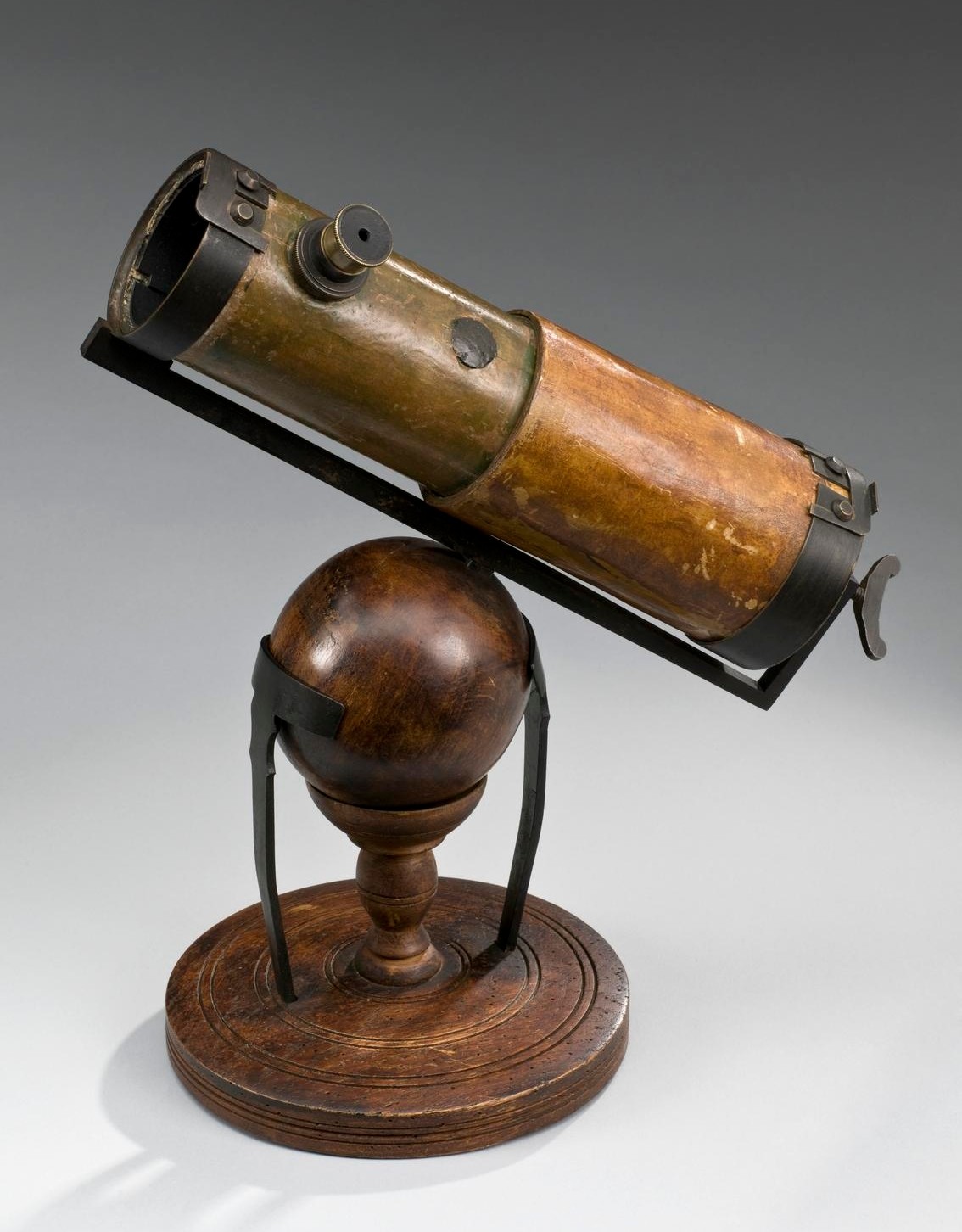
Telescope and Optics
Newton stopped trusting lenses and started trusting mirrors. The result was a six-inch tube that changed astronomy — and a theory of color that changed physics.
The telescope
Chromatic aberration — the rainbow fringing at the edges of lens images — convinced Newton that refracting telescopes could never be perfected. His answer was the reflector: a concave mirror instead of an objective lens. He built the first in 1668 (with a speculum-metal mirror about 1.3 inches across, in a six-inch tube) and a second, improved instrument in 1671. When the second was shown to the Royal Society in December 1671, the fellows were astonished: it magnified forty times and outperformed refractors many times its length. Newton was elected a Fellow of the Royal Society in January 1672, on the strength of the instrument.
Reporting it to Henry Oldenburg on 18 January 1672, Newton called the telescope “the oddest if not the most considerable detection which hath hitherto been made in the operations of Nature.” Replicas survive at the Royal Society and the Whipple Museum, Cambridge.
The prism years
The telescope’s fame got Newton invited to publish — and what he chose to publish was optics. His paper “A New Theory about Light and Colours,” read to the Society on 6 February 1672 (Philosophical Transactions no. 80), argued from the famous experiments of 1665–66: that white light is not pure but a mixture of rays of different refrangibility — different colors — and that the prism does not create the colors, it separates them.
The decisive move was the experimentum crucis (“crucial experiment”): having split sunlight with one prism, Newton passed a single color through a slit into a second prism — and it emerged unchanged, not further split into new colors. Color, therefore, was a property of the light itself, not of the glass. The phrase experimentum crucis became the model of the decisive test.
The backlash
Robert Hooke and Christiaan Huygens attacked the theory — Hooke defending a wave account, and with personal venom. The controversy drove Newton to a vow of silence: he published nothing more on optics for thirty years. Only after Hooke’s death did Newton release the Opticks (1704) — a book in English, not Latin, built around 31 “Queries,” the great open questions he left to the future. Query 31’s speculations about short-range forces read, to modern eyes, like a first sketch of chemistry.
The fair story
Tradition says Newton bought his first prism at Stourbridge fair in 1665. It is a plausible story, and a good one — but it is tradition, not document. What is documented is the darkened chamber at Woolsthorpe, the hole in the shutter, and the spectrum thrown across the room: the most famous parlor trick in the history of science, and the one that worked.
Source notes
- Reflector of 1668; second telescope shown December 1671; FRS January 1672: Royal Society records.
- “The oddest if not the most considerable detection…”: Newton to Oldenburg, 18 January 1672, documented in the correspondence.
- “A New Theory about Light and Colours”: read 6 February 1672, Philosophical Transactions no. 80.
- Experimentum crucis and the Opticks (1704): the published texts; 31 Queries.
- Stourbridge fair prism: traditional, reported — not documented.