Newton in Art and Memory
No scientist has been sculpted, painted, and versified more than Newton. Three centuries of artists each made their own Newton — and each one tells us about the age that made it.
The statues
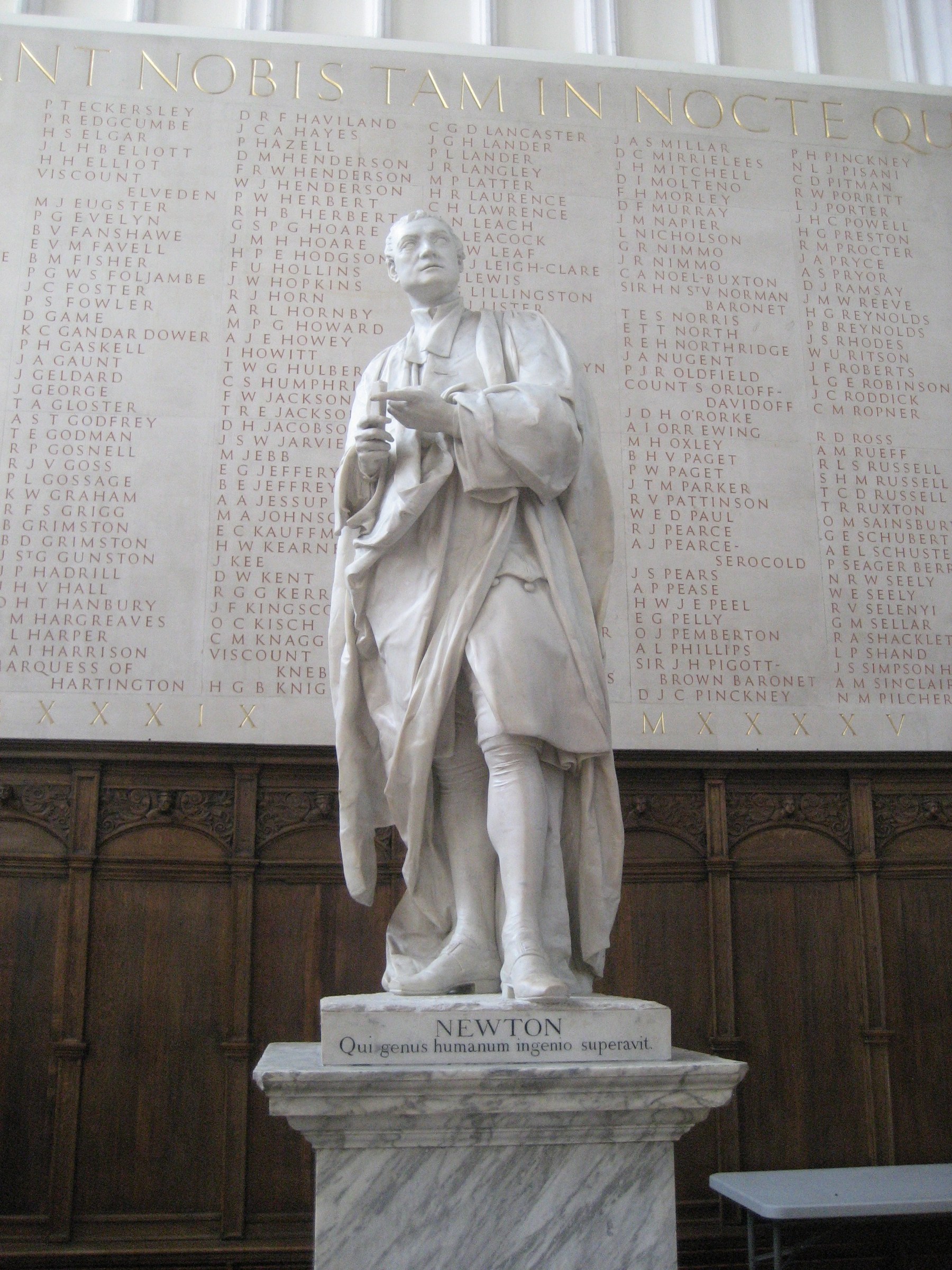
- Trinity College, Cambridge (1755): Louis-François Roubiliac’s marble shows Newton in classical drapery, holding a prism, a scroll of the Principia at his feet — the Enlightenment’s Newton, reason made marble.
- Westminster Abbey (1731): The monument designed by William Kent and executed by Michael Rysbrack lays him out like a Roman, elbow resting on four great books — the spines, unexpectedly, mark Chronology and Theology as equal in weight to Gravity and Optics. The sculptor knew what the century was already forgetting.
The words
Alexander Pope’s intended epitaph (1730) is the most quoted four lines in the history of science:
“Nature, and Nature’s Laws lay hid in Night: God said, Let Newton be! and All was Light.”
Pope meant it as praise; later ages have read it as the whole Enlightenment in miniature — and as a provocation, since Newton’s own God was nothing like Pope’s.
Wordsworth, standing before the Trinity statue a century later, answered with the Romantic Newton:
“Newton with his prism and silent face, The marble index of a mind for ever Voyaging through strange seas of Thought, alone.”
(The Prelude, Book III.) The solitary genius, alone with the infinite: the nineteenth century’s invention, still with us.
The brooding print
William Blake’s color print Newton (c. 1795, printed c. 1805) shows the philosopher crouched on a rock, compasses in hand, back turned to the living world — Blake’s indictment of single vision, of the reason that measures everything and sees nothing. It is the most hostile great image of Newton ever made, and one of the most famous.
The portraits
Newton sat for some nine painters. The images that fixed his face: Godfrey Kneller’s 1689 portrait (the young Lucasian professor, long hair, direct gaze) and Kneller’s 1702 portrait (the public man); James Thornhill’s baroque ceiling and portrait of c. 1709–12; and the engravings after them that carried his face across Europe. Milo Keynes’s catalogue, The Iconography of Sir Isaac Newton to 1800, lists 231 portraits and sculptures — about fifty made in his lifetime. Few historical figures were so looked-at.
The tree
And then there is the apple tree at Woolsthorpe — a Flower of Kent, the National Trust’s descendant of the original — which may be the most visited scientific relic in England. Pilgrims go to stand where, the story says, a falling apple asked the question.
Source notes
- Roubiliac statue, Trinity College Chapel (1755): college records.
- Westminster Abbey monument, designed by William Kent, executed by Michael Rysbrack, erected 1731: Abbey records.
- Pope’s “Epitaph. Intended for Sir Isaac Newton” (1730): published text.
- Wordsworth, The Prelude, Book III (1805 text): published text.
- Blake, Newton, color print, c. 1795 (printed c. 1805): Tate collection dating.
- Portrait count: M. Keynes, The Iconography of Sir Isaac Newton to 1800 (2005) — 122 portraits, 109 sculptures catalogued.