The Apple
The apple story is better documented than most people think. It is also nothing like the cartoon. Here is what the witnesses actually said.
What is documented
The story reaches us through three independent early channels:
- William Stukeley, 15 April 1726. Dining with Newton at Kensington, Stukeley recorded the old man’s own account in his Memoirs of Newton’s Life (manuscript 1752, Royal Society archives): sitting in the garden at Woolsthorpe, “why should that apple always descend perpendicularly to the ground, thought he to himself: occasion’d by the fall of an apple, as he sat in a contemplative mood.”
- John Conduitt, 1726. Newton’s nephew-by-marriage (he married Newton’s niece Catherine Barton) collected the same account in his notes the same year.
- Voltaire, 1727. In his Essay upon the Civil Wars of France (and the Essay on Epic Poetry), Voltaire — who had the story from Conduitt and Barton in London — gave it to Europe. Voltaire’s telling is the one that made the apple famous.
Three witnesses, two of them taking notes within months of the conversation, all pointing to the same orchard. That is a solid documentary base for a seventeenth-century anecdote.
What the witnesses did NOT say
- The apple did not hit Newton on the head. No early source claims this. It fell near him; the thought was his.
- There was no instant “Eureka.” Stukeley’s Newton was in “a contemplative mood”; the moon-test, the calculations, the Principia — that took twenty years.
- It was not a myth invented later. The story predates Newton’s death by a year and comes from his own circle, not from Victorian hagiography.
The tree
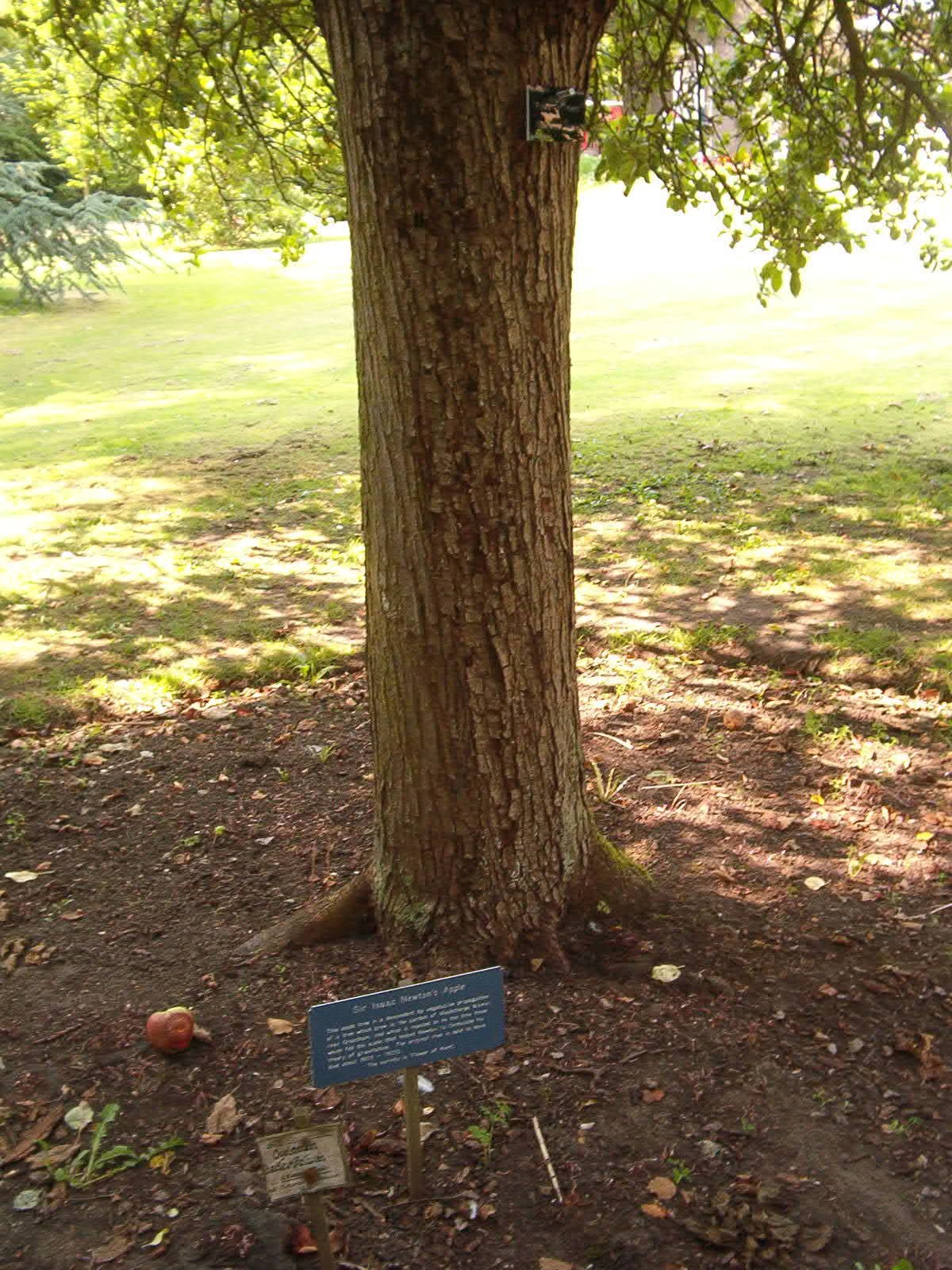
Woolsthorpe Manor still stands, and the orchard still has an apple tree of the Flower of Kent variety — the National Trust’s tree is a descendant of the original, which blew down in the nineteenth century. A grafted descendant grows in the Cambridge University Botanic Garden. Botanists have done the paperwork; the genetics check out.
Why it matters
The story survives because it is true in the sense that matters: not that an apple explained gravity, but that a mundane falling body prompted the question Newton spent his life answering — whether the force that pulls an apple to the ground might be the same force that holds the Moon. The apple was the question, not the answer.
Source notes
- Stukeley, Memoirs of Sir Isaac Newton’s Life (1752 manuscript): conversation dated 15 April 1726; Royal Society archives.
- Conduitt’s 1726 memoranda: Keynes MS, King’s College, Cambridge.
- Voltaire’s accounts (1727): Essay upon the Civil Wars of France; Voltaire sourced it via Conduitt and Catherine Barton Conduitt.
- The Flower of Kent tree at Woolsthorpe and its Cambridge descendant: National Trust and Cambridge University Botanic Garden records.