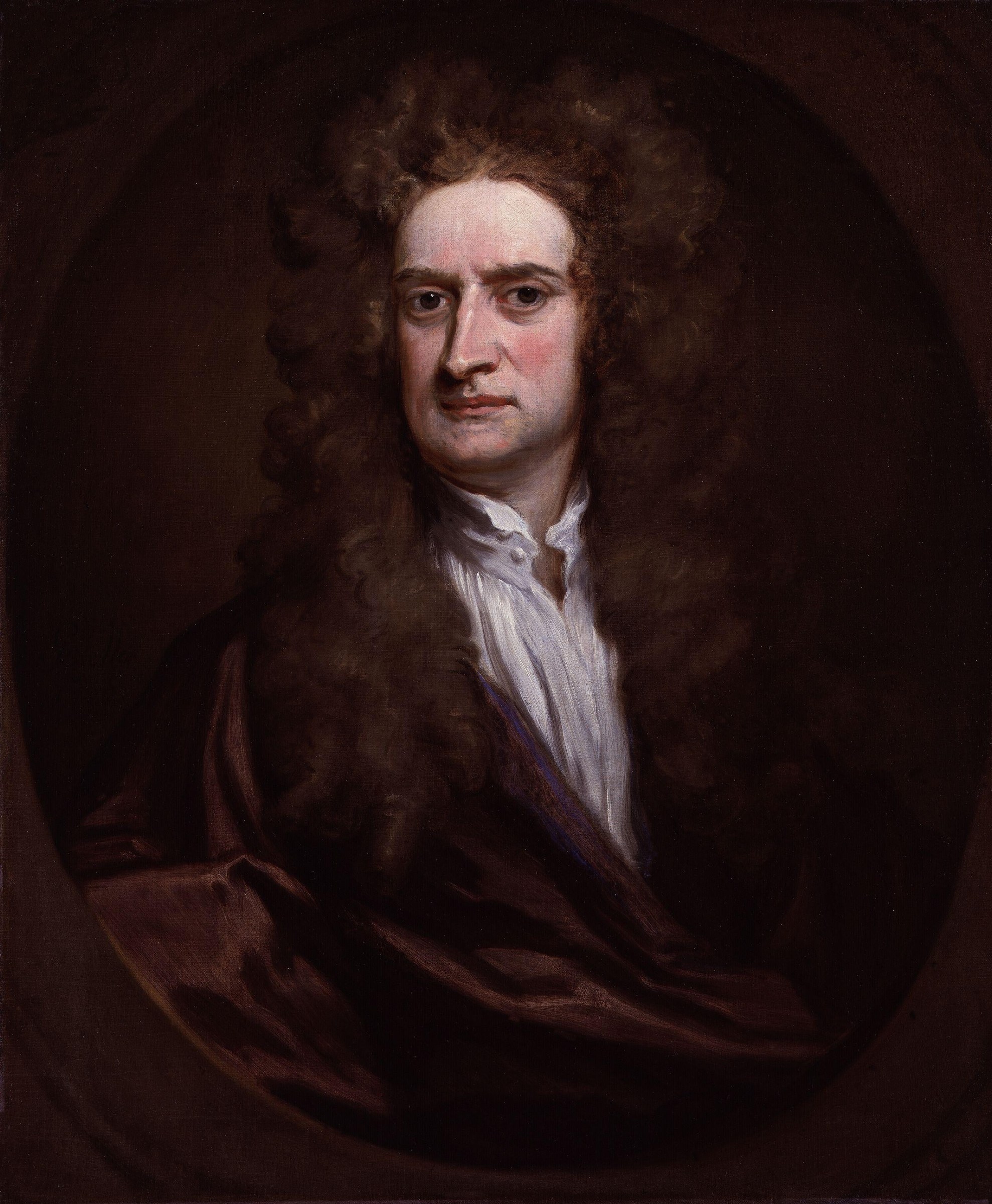
Later Life
The last twenty-four years of Newton's life were spent at the summit of English science — presiding, feuding, investing, and becoming a national monument before he died.
President of the Royal Society
Elected in 1703 on Hooke’s death, Newton presided over the Royal Society for the rest of his life — re-elected annually for 24 years. He ran it as he ran everything: absolutely. He moved its meetings, managed its publications, and used its machinery in the calculus war with Leibniz (see The Calculus Dispute). He was also made an associate of the French Académie des Sciences.
Knighted
In April 1705 Queen Anne knighted Newton at Trinity College, Cambridge — the second scientist to be knighted, after Francis Bacon. Historians note the timing: the honor came during the run-up to the May 1705 parliamentary election, in which Newton stood, and was likely political as much as scientific. It made him Sir Isaac regardless.
The Flamsteed feud
Newton’s other great enmity was with John Flamsteed, the Astronomer Royal, whose star catalogue Newton needed for the Principia’s lunar theory and would not wait for. In 1712 Newton had Flamsteed’s Historia Coelestis Britannica published prematurely, against its author’s wishes — an act of high-handedness Flamsteed never forgave. The two men died unreconciled.
Parliament and investments
Newton sat as MP for Cambridge University in 1689 and 1701 — famously silent, apart from (reportedly) asking for a window to be shut. He invested heavily in his final decade, including a large position in South Sea stock. The familiar story of his losses is told, with the honest caveats, on our South Sea Bubble page.
Death and burial
Newton died at Kensington on 20 March 1726/7 (Old Style) — 31 March 1727 (New Style) — attended, by the reports of those present, with the same composure he had brought to everything. He refused the sacrament and died intestate, leaving an estate of about £30,000. He was given a state funeral and buried in Westminster Abbey on 28 March, the pall borne by dukes and earls — the first scientist to be so honored. The monument there, designed by William Kent and executed by Michael Rysbrack (1731), shows him reclining on books of his own works, elbow on the Principia.
Source notes
- Royal Society presidency 1703–1727; knighting by Queen Anne, April 1705, Trinity College: standard biographical record (Westfall, Never at Rest).
- Political context of the knighthood: noted in modern biographies; treat as historians’ interpretation, not document.
- Flamsteed and the 1712 Historia Coelestis: documented in the correspondence of both men.
- Death 20 March 1726/7 OS (= 31 March 1727 NS), burial 28 March 1727, Westminster Abbey; intestate: parish and Abbey records.
- Refusal of the sacrament: reported by attendants; not independently audited.
- Abbey monument (Kent/Rysbrack, erected 1731): Westminster Abbey records.