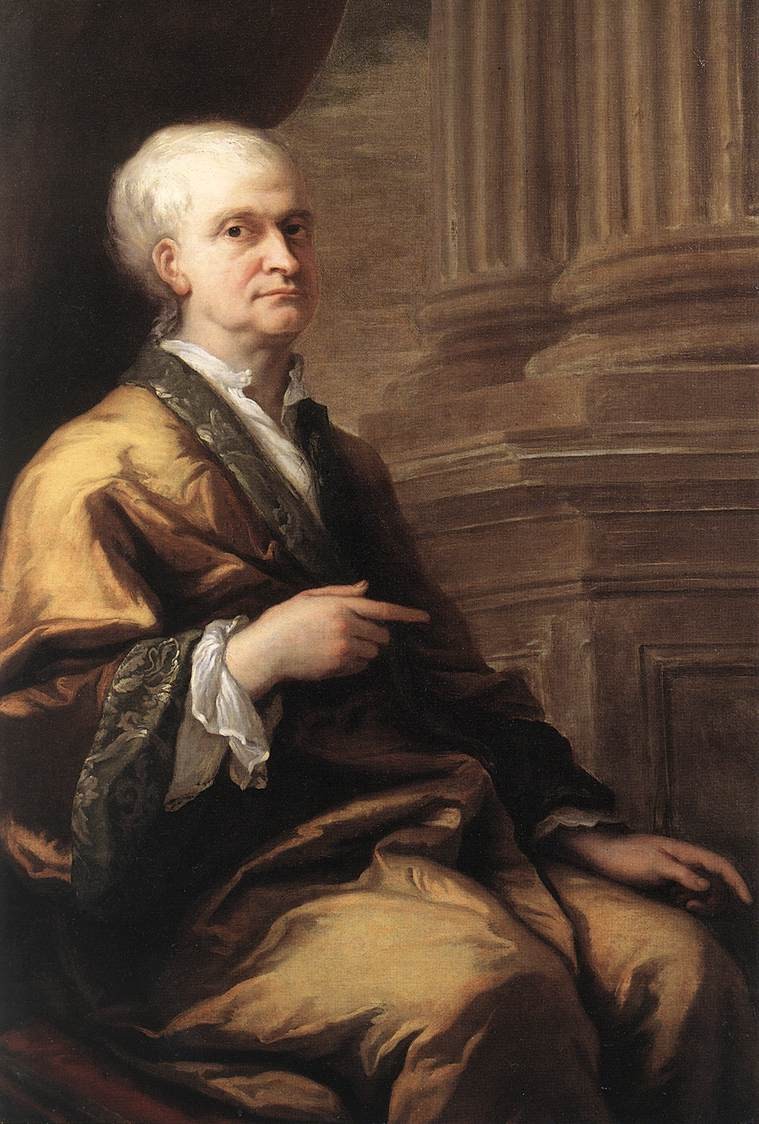
Biography
A lonely Lincolnshire boy who became the Lucasian Professor at Cambridge, wrote the Principia, ran the Royal Mint, and died the most famous natural philosopher in Europe.
Woolsthorpe (1642–1661)
Isaac Newton was born on 25 December 1642 (Julian calendar; 4 January 1643 Gregorian) at Woolsthorpe Manor, near Grantham in Lincolnshire. He arrived prematurely, and his mother later said he could have fit into a quart mug. His father, also Isaac Newton, a prosperous yeoman farmer, had died three months before the birth.
When Newton was three, his mother Hannah remarried the Reverend Barnabas Smith, a wealthy older widower from a nearby parish, and moved away — leaving the boy to be raised by his maternal grandmother, Margery Ayscough. The abandonment left marks: years later, in a private notebook, Newton listed among his “sins” the wish that his mother and stepfather’s house be burned down with them in it.
At the King’s School in Grantham, where he lodged with the apothecary William Clarke, Newton showed mechanical ingenuity rather than scholarship at first: sundials, model windmills, kites with lanterns. By his final years there he was at the top of the school. His stepfather died in 1653; his mother, now with three more children, pulled him home in 1659 to run the farm. He was a hopeless farmer — found reading under a hedge while the sheep strayed — and his uncle William Ayscough intervened to send him back to school and on to Cambridge.
Cambridge and the plague years (1661–1667)
Newton entered Trinity College, Cambridge, in 1661 as a subsizar — a poor student who earned his keep by waiting on wealthier undergraduates. He studied Aristotle’s curriculum but taught himself the new mathematics on the side: Descartes’ geometry, Kepler’s optics, the algebra of Viète. Isaac Barrow, the first Lucasian Professor of Mathematics, recognized his ability.
He took his BA in 1665 — and then the plague came. Cambridge closed, and Newton retreated to Woolsthorpe for most of 1665–66. Those eighteen months became the famous annus mirabilis: working alone, he developed his method of fluxions (the calculus), began the work on universal gravitation, and performed the prism experiments that overturned the received theory of color. He was twenty-three.
Back at Cambridge, he was elected a fellow of Trinity in 1667 and took his MA in 1668.
The Lucasian Professor (1669–1696)
In 1669, Isaac Barrow resigned the Lucasian chair of mathematics — and maneuvered to have the twenty-six-year-old Newton succeed him. Newton would hold the professorship for over thirty years.
His first great public success was technological: the reflecting telescope. In 1668 he built a small reflector that avoided the chromatic aberration of lenses; a larger one presented to the Royal Society in January 1672 caused a sensation, and he was elected a Fellow of the Royal Society that year. His first paper to the Society — the 1672 “New Theory about Light and Colours” in the Philosophical Transactions — argued that white light is a mixture of colors, proven by his experimentum crucis with two prisms.
The paper drew fierce criticism from Robert Hooke, Christiaan Huygens, and others. Newton, thin-skinned and secretive by temperament, took it badly. He swore off publishing and withdrew into private work for years. The pattern repeated through the decade: brilliant private manuscripts — on the calculus, on optics, on alchemy — circulated to almost no one.
Two correspondences broke the isolation. In 1675–76 he exchanged tense letters with Robert Hooke; the famous “shoulders of giants” line comes from a conciliatory letter of 5 February 1676. In 1679–80, Hooke, then secretary of the Royal Society, drew Newton into a correspondence about orbital motion that rekindled Newton’s interest in dynamics — and planted the seeds of a priority quarrel that would poison both men’s later years.
The Principia (1684–1687)
In August 1684, Edmond Halley — astronomer, and the great facilitator of Newton’s career — visited Cambridge with a question: what curve would a planet follow if attracted to the sun by a force falling off as the square of the distance? Newton answered at once: an ellipse. He had computed it years before but couldn’t find the papers. Halley pressed him to write it up.
The result was De Motu Corporum in Gyrum (November 1684), then, in a sustained burst of work through 1685–86, the Philosophiæ Naturalis Principia Mathematica. Halley personally funded the printing — the Royal Society’s funds were tied up in a lavish History of Fishes — and shepherded the book through the press. It appeared on 5 July 1687.
The Principia derived Kepler’s laws from a universal inverse-square law of gravitation, set out the three laws of motion, and treated the tides, comets, and the shape of the Earth. It was immediately recognized as a landmark, though few could follow its dense geometrical arguments.
Newton also served as MP for Cambridge University in the Convention Parliament of 1689 (and again in 1701–02), though he is said to have spoken only once — to ask that a window be closed.
The black year and the Mint (1693–1703)
In 1693 Newton suffered what historians call his breakdown: months of insomnia, paranoia, and depression, documented in anguished letters to Samuel Pepys and John Locke (September 1693) accusing them of plotting against him. The cause is debated — overwork, mercury poisoning from alchemical experiments, the collapse of his intense friendship with the young Swiss mathematician Nicolas Fatio de Duillier, or some combination. He recovered, but his creative scientific peak was behind him.
In 1696, through the patronage of Charles Montagu (later Earl of Halifax), Newton was appointed Warden of the Royal Mint and moved to London. He took the job with startling energy: during the Great Recoinage he ran the Mint’s Cambridge branch, and he pursued counterfeiters as a criminal investigator — gathering evidence, interrogating suspects, and testifying at trials. The forger William Chaloner, who had even accused the Mint itself of corruption, was convicted on Newton’s evidence and hanged in March 1699. Newton became Master of the Mint in 1699, a lucrative post he held until his death. In 1701 he resigned the Lucasian chair (William Whiston succeeded him) and left Cambridge for good.
President of the Royal Society (1703–1727)
Elected President of the Royal Society in 1703, Newton ruled it imperiously for the remaining twenty-four years of his life. The presidency years were dominated by the calculus priority dispute with Leibniz. Leibniz had published his differential calculus in 1684; Newton had developed fluxions earlier but published almost nothing. When the dispute flared, the Royal Society’s 1712 Commercium Epistolicum — nominally a committee report, largely drafted by Newton himself — ruled in Newton’s favor. Modern scholarship credits independent invention by both men, while noting Newton’s earlier start and Leibniz’s superior notation.
The Opticks appeared in 1704, in English rather than Latin — a deliberate choice for a wider audience. Its closing Queries speculated boldly about forces acting at a distance, the nature of light, and even (Query 31) the possibility of transmutation. On 16 April 1705, Queen Anne knighted Newton at Trinity College — the first scientist to be knighted for his work.
Meanwhile Newton continued the private labors he cared about as much as the physics: alchemical experiments (decades of them, recorded in dense coded notebooks) and biblical studies — chronology, prophecy, and a heretical, anti-Trinitarian theology he never dared publish.
Death
Newton died on 20 March 1727 (Julian; 31 March Gregorian) at his home in Kensington, London, after a painful final illness involving bladder stones and gout. He never married and died intestate; his estate passed to his relatives, administered by his niece’s husband John Conduitt. He was given a state funeral and buried in Westminster Abbey, where his monument by Rysbrack shows him reclining on books, an arm resting on a celestial globe.
He was eighty-four, and the most famous natural philosopher Europe had ever produced.
Source notes
- Life dates and career outline: R. S. Westfall, Never at Rest: A Biography of Isaac Newton (1980); Oxford Dictionary of National Biography, “Newton, Sir Isaac”.
- Childhood and the “sins” notebook: Westfall, ch. 1–2; the Fitzwilliam notebook.
- Plague years and annus mirabilis: Westfall, ch. 4.
- Reflecting telescope and 1672 optics paper: A. R. Hall, All Was Light (1993), ch. 2; Royal Society archives.
- Halley’s 1684 visit and the Principia’s publication: Westfall, ch. 7–9; I. B. Cohen’s introduction to the Principia (1999 translation).
- 1693 breakdown and the Pepys/Locke letters: Westfall, ch. 11; Newton Correspondence, vol. 3.
- Mint career and Chaloner: T. Levenson, Newton and the Counterfeiter (2009).
- Knighthood, 16 April 1705: London Gazette record; Westfall, ch. 13.
- Death and burial: parish and Abbey records; Conduitt’s memoir.