Reception
The most famous scientist in history is also one of the most mythologized. Here's what survives scrutiny.
The apple
Verdict: genuine anecdote, cartoon physics. Newton himself told the story to William Stukeley: sitting in the Woolsthorpe orchard, watching an apple fall, he wondered whether the force reaching to the Moon was the same. Stukeley recorded it in his Memoirs (1752). What Newton did not do: get hit on the head, or discover gravity in a flash. The anecdote marks a line of thought, not a eureka moment — the mathematics took twenty more years.
The lone genius
Verdict: half true. Newton really did work alone through the plague years, and his secrecy was legendary. But the Principia exists because Halley badgered, funded, and edited him into publishing; the optics because the Royal Society gave him an audience; the calculus dispute because Leibniz was working the same problems. Remove the correspondents and the genius has no one to talk to — and often, no reason to write.
“The first of the age of reason”
Verdict: Victorian wishful thinking. Keynes’s famous counter-verdict — “Newton was not the first of the age of reason. He was the last of the magicians” (“Newton, the Man,” 1946) — came from reading the alchemical manuscripts Keynes had bought in 1936. Modern scholarship (notably Rob Iliffe’s Priest of Nature, 2017) has complicated both slogans: Newton pursued alchemy, theology, and physics as one continuous inquiry into how God ordered the world. The categories “scientist” and “magician” are ours, not his.
The calculus: who won?
Verdict: independent invention; Leibniz’s notation won the future. The Royal Society’s Commercium Epistolicum (1712) — drafted largely by Newton himself — declared Newton first inventor and implied Leibniz had borrowed. Modern historians (Westfall above all) find no evidence of borrowing: Newton worked earlier, Leibniz published first, and Leibniz’s d-notation proved so superior that even British mathematics eventually adopted it.
Einstein killed Newton?
Verdict: no — he bounded him. General relativity superseded Newtonian gravitation as a fundamental theory, but Newton’s laws remain exactly what engineers use to fly spacecraft and predict tides. Newton wasn’t refuted the way phlogiston was; he was shown to be the limiting case of a deeper theory. The Principia still works everywhere it was ever tested.
The Mint years: sinecure or second career?
Verdict: second career, ruthlessly pursued. Victorian biographers treated the Mint as Newton’s retirement from science. The records show otherwise: he mastered metallurgy, ran the Great Recoinage, and personally built the case that hanged the forger William Chaloner in 1699. Thomas Levenson’s Newton and the Counterfeiter (2009) documents a Newton as formidable in criminal investigation as in mathematics.
The secret heretic
Verdict: documented, and deliberately hidden. Newton’s anti-Trinitarian manuscripts — the Two Notable Corruptions, the prophecy commentaries — are real, extensive, and were never published in his lifetime. He knew the stakes: denying the Trinity was illegal, and would have cost him his Cambridge posts. The 19th century buried this Newton; the 20th, with the Keynes and Yahuda manuscripts, dug him back up.
The “shoulders of giants” problem
Verdict: the humility reading is too simple. Generations learned the line as Newton’s gracious tribute to cumulative science. But the metaphor predates him by five centuries (Bernard of Chartres), and the letter’s recipient was Hooke — short, stooped, and mid-feud with Newton. Some writers (following hints from Hooke’s biographers) read the line as a deliberate needle. The evidence supports the metaphor’s history and the feud’s bitterness; it does not settle Newton’s intent. We report the debate, not a winner.
The statues and the £2 coin
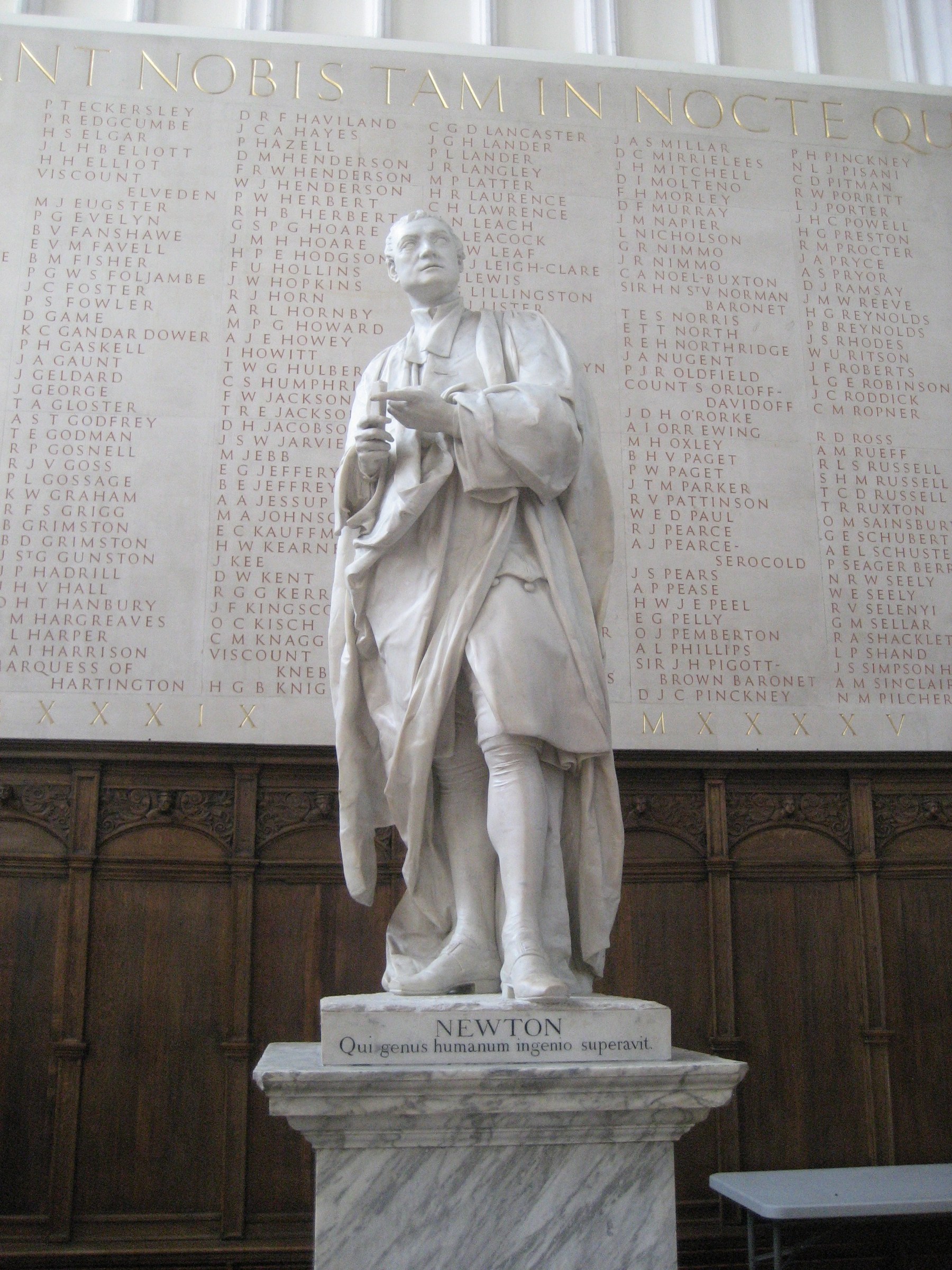
Newton’s afterlife in stone and metal — Roubiliac’s Trinity statue (1755), the Westminster Abbey monument, the British £2 coin’s edge inscription “STANDING ON THE SHOULDERS OF GIANTS” — shows how quickly the man became a monument. Useful rule of thumb: the grander the memorial, the more of the real Newton it edits out.
Source notes
- Apple anecdote: Stukeley, Memoirs of Sir Isaac Newton’s Life (1752; ed. A. R. Hall).
- Keynes, “Newton, the Man” (1946): written for the Royal Society Newton tercentenary; published in The Royal Society Newton Tercentenary Celebrations (1947).
- Alchemy/theology reassessment: B. J. T. Dobbs, The Janus Faces of Genius (1991); R. Iliffe, Priest of Nature (2017).
- Calculus dispute: Westfall, Never at Rest, ch. 14–15; Hall, Philosophers at War (1980).
- Mint: Levenson, Newton and the Counterfeiter (2009).
- £2 coin inscription: Royal Mint records; the edge inscription dates to the 1997 bimetallic issue.