Sayings
Nine quotations we can actually trace to Newton — each labeled documented or reported — plus the famous lines to stop attributing to him.
Each entry carries its tier: documented (traceable to Newton’s own writing) or reported (attributed by someone else, with the chain of transmission). See methodology.
“If I have seen further it is by standing on the shoulders of Giants.”
Documented. Letter to Robert Hooke, 5 February 1676 (dated 5 February 1675 in Old Style, the English year then beginning on 25 March). Newton’s original spelling: “If I have seen further it is by standing on ye sholders of Giants.” The image itself is ancient — it goes back to Bernard of Chartres, quoted by John of Salisbury in the Metalogicon (1159) — so Newton was deploying a well-known metaphor, not inventing one. Some modern writers have suggested the line carried a jab at Hooke, who was short and stooped; that reading is debated, not settled.
Source: H. W. Turnbull (ed.), The Correspondence of Isaac Newton, vol. 1 (1959), p. 416.
“Hypotheses non fingo” — “I feign no hypotheses.”
Documented. From the General Scholium added to the second edition of the Principia (1713), where Newton refuses to offer a mechanical explanation of gravity’s cause: he has derived its laws from phenomena, and “hypotheses… have no place in experimental philosophy.” It is his most quoted methodological statement — and often quoted out of context, since the Opticks is full of hypotheses he was happy to entertain.
Source: Principia, 2nd ed. (1713), General Scholium.
“We are to admit no more causes of natural things than such as are both true and sufficient to explain their appearances.”
Documented. Rule I of the “Rules of Reasoning in Philosophy” at the opening of Book III of the Principia — Newton’s statement of parsimony in natural philosophy.
Source: Principia, Book III.
“This most beautiful system of the sun, planets, and comets, could only proceed from the counsel and dominion of an intelligent and powerful Being.”
Documented. From the General Scholium (1713). Newton the natural theologian: the order of the heavens, for him, pointed to a divine intelligence — a God who intervened to keep the planetary system stable.
Source: Principia, 2nd ed. (1713), General Scholium.
“Have not the small Particles of Bodies certain Powers, Virtues, or Forces, by which they act at a distance…?”
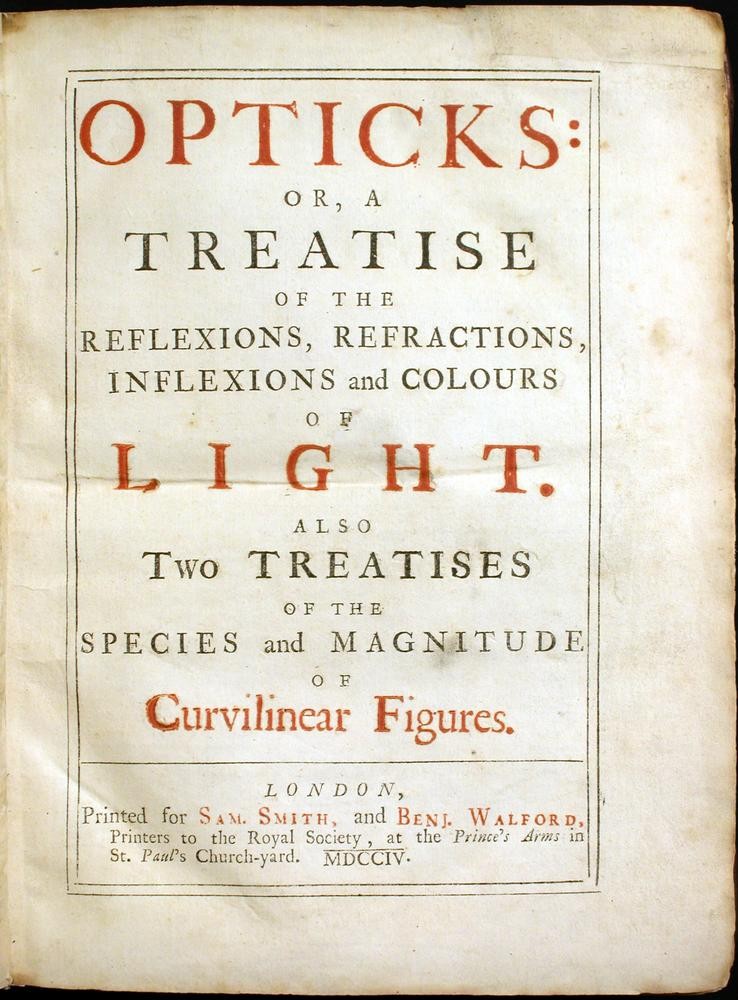
Documented. Query 31 of the Opticks (1704) — Newton speculating that short-range attractions and repulsions between particles might explain chemistry, capillarity, and cohesion. It shows the side of Newton the Principia hides: freely conjecturing.
Source: Opticks (1704), Query 31.
“‘Tis much better to do a little with certainty, & leave the rest for others that come after you, than to explain all things by conjecture without making sure of any thing.”
Documented. From Newton’s unpublished notes for a preface to the Opticks — the private motto behind the public method.
Source: Unpublished manuscript, quoted in R. S. Westfall, Never at Rest (1980), p. 643.
“I do not know what I may appear to the world, but to myself I seem to have been only like a boy playing on the sea-shore…”
Reported. “…and diverting myself in now and then finding a smoother pebble or a prettier shell than ordinary, whilst the great ocean of truth lay all undiscovered before me.” The most famous Newton deathbed-style remark — but it comes to us secondhand, reported by Sir David Brewster in his Memoirs of the Life, Writings, and Discoveries of Sir Isaac Newton (1855), from Newton’s final years. Treat it as Brewster’s report, not as manuscript fact.
Source: Reported in D. Brewster, Memoirs (1855), vol. II, ch. 27.
“I keep the subject constantly before me, and wait till the first dawnings open slowly, by little and little, into a full and clear light.”
Reported. Newton’s reply when asked how he made his discoveries — patience as method. Reported in the Biographia Britannica (1760), decades after his death.
Source: Reported in Biographia Britannica, vol. 5 (1760), p. 3241.
“I have studied these things — you have not.”
Reported. Newton’s reported retort whenever Edmond Halley spoke disrespectfully of religion — reported by Brewster in The Life of Sir Isaac Newton (1831), who attributes the anecdote to the astronomer Nevil Maskelyne via Stephen Rigaud. Note: it is sometimes misquoted as a defense of astrology; Newton studied prophecy and alchemy, but there is little evidence he took astrology seriously.
Source: Reported in D. Brewster, The Life of Sir Isaac Newton (1831).
What he never said
Famous lines with no traceable source in Newton’s writings — we do not quote these as his words:
- “What goes up must come down.” No source; a modern schoolbook summary, not a Newton quotation.
- “I can calculate the motion of heavenly bodies, but not the madness of people.” Widely repeated about his South Sea Bubble losses (1720), but no contemporary source has been found. Treat as anecdote, not quotation.
- “If I have not seen as far as others, it is because giants were standing on my shoulders.” A parody (popularized by computer scientist Hal Abelson), not Newton.
- “To myself I am but a small child wandering upon the vast shores of knowledge…” A modern paraphrase of the Brewster sea-shore report, sometimes misattributed to Plato. The earliest published form traces to a 2004 coaching book — not to Newton, and not to Plato either.
- “God created everything by number, weight and measure.” Often attributed to Newton; the phrase echoes Wisdom 11:20 and was used by many writers. No Newton source.
Source notes
- Letter texts: Turnbull, Correspondence of Isaac Newton (7 vols., 1959–77).
- Principia quotations: Cohen & Whitman translation (1999), checked against the Latin of the 2nd/3rd editions.
- Opticks quotations: 4th edition text (Dover reprint, 1952).
- Reported remarks: Brewster (1831; 1855); Biographia Britannica (1760).
- Misattribution research: this site’s editorial review, 2026-09-26; Wikiquote’s sourced/unsourced sections were used as a finding aid, not as authority.