People
Newton worked alone more than most — but the few people who got close shaped his career, and his enemies shaped his legend.
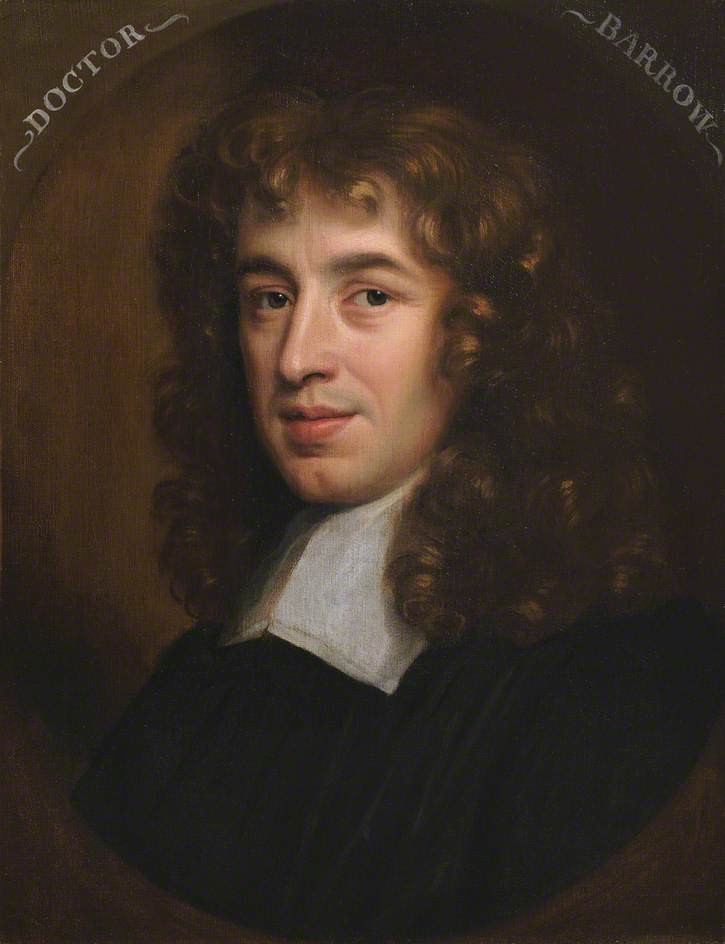
Isaac Barrow (1630–1677)
Newton’s mentor and predecessor. As the first Lucasian Professor of Mathematics at Cambridge, Barrow recognized Newton’s talent, encouraged his private mathematical studies, and — crucially — resigned the Lucasian chair in 1669 to make way for him. His own work on tangents came close to the calculus; he cheerfully ceded the field to his student.
Robert Hooke (1635–1703)
Curator of experiments at the Royal Society, architect, microscopist — and Newton’s great antagonist. Hooke claimed Newton had taken the inverse-square idea from him; Newton, stung by Hooke’s criticism of his 1672 optics paper, developed a lasting hatred. Their 1675–76 correspondence produced the “shoulders of giants” letter; their 1679–80 exchange on orbital motion fed directly into the Principia. No authentic portrait of Hooke is known to survive — the image on this site is a modern memorial reconstruction, labeled as such.
Edmond Halley (1656–1742)
Astronomer, and the indispensable friend. It was Halley’s August 1684 visit to Cambridge — asking what orbit an inverse-square force would produce — that goaded Newton into writing De Motu and then the Principia. When the Royal Society couldn’t pay for printing, Halley funded the book himself and saw it through the press. He later became Astronomer Royal and predicted the return of the comet that bears his name.
Gottfried Wilhelm Leibniz (1646–1716)
German philosopher-mathematician who published his differential calculus in 1684 — while Newton had developed fluxions earlier but published almost nothing. What should have been a story of independent invention became the bitterest priority dispute in science, with the Royal Society’s Commercium Epistolicum (1712) ruling for Newton. Modern scholarship credits both men independently, while noting Leibniz’s notation won the future.
John Locke (1632–1704)
The philosopher was Newton’s closest intellectual friend in London in the 1690s. Their correspondence on biblical interpretation and the nature of the mind is warm — until Newton’s 1693 breakdown produced a paranoid, accusatory letter to Locke (September 1693), for which Newton later apologized. The friendship survived.
Nicolas Fatio de Duillier (1664–1753)
Brilliant young Swiss mathematician who became Newton’s intimate friend in the early 1690s — the most emotionally intense relationship of Newton’s adult life. The friendship collapsed around 1693, amid the breakdown; the exact cause is unknown. Fatio later attached himself to radical religious sects and faded from science.
John Flamsteed (1646–1719)
The first Astronomer Royal, whose meticulous star observations Newton needed for the Principia’s lunar theory — and then demanded, imperiously, for himself. Newton tried to force publication of Flamsteed’s catalog; Flamsteed resisted, and their quarrel became one of the ugliest in the Royal Society’s history. Newton had the offending published copies burned.
Henry Oldenburg (1619–1677)
Secretary of the Royal Society and editor of the Philosophical Transactions — the man who managed Newton’s prickly relationship with the scientific world in the 1670s, mediating the optics disputes and the Leibniz correspondence. His death in 1677 removed a moderating influence Newton never replaced.
Christiaan Huygens (1629–1695)
Dutch physicist and astronomer, the leading continental natural philosopher of Newton’s generation. Huygens admired the Principia’s mathematics but rejected action at a distance and Newton’s corpuscular light; their respectful disagreement marks the fault line between Cartesian mechanism and Newtonian physics.
Charles Montagu, Earl of Halifax (1661–1715)
Cambridge acquaintance turned powerful politician. As Chancellor of the Exchequer he secured Newton the Wardenship of the Mint in 1696 — the appointment that moved Newton to London and made his fortune. The patronage link ran through Montagu’s admiration for Newton, and through Newton’s niece Catherine Barton, who kept Montagu’s house.
Samuel Pepys (1633–1703)
The diarist, then President of the Royal Society, corresponded with Newton on probability (the famous dice problem) — and received one of the distraught letters of the 1693 breakdown, accusing him of conspiracy. Pepys, bewildered, showed the letter around; Newton later retracted it.
Catherine Barton (1679–1739)
Newton’s clever, beautiful half-niece, who kept house for him in London and moved in the highest Whig circles. Gossip — never substantiated — linked her to Charles Montagu; what is documented is her devotion to her uncle and her capable management of his household. She married John Conduitt in 1717.
John Conduitt (1688–1737)
Husband of Catherine Barton from 1717, Newton’s companion in his final decade, and his successor as Master of the Mint. Conduitt gathered materials for a biography of Newton that he never finished; his notes are a valuable source for Newton’s last years.
William Whiston (1667–1752)
Newton’s successor as Lucasian Professor (1701) and his most indiscreet disciple. Whiston published Newton’s algebra lectures as Arithmetica Universalis (1707) without permission, infuriating him — and later publicized Newton’s anti-Trinitarian views after Newton’s death, to the establishment’s horror.
Roger Cotes (1682–1716)
The brilliant young Cambridge mathematician who edited the second edition of the Principia (1713) — corresponding intensely with Newton, correcting errors, and writing the preface that answered the Cartesians. He died at thirty-three; Newton reportedly said, “If he had lived we might have known something.”
William Stukeley (1687–1765)
Antiquary and early biographer whose Memoirs of Sir Isaac Newton’s Life (1752, unpublished until the 20th century) gives us the famous apple story: Newton telling him, over tea at Kensington, how watching an apple fall in the Woolsthorpe orchard set him thinking about gravitation. The anecdote is genuine — the “apple hit his head” version is not.
Source notes
- Biographical core: Westfall, Never at Rest (1980); ODNB entries for each figure.
- Hooke: no authentic portrait survives — the standard scholarly position (e.g., Jardine, Ingenious Pursuits; Inwood’s Hooke biography discusses the lost portrait).
- Halley and the Principia’s funding: Westfall, ch. 7–8; Cohen’s introduction (1999).
- Fatio: Westfall, ch. 11.
- Flamsteed quarrel: Westfall, ch. 12–13; Flamsteed’s correspondence.
- Stukeley apple anecdote: Stukeley, Memoirs of Sir Isaac Newton’s Life (1752; ed. A. R. Hall, 1752/1936).
- Whiston’s remark on Cotes: reported in Whiston’s memoirs.