Making the Principia
The most famous book in science was written in eighteen months because a young astronomer asked the right question — and then paid for the answer himself.
The question
In August 1684 Edmond Halley rode to Cambridge with a question that had stumped London’s philosophers: what curve would a planet follow if the sun attracted it with a force falling off as the square of the distance? Newton answered at once — an ellipse — and said he had calculated it years before but could not find the papers. Halley, electrified, begged him to write it up. In November Newton sent him the nine-page tract De Motu Corporum in Gyrum — “On the Motion of Bodies in an Orbit.” Halley read it, grasped what it was, and refused to let the matter rest.
The writing
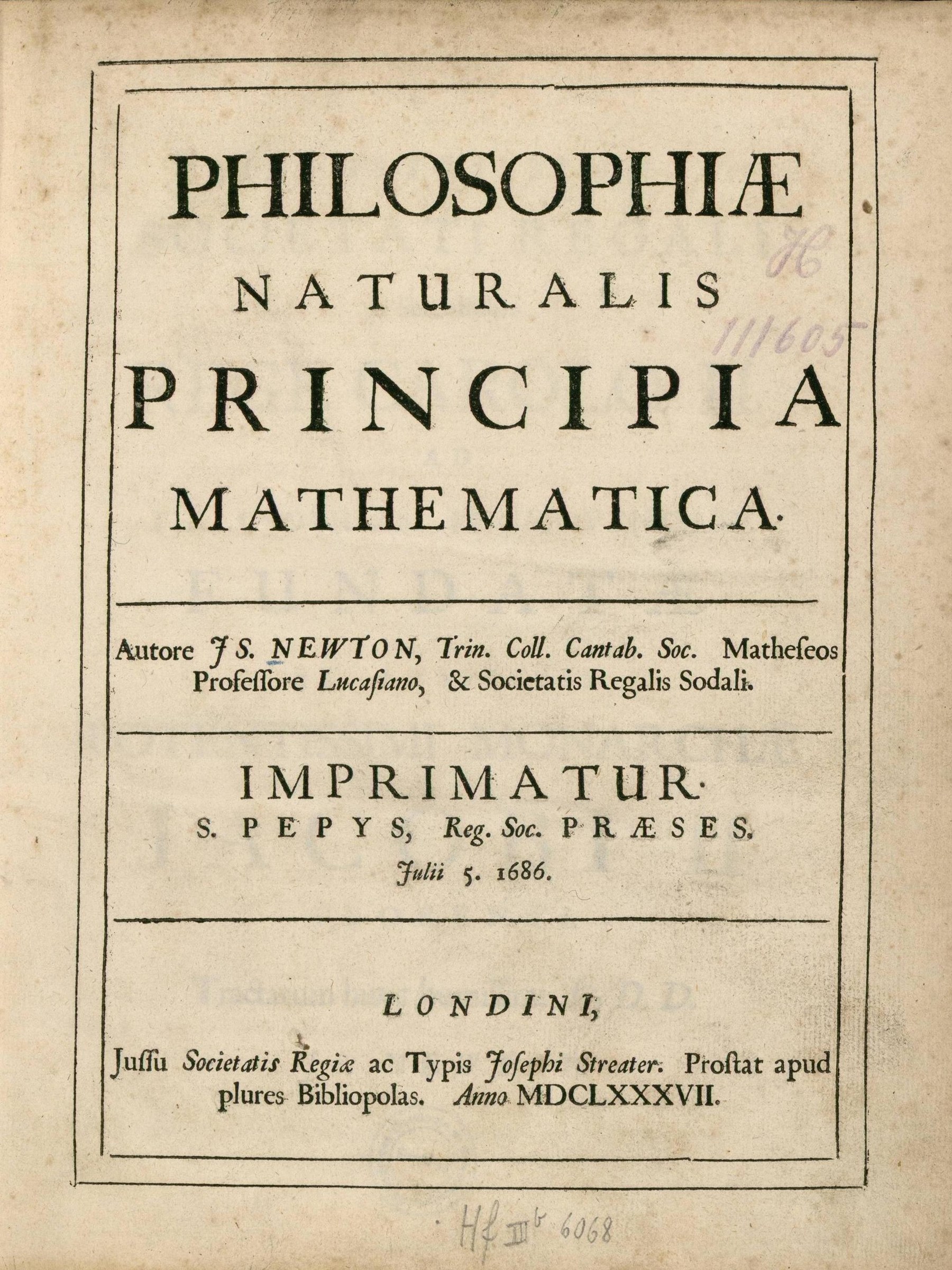
Between late 1684 and the spring of 1686 Newton wrote the Philosophiæ Naturalis Principia Mathematica — three books containing the three laws of motion, the law of universal gravitation, and the derivation of Kepler’s laws, the tides, and the paths of comets from a single principle. He worked, in Humphrey Newton’s later account, with an intensity that displaced food and sleep.
Hooke’s claim
As publication neared, Robert Hooke asserted that the inverse-square idea had been his — that Newton had it from Hooke’s 1679 letters. Hooke had indeed written to Newton in 1679 about orbital motion; whether the letters contained the law is the disputed point. Newton, enraged, threatened to suppress the third book — the “System of the World,” the payoff of the whole work. Halley talked him down, and Newton agreed to publish, adding to the second book the famous scholium acknowledging his predecessors. “It will help the sale of the book,” he wrote to Halley, “which I ought not to diminish, now it is yours.”
The money
The Royal Society had voted to publish the book — and then found it had spent its book budget on a lavish History of Fishes. On 2 June 1686 the Society’s council resolved that the book be printed “at Mr. Halley’s charge.” Halley, a young man of modest means, paid the printer, corrected the proofs, drew the diagrams, and managed the irascible author through two years of production. The Principia appeared in the summer of 1687 — published 5 July — in a run of a few hundred copies, and did not sell out for years.
The aftermath
Newton revised the work twice more: the second edition (1713), edited by Roger Cotes, added the General Scholium with “hypotheses non fingo”; the third (1726), edited by Henry Pemberton, was the last he saw. It remains the single work that turned natural philosophy into mathematical physics.
Source notes
- Halley’s August 1684 visit and De Motu (November 1684): the standard account, via Halley and Newton correspondence.
- Royal Society finances and the 2 June 1686 council resolution: the Society’s records; Halley’s financing documented in his correspondence and accounts.
- Hooke’s 1679 letters and the priority claim; Newton’s threat to suppress Book III: correspondence, H. W. Turnbull (ed.), Correspondence.
- “It will help the sale of the book, which I ought not to diminish, now it is yours”: Newton to Halley, documented in the correspondence.
- Publication date (5 July 1687): established from the imprint and Stationers’ records.
- Later editions: Cotes (1713), Pemberton (1726).