Timeline
Eighty-four years, Julian calendar throughout — England did not adopt the Gregorian reform until 1752, after Newton's death.
1642 — Birth at Woolsthorpe
Born 25 December 1642 (Julian; 4 January 1643 Gregorian) at Woolsthorpe Manor, Lincolnshire — premature, and posthumous: his father Isaac Newton died in October 1642.
1646 — Mother’s remarriage; raised by his grandmother
Hannah Newton marries the Reverend Barnabas Smith and moves away; the three-year-old is left with his grandmother Margery Ayscough at Woolsthorpe.
1655–1660 — The King’s School, Grantham
Boards with the apothecary William Clarke; builds sundials, model windmills, and kites. Finishes at the head of the school.
1661 — Enters Trinity College, Cambridge
Admitted as a subsizar (a poor scholar working his way through). Studies the standard Aristotelian curriculum while privately mastering Descartes, Kepler, and the new algebra. Isaac Barrow takes notice of him.
1665 — BA; the plague; annus mirabilis
Takes his BA in January. Plague closes Cambridge that summer; Newton withdraws to Woolsthorpe for most of 1665–66, developing the method of fluxions, the first work on universal gravitation, and the prism experiments on color.
1667 — Fellow of Trinity
Elected to a fellowship at Trinity College — the secure academic base he would hold for nearly thirty years.
1668 — Reflecting telescope; MA
Builds the first working reflecting telescope (to avoid the chromatic aberration of lenses) and takes his MA.
1669 — Lucasian Professor
Isaac Barrow resigns the Lucasian chair of mathematics in Newton’s favor. Newton, aged twenty-six, will hold it until 1701.
1672 — Fellow of the Royal Society; first optics paper
Presents his reflecting telescope to the Royal Society in January and is elected FRS. His “New Theory about Light and Colours” appears in the Philosophical Transactions — and draws immediate fire.
1672–1678 — The optics disputes; withdrawal
Attacks from Hooke, Huygens, and Pardies on his theory of light embitter Newton. He vows to publish no more and retreats into private manuscript work.
1676 — “Shoulders of giants”
In a conciliatory letter to Robert Hooke dated 5 February 1676 (5 February 1675 Old Style), Newton writes: “If I have seen further it is by standing on the shoulders of Giants.” See sayings.
1679–1680 — Correspondence with Hooke on orbital motion
Hooke, as secretary of the Royal Society, solicits Newton’s thoughts on planetary motion. The exchange — including Hooke’s suggestion of a “compounding” of tangential motion with an attractive force — reawakens Newton’s dynamics.
1684 — Halley’s visit; De Motu
In August, Edmond Halley visits Cambridge to ask about inverse-square orbits; Newton says he has already shown the orbit is an ellipse. In November he deposits De Motu Corporum in Gyrum with the Royal Society — the seed of the Principia.
1687 — The Principia
Philosophiæ Naturalis Principia Mathematica is published on 5 July, printed at Halley’s expense. It sets out the laws of motion and universal gravitation.
1689 — MP for Cambridge University
Elected to the Convention Parliament. Serves again in 1701–02. (Tradition holds he spoke only once, to ask for a window to be shut.)
1693 — The “black year”
Months of insomnia, paranoia, and depression. Distraught letters to Pepys and Locke (September) accuse them of conspiring against him. The cause — overwork, mercury from alchemy, the rupture with Fatio — remains debated. He recovers; his great creative period is over.
1696 — Warden of the Mint
Through Charles Montagu’s patronage, Newton is appointed Warden of the Royal Mint and moves to London. He throws himself into the Great Recoinage and into hunting counterfeiters.
1699 — Master of the Mint; Chaloner hanged
Promoted to Master of the Mint. The forger William Chaloner, convicted on evidence Newton gathered, is hanged in March.
1701 — Resigns the Lucasian chair
Leaves Cambridge for good; William Whiston succeeds him as Lucasian Professor.
1703 — President of the Royal Society
Elected president on the death (in office terms) of Lord Somers’s tenure; he will dominate the Society for the rest of his life.
1704 — The Opticks
Opticks published — in English, not Latin — with its speculative closing Queries.
1705 — Knighted
Queen Anne knights Newton at Trinity College, Cambridge, on 16 April — the first knighthood for scientific work.
1712–1713 — Commercium Epistolicum
The Royal Society’s committee report on the calculus priority dispute — drafted largely by Newton himself — rules for Newton against Leibniz. The feud never heals.
1727 — Death and burial
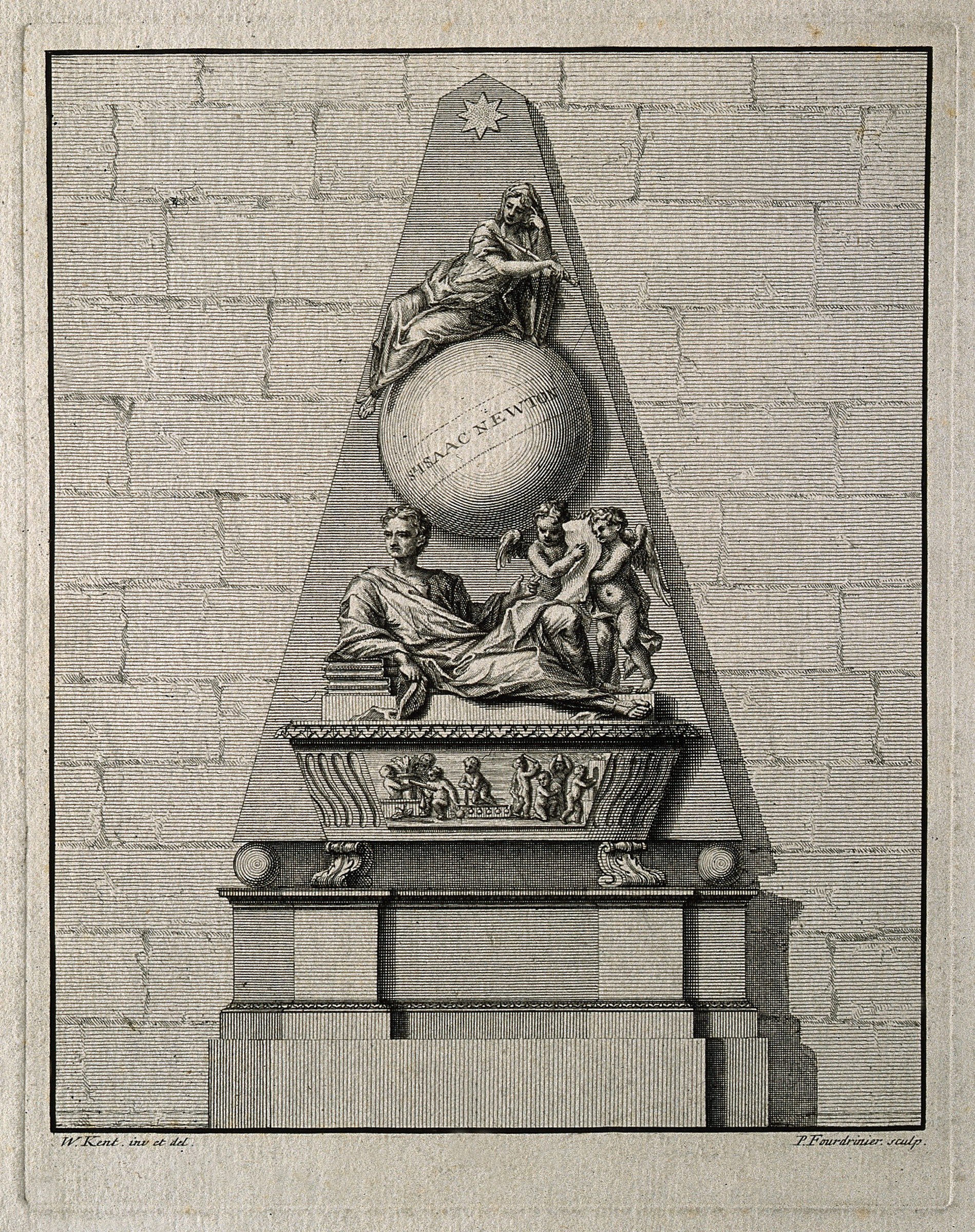
Dies 20 March 1727 (Julian; 31 March Gregorian) at Kensington, aged eighty-four. State funeral; buried in Westminster Abbey, where Rysbrack’s monument shows him among his books.
Source notes
- Chronology follows Westfall, Never at Rest (1980), with dates in Old Style as in the sources; calendar note per methodology.
- Halley’s August 1684 visit: De Morgan’s account via Abraham de Moivre’s recollection; Westfall, ch. 7.
- Principia publication date (5 July 1687): the imprimatur record; Cohen, introduction to the 1999 translation.
- Knighthood (16 April 1705): London Gazette.
- The 1693 letters to Pepys and Locke: Newton Correspondence, vol. 3.